Search

The Revenant Review

Horror Film History, Analysis, and Reviews

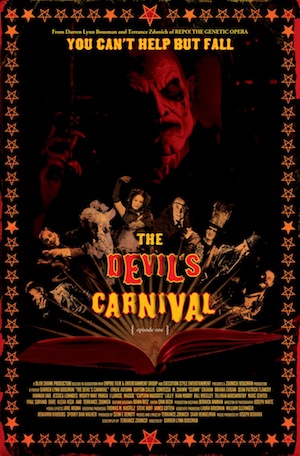
Movie Review – The Devil’s Carnival (2012)

Movie Review – The Devil’s Carnival (2012)

The Devil’s Carnival (2012) is the second collaboration of Darren Bousman and writer Terrance Zdunich, who also stars, after 2008’s Repo! The Genetic Opera. After years of talk about a possible sequel to that film, the pair decided to instead embark on another horror musical entirely. The Devil’s Carnival’s approach is less rock opera and more cabaret, and it presents a scenario in which three damned souls are sent to a carnival run by the devil, their tales each being based upon one of Aesop’s fables.

Like Repo!, there’s a lot to like about this film, not the least of which is its very premise. The costume designs are fun and seemingly meant to once again appeal to the Goth crowd and one of musical numbers really intrigued me, likening the story of “The Scorpion and the Frog” to a girl who dates an obviously abusive man, complete with references to his stinging “prick.” Also, there’s a really well done number during the credits which tells the story of a girl on a ship who tries to stay awake because she’s convinced she’ll drown in her sleep, and I wish it had been included in the actual film.

All that being said the movie as a whole left me underwhelmed. The other songs are mediocre and the set is more cluttered than sinister. Nivek Ogre from Skinny Puppy makes a cameo, but his number is cut in half and unremarkable. The script suffers from too many characters and too little development, and the horror payoffs are unfortunately predictable and anti-climactic. Even at only 55 minutes the film still seems padded, and it feels like the actors weren’t always sure what to do within a scene, or the director for that matter. (To be fair, I read that Briana Evigan was cast just hours before shooting her musical number).

It’s not a bad film, and I actually like it slightly better than Repo!, but one that doesn’t meet the potential of its style or premise.

Grade: C-
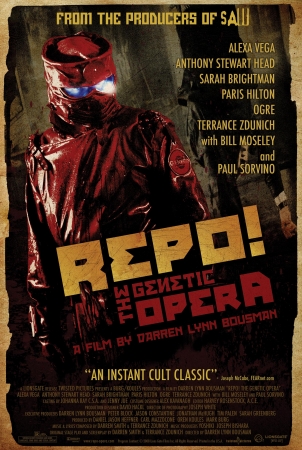
Movie Review – Repo! The Genetic Opera (2008)

Movie Review – Repo! The Genetic Opera (2008)

I love horror. My wife loves musicals. Why not mix the two?

Repo! The Genetic Opera (2008) is a horror Goth-rock opera based on the 2002 musical of the same name, which was written and composed by Darren Smith and Terrance Zdunich. Directed by Darren Lynn Bousman, the film depicts a dystopian future where organ failure is epidemic and society is saved by a megacorporation called GeneCo. However, the corporation’s intentions are not altruistic – for those who cannot maintain their payments hitmen known as Repo Men hunt them down and repossess their organs. Amidst this nightmare world are grave robbers who steal an addictive painkiller from corpses to sell on the black market. Add to this some coming-of-age teenage drama, blood feuds, and a Repo Man with a tortured conscience and you’ll have a decent idea of what this film is about.

The film bombed at the box office and received mostly negative critical reviews, but over the years it has gained a niche cult following in the vain of The Rocky Horror Picture Show (1975). There’s a lot to like about this film: the splatter punk gore, the Goth visuals – particularly Blind Meg, the interesting premise, and, in my opinion, Anthony Stewart Head’s performance. Even Paris Hilton, who then was at the height of her unfathomable celebrity, puts in a decent showing. There is enough to keep my interest most of the time, and only one song I actively dislike (“Seventeen”).

That being said, the film runs too long and the convoluted story, especially when it comes to the central character of Shiloh (Alexa Vega), feels stretched too thin. However, the movie’s biggest failing is that for a musical of fifty-plus songs there are very few melodies or lyrics that are any good. Most of the music is simply mediocre and when they have something good going it’s over too soon, transitioning to a new, less interesting piece. Also, the ending involving Head’s character is rather anti-climactic, especially for a splatter punk movie. They build up an ultra-violent confrontation and end it with a whimper.

I can understand why audiences are divided on this one, with one half loving it and the other half loathing it. I’m in the middle. Ultimately, it’s a forgettable film. Nevertheless, it makes me curious to see what else is out there for horror musicals, as the combination is an intriguing one. Bousman and Zdunich collaborated twice more for 2012’s The Devil’s Carnival and its sequel Alleluia! The Devil’s Carnival (2015), and those are films that, based on Repo!, at least have me curious.

Grade: D+

Movie Review – Bad Kids Go to Hell (2012)

Movie Review – Bad Kids Go to Hell (2012)

The initial premise of Bad Kids Go to Hell (2012), directed by Matthew Spradlin, sounds like a surefire winner: mix The Breakfast Club (1985) with a whodunit mystery, and throw in a cameo by Judd Nelson as the crotchety principal. Based upon Spradlin and Barry Wernick’s popular graphic novel of the same name, it’s a promising recipe for an entertaining horror comedy. What could go wrong?

Well, most of it. Judd Nelson’s cartoonish lines fail muster any enjoyable nostalgia, and most of the cast is unable to rise above their trite dialogue. The plot gets increasingly ludicrous, particularly as the so-called “twists” are being unraveled. The movie overall comes off as fairly sloppy, especially in the sound design where the blaring music sometimes drowns out the actors’ voices. And what’s with all the CGI cockroaches that are ever-present but never explained?

Is there anything to like about this film? Well, the sexy redhead does a striptease, so that’s one minute of the film that many viewers will not mind. However, if the price of admission is the rest of the film, audiences may want to pass.

Grade: D-

Movie Review – Carrie (2013)

Movie Review – Carrie [remake] (2013)

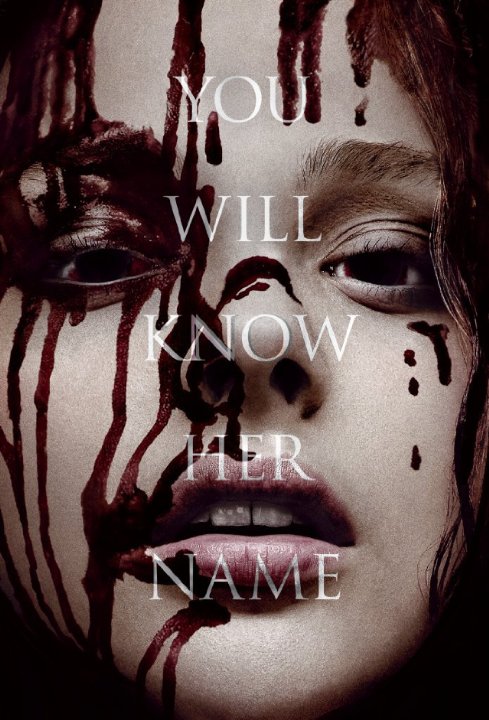
When the new Carrie (2013) was first announced I was curious to see if director Kimberly Pierce could cull anything new or relevant for our modern era that Brian De Palma’s 1976 classic, due to the time in which it was made, could not. Her film Boy Don’t Cry (1999) dealt smartly with the heavy issues of self-identity, sexuality, and class identification – all themes which the story of Carrie White touches upon. When buzz for this film was first making its rounds, I recall cast members and those associated with the picture touting that this version would be closer to Stephen King’s 1974 novel. They claimed their film was not a remake of the original but a reimagining of the source material. However, considering this movie hardly deviates from the path laid by De Palma, except to insert references to social media, 2013’s Carrie can be safely stored in the vault of pointless and soon-to-be-forgotten remakes.

To be fair, Pierce has claimed that studio executives butchered about forty minutes from her film. This footage supposedly contains many elements from the book, such as the White Commission, and more gore. There is currently an online petition from fans meant to restore Pierce’s vision. Nevertheless, as it now stands the movie closely resembles De Palma’s, and the scenes which it mirrors only serves to highlight the original’s superiority.

I love the 1976 Carrie but I don’t think of it as one of the untouchable classics. The story is perfectly served to be reimagined for each teen generation, changed to make it relevant to their fears and anxieties. The original is a terrific, artistic achievement, but it’s very much a capsule of its time. The 2013 film, though, is more tailored to modern teens’ short attention spans and reliance on pop culture. The overuse of CGI makes the scenes of Carrie testing her powers more akin to an X-men movie or Matilda (1996) than to anything foreboding. Sissy Spacek’s Carrie had a growing awareness of her ability that never went too far until her climactic mental breakdown. But this new Carrie is quickly confident in her powers and is closer to the literary version in this way, but it is a confidence that undermines the character who we should be viewing as a tortured victim unable to see potential within herself.

Chloe Grace Moretz is a capable actress, but when compared with Spacek’s iconic portrayal we see just how miscast she is. She fails to exhibit the vulnerability essential to the character or illicit the pity that Spacek was able to cull. I’ve seen reviewers who praise her performance but it didn’t work for me.

Yet it’s in the prom scene were everything truly falls apart and any comparison made to the original film reveals just how brilliant and horrifying De Palma’s work truly is. By comparison, the new film is flashier but tension-free. Also, it can’t decide if Carrie is a monster or a victim as it tries to redeem her in odd ways, but if we were to replace her telekinesis with a gun the distinction would be clear – Carrie is a monster.

2013’s Carrie is not a horrible film. It has its merits. Julianne Moore does well, for instance. But the film fails to elicit an emotional connection and feels sanitized in a way that the original didn’t. Despite the CGI deaths, it feels like the rest of the movie is holding back, particularly on the performance end. It’s a perfectly fine workmanlike movie, but I prefer the artistry of De Palma’s.

Grade: C-

Movie Review – Scream 4 (2011)

Movie Review – Scream 4 (2011)

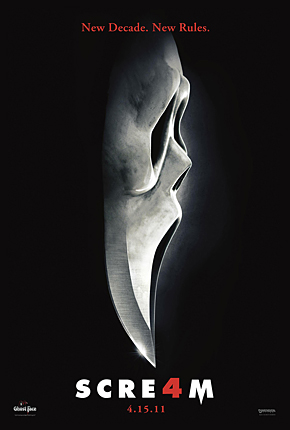
Scream 4 (2011) is the fourth Scream franchise entry and comes a full decade after the last movie. Wes Craven once again directs and Kevin Williamson, who wrote Scream and Scream 2, returns as the writer.

The film picks back up with consummate survivor Sidney Prescott, played by a still stunning and capable Neve Campbell, who returns to her hometown as a last stop on a book tour. But of course a Ghostface copycat is once again making foreboding phone calls and slashing at people close to her, including her teenage cousin, Jill (Emma Roberts). Old faces return and some new ones are added, mostly to be stuck like pincushions.

Of course, true to form, the script is laden with meta-commentary mostly directed at the nature of horror remakes, particularly their shortcomings. A lot of this works well, though sometimes the film seems to slip too far out of satire and into spoof, as Scream 3 did before it. The reveal is a jab on the nature of the modern celebrity, and while I appreciate what the film attempts to do the result is clunky. Some of the dialogue is funny, but if you think about the plot too hard you’ll soon find holes big enough to fall into, so mind the gaps.

I am once again perturbed by a film that points out clichés and then uses them so often. For instance, are cops really incapable of running after a suspect? I wish Craven would have stepped up his directing game in some scenes as little tension is built throughout the film and there are once again too many fake jump-scares. I wanted the movie to nod its head at the inevitable teenage audience and say, “We know these tricks, we invented them,” and then like Dan Akroyd in The Twilight Zone: The Movie (1983) say, “You wanna see something really scary?” Craven made his mark by pioneering the “video nasties,” and while I don’t want to see extensive rape scenes I was hoping for more drama in the kills, giving the audience an uncomfortable intimacy with the knife. It is, after all, rated-R, and the horror trend that had the most prominence between this film and the last was the subgenre known pejoratively as “torture-porn.” While it’s far from my preferred subgenre, I would have liked to have seen this new Scream take a few notes from it. But instead Ghostface stumbles like always and more by luck than by skill gets his victims, usually with a quick stab as the person goes down dead, blood dripping from their mouths. Yawn.

A real knife attack is quick and relentless. Police officers are trained to fear knives, as a wielder can close a distance of many yards and stab repeatedly before an officer can draw their gun (check out training videos on YouTube and you’ll never take a Hollywood knife fight seriously again). It’s terrifying in its primal brutality and in the violation of the blade biting into flesh. Instead, like most teen slashers of the past two decades, the punch of the violence is pulled and true fear never looms its head.

Likewise, I was hoping for more from Sidney. She’s noble, brave, and a fighter, and I really shouldn’t complain. But I was hoping she’d be confronted by Ghostface and reveal that she’s been training in self-defense against knife attacks for the last decade, and then kick his ass out a window before he can run away. It would have been a nice twist and a message that says we’re over this mediocre slasher crap, and it might have been a more appropriate metaphor for a post-9/11 Scream in which horror victims became more proactive. That being said, Sidney is well-written and portrayed perfectly by Campbell, who is the highlight of the film, as one who refuses to be a victim.

The other performances are a mixed bag, though Rory Culkin does well and is in what is perhaps my favorite scene. Hayden Panettiere eventually won me over towards the end. Emma Roberts, who plays Jill, doesn’t sell the role in my opinion, and couldn’t rise above the trite dialogue.

Scream 4 is an improvement when compared to Scream 3. That’s not high praise, but it remains an enjoyable film that, I think, ends the film series on a better note than its predecessor.

Grade: C+

Movie Review – Scream 3 (2000)

Movie Review – Scream 3 (2000)

Scream 3 (2000), again directed by Wes Craven but with a script by Ehren Kruger, continues the story of Sidney Prescott (Neve Campbell), Gale Weathers (Courtney Cox), and former-deputy Dewey (David Arquette). Due to public sensitivity about media violence resulting from the 1999 massacre at Columbine High School, the kills, which are noticeably less bloody, are moved out of small-town America to Hollywood, California. This time the victims are the actors of Stab 3, the metafictional movie-within-a-movie that dramatizes the tragic events surrounding our principal characters.

Scream 3 opens strongly but peters out quickly, and it never quite lives up to the two installments that came before. In Scream 2 the horror references were present, but they were beginning to be overshadowed by references to the stars’ other projects and pop culture. Scream 3 continues that trend and amplifies it by focusing on Hollywood culture, but in doing so it continuously threatens to cross over from being self-referential to being self-parodying. In some scenes the film definitely crosses that line, such as with the cameo by Jay and Silent Bob – not Jason Mewes and Kevin Smith, but the drug dealing characters they portray. Such scenes are little more than farce and can be taken as an indication that what made the Scream franchise fresh has grown stale.

Even though it posits itself as an examination of horror trilogies, even having the obligatory scene of Randy (Jamie Kennedy) giving us the rules, the movie never really feels about that. It instead goes off the rails and become a spoof on Hollywood rather than an examination of horror. As Stab takes over more of the narrative, the tone becomes decidedly comedic and the wit and tension are lost. At times it’s more Scary Movie, which was released the same year, than horror, and it hardly feels like it resides in the same universe as the first two Screams. Likewise, the series which was founded on exposing and upturning horror clichés falls into these dusty traps again and again in this outing. We get tired fake jump scares and characters who should know better making absurd decisions. The kills, too, are unimaginative and forgettable.

This being said, the acting is still solid, particularly Campbell’s portrayal of Sidney. She is able to convey strength and vulnerability in equal measure. Nevertheless, Sidney as the victim gets tiresome and I feel the writers lost a golden opportunity to make Gale the target, as they readily establish how disliked she is by the people about whom she writes. Due to Campbell filming another movie, Sidney gets less screen time and Gale and Dewey take up most of the plot. Making Gale the object of murderous intent could have taken advantage of this and we could have had Sidney come out of hiding to help Gale. Alas, Scream 3 sticks to its own franchise trope.

Despite the tired cameos and pop references, Craven films the lackluster script with the high quality filmmaking we’ve come to expect from the series, and even though it’s retreading old ground it always remains entertaining to watch. Nevertheless, this film was meant to close the trilogy and I imagine that anyone who saw it must have felt that there was nowhere else for the franchise to go.

Of course, Scream 3 would not be the last. After a decade Craven would return to the franchise for Scream 4 (2011), which I believe is actually a stronger film than this entry, if only by a small measure, and manages to successfully comment on Hollywood in a manner which this movie ultimately attempts but fails to do.

Grade: C

Movie Review – Devil’s Pass (2013)

Movie Review – Devil’s Pass (2013)

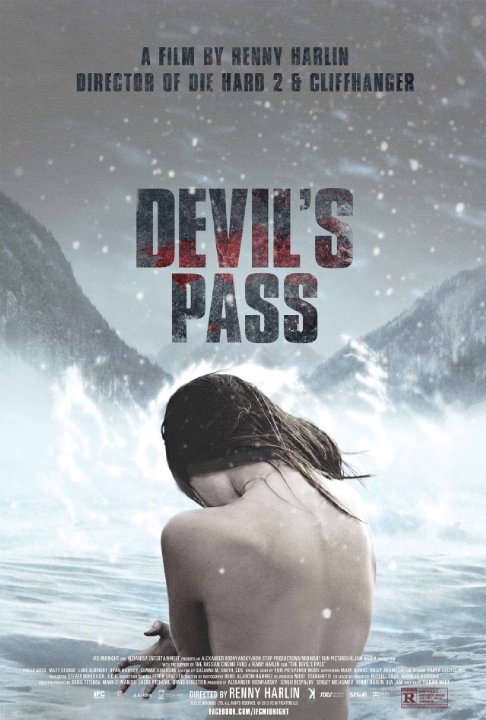
In 2013 Renny Harlin, who is known mostly for his action movies, once again returned to the horror genre with Devil’s Pass (2013). I’ve never been a fan of his previous horror/thriller forays. He did the passable A Nightmare on Elm Street 4: The Dream Master (1988), which still shines in my mind for the obvious stunt-double-in-a-wig-swinging-nunchacku scene. But he also gave us the “violently banal” The Covenant in 2006 (“I’m going to make you my wee-otch”), which is one of the worst horror films I’ve ever seen, though it at least gave us some choice reviews.

This time Harlin delves into found-footage horror and instructs us all on how not to do it. I don’t mean to sound flippant here, as I believe Harlin makes a genuine effort, but nowhere do we see evidence that he grasps what makes the story-telling technique truly effective. The story, which had an interesting plot relating to the real life Dyatlov Pass incident of 1959, in which nine hikers’ bodies were found in the snows of the Ural mountains and who appeared to have died under mysterious circumstances, is lost in an uninspired script. Harlin shot on location in the mountains of Russia, which is commendable, but it doesn’t really contribute anything authentic to the film. There are some interesting sci-fi elements which run along Harlin’s own theory on the case, but they never come together amidst the stale dialogue and rudimentary action. The acting is mediocre and the film devolves into a CGI-fest at the end, to mixed results.

Worst of all, the found-footage aspect was unnecessary and poorly done. Devil’s Pass may have actually worked better had it not been found-footage, or at least not entirely. Devil’s Pass has some promising ideas and it attempts an almost smart circular story, but in the end the movie is too light on story and too heavy on gimmick.

Grade: D

The Rules of Cheap Horror According to Jason Blum

Recently NPR’s Planet Money examined the business model of Jason Blum who is one of the most successful low-budget movie producers of all time. He accomplished this status by thumbing his nose at the Hollywood trend of creating ever bigger and flashier movies, where the budgets expand as quickly and as broadly as the monetary risks they entail, and scaling movies back to basics. Instead of putting all of his resources into one big film, Blum finances smaller films, most of which are horror. Up to 40% of these films flop, but others hit and when they do he makes an absolute fortune. The risk is smaller but the profit is just as considerable as those of the bigger budget productions.

Blum’s three rules for creating a cheap horror movie are as follows:

1. Not too many speaking parts (you need to pay extras extra if they speak).
2. Not too many locations. This is why so many of his films take place in a house.
3. Pay stars as little as legally possible. He approaches actors more as investors than as employees – if the film does well, they will profit. The talent is as invested in the film as he is.
4. Never, ever break your budget. This is the rule the rest of Hollywood is afraid to stick to.

While these limitations restrict filmmakers in many ways, they force them to be creative and inventive in others. These films include the Paranormal Activity series and certainly many duds, but it has also resulted in some notable genre entries including Insidious (2011), Oculus (2013), and 13 Sins (2013), the last of which can be counted among Blum’s flops, as well as many others. It also resulted in the Academy Award winning Whiplash (2014). His most recent release, M. Night Shyamalan’s The Visit (2015), cost only five-million dollars to make and has already grossed over thirty-million as of this writing. For more evidence, here is a list of some of Blum’s horror offerings (source):

2009 Paranormal Activity Budget: $15,000 Gross: $193,355,800
2010 Paranormal Activity 2 Budget: $3,000,000 Gross: $177,512,032
2011 Insidious Budget: $1,500,000 Gross: $99,549,294
2011 Paranormal Activity 3 Budget: $5,000,000 Gross: $207,039,844
2012 Sinister Budget: $3,000,000 Gross: $82,015,113
2012 Paranormal Activity 4 Budget: $5,000,000 Gross: $142,817,992
2012 The Bay Budget: $2,000,000 Gross: $1,581,242
2013 Dark Skies Budget: $3,500,000 Gross: $27,858,103
2013 The Lords of Salem Budget: $1,500,000 Gross: $1,544,989
2013 The Purge Budget: $3,000,000 Gross: $89,328,627
2013 Insidious: Chapter 2 Budget: $5,000,000 Gross: $161,919,318
2014 Paranormal Activity: The Marked Ones Budget: $5,000,000 Gross: $90,904,854
2014 Oculus Budget: $5,000,000 Gross: $44,105,496
2014 13 Sins Budget: $4,000,000 Gross: $794,767
2014 The Purge: Anarchy Budget: $9,000,000 Gross: $110,602,999
2014 Ouija Budget: $5,000,000 Gross: $102,529,779
2015 The Lazarus Effect Budget: $3,300,000 Gross: $36,143,981
2015 Unfriended Budget: $1,000,000 Gross: $62,882,090
2015 Area 51 Budget: $5,000,000 Gross: $7,556
2015 Insidious: Chapter 3 Budget: $10,000,000 Gross: $109,518,558
2015 The Gallows Budget: $100,000 Gross: $38,164,410
2015 Sinister 2 Budget: $10,000,000 Gross: $31,775,300
2015 The Visit Budget: $5,000,000 Gross: $34,943,156

Blumhouse has become a staple in the genre over the past five years. While at least half of these films flop we’ve thus far been given a few diamonds in the rough each year, and I for one am excited for what is yet to come.

To listen to the full Planet Money episode, click here.

Movie Review – Scream 2 (1997)

Movie Review – Scream 2 (1997)

Following the overwhelming success of 1996’s Scream, Scream 2 (1997), also directed by Wes Craven and written by Kevin Williamson, was released just shy of a year after the first film. Following the same winning whodunit slasher formula, the film nevertheless suffered considerable production problems, most notably being that the screenplay was leaked onto the internet revealing the identity of the killers. Major rewrites, therefore, had to be completed as the movie was being filmed. The actors did not even know who the killers were until those scenes were set to be shot.

Set two years after Scream, the film once again centers around Sidney (Neve Campbell) at her college campus as murders begin to spread familiarly around her. The script ups the meta ante, having a film within a film as the events of the first movie are dramatized in a feature called Stab. As Scream was partly inspired by the very real Gainesville Ripper murders, it’s fitting that the Woodsboro murders would get their own satirical Hollywood treatment complete with bad acting and even worse wigs. Craven shows just how skewed and shallow the Hollywood version of reality ultimately is.

While there are still horror film references, this time focusing more on Friday the 13th (1980) instead of Halloween (1978), many more references are dedicated to the other projects of the actors and actresses involved, such as Courtney Cox’s Gale Weathers mentioning Friends co-star Jennifer Aniston or the character of Sarah Michelle Gellar, who had recently begun playing the titular television role on Joss Whedon’s Buffy the Vampire Slayer, watching 1922’s Nosferatu. These are certainly timelier and, as a result, have not aged as well.

In addition to this self-analysis Scream 2 also confronts the nature and quality of horror sequels, which historically have been largely terrible. As Randy (Jamie Kennedy) comments, “The entire horror genre was destroyed by sequels.” Randy also, as in the first film, lays out the guidelines for the audience: “There are certain rules that one must abide by in order to create a successful sequel. Number one: the body count is always bigger. Number two: the death scenes are always much more elaborate – more blood, more gore – carnage candy. And number three…” Here he’s cut off in the film, though the movie’s trailer has him continue with: “never, ever, under any circumstances, assume the killer is dead.” True to form, Craven gives the audience a higher body count and some elaborate tension-filled set pieces, the first involving Sidney and her friend trapped in a police car with the unconscious killer and the second involving Gale Weathers in a soundproof booth.

The performances from our returning cast are strong, including David Arquette who adds a sympathetic vulnerability to Deputy Dewey. His and Gale’s story arc is the best written. That being said, the new characters are never really fleshed out. We learn too little about them to be emotionally invested, and also too little to suspect them to any real degree, with the exception of Liev Schreiber’s Cotton Weary. The movie becomes less of a whodunit mystery and more of a waiting game, as the red herrings are not nearly as convincing as in the first film.

Scream began strong and ended strong, and this film inverts that, though not purposefully. The opening scene is rather over-the-top and the ending not nearly as satisfying. However, considering the re-writes that occurred it’s impressive that Scream 2 is as solid a sequel as it is, even if it does not quite meet the standards of its predecessor. When compared to the other teen slashers that were being released or about to be released, including Williamson’s own I Know What You Did Last Summer (also starring Gellar) which came out the same year, Scream 2 is definitely a superior entry.

Grade: C+

Movie Review – The Town That Dreaded Sundown (2014)

Movie Review – The Town That Dreaded Sundown (2014)

In the spring of 1946 the Texas town of Texarkana experienced an odd string of unsolved serial murders, known collectively as the Moonlight Murders, by a masked assailant. In 1976 a docudrama based loosely on the murders was released. The Town That Dreaded Sundown was something of a proto-slasher, and the hooded killer it depicted would go on to influence later horror films, especially Jason’s sack-mask in Friday the 13th Part 2 (1981).

After watching the documentary Killer Legends (2014), which dealt in part with the Moonlight Murders, I felt it was time to look at the remake/sequel to the 1976 film. Carrying the same name, 2014’s The Town That Dreaded Sundown, directed by Alfonso Gomez-Rejon, takes place in a world where both the Moonlight Murders and the 1976 movie exist, and a copycat is now stalking Texarkana, killing people in the same manner as the original film. An intriguing basis for a film, no doubt.

What results is an attempt at self-aware meta-horror in the style of Scream (1996). Unfortunately, the film stays too closely to the formula perfected by Wes Craven and the movie becomes predictable and lackluster. The film-makers seem more interested in sweeping camera movements than improvements to plot. The kills are derivative of typical slasher fare, being sure to insert gratuitous sexuality before most of the kills. I’m not one to complain about sex on film, but these scenes are pointless.

I know full well that many, if not most, slashers fans will disagree with me. I enjoy the subgenre, but more its earliest entries from the late 70s and early 80s, when it still took itself seriously, before it became a formulaic shadow of its former self. This film has been referred to as a return to form for slashers, but it’s not the form I prefer. I have fun watching the mindless popcorn variety, and it’s no secret that these are the overwhelming majority that were made, but I have no desire to see it reborn. I’d prefer to see the slasher movie forward instead of retread well-worn paths, and this movie doesn’t do that for me. Let the old formula go the way of Aqua Net and legwarmers. Even the meta angle, after the Scream movies, is tired.

This is all not to say that The Town That Dreaded Sundown is a bad film, because it’s not. It’s a good slasher, but the bar is so low that such a compliment isn’t high praise, and that’s partly the problem. It doesn’t try to move the subgenre forward, but merely tries to conform in the best way possible to what we already have come to expect. Given the movie’s meta-sequel status it could have been something deeper and cleverer, but it settles for the middle of road and doesn’t have much to say. If you’ve seen the Scream films, you’ve seen all that this film has to offer.

Grade: C

Movie Review – Killer Legends (2014)

Movie Review – Killer Legends (2014)

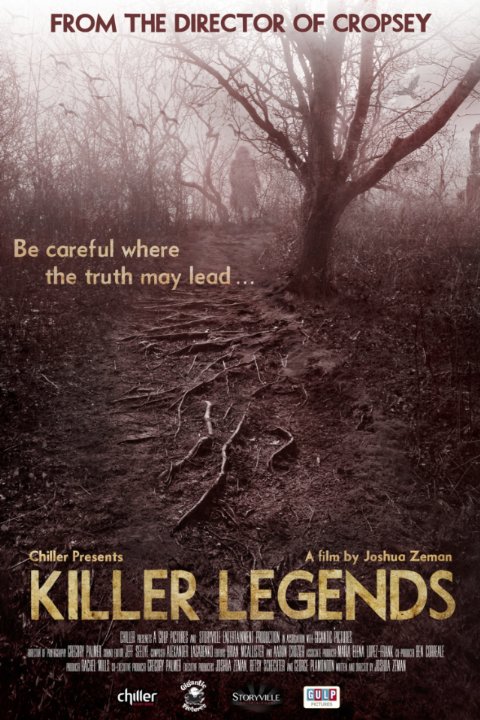
A few years back I watched the horror documentary Cropsey (2009). It began with an exploration of the urban legend of Cropsey, a child-killing maniac who lived in the woods of Long Island. He was a campfire tale told at sleepaway camps throughout the 70s and 80s, one which even inspired the slasher film The Burning (1981). The film then found connections with a real child-killer in the same area and to the infamous Willowbrook State School. The tale which unfolded was unsettling and fascinating and it made me wish there were more documentaries like it.

In 2014 the same filmmaker, Joshua Zeman, obliged and released Killer Legends for Chiller. Instead of focusing on one urban legend, this movie delves into four of them: the hook man, the babysitter killer, the poisoned Halloween candy, and the killer clown. It seeks out the real life events which may have inspired them and attempts to test their validity. The stories are disturbing, but also informative. Rather than reinforcing our fears the investigations tend to have the effect of relieving them and revealing them to be exaggerated or misplaced entirely. Nevertheless, the film doesn’t hold back from showing actual crime photos and other unsettling primary sources.

Killer Legends is thoroughly enjoyable and watchable, even if it’s not as hard-hitting as the filmmakers sometimes try to make it seem. I enjoy documentaries in general and I appreciate having ones which cross into my favorite fictional genre.

Grade: C+

Movie Review – Event Horizon (1997)

Movie Review – Event Horizon (1997)

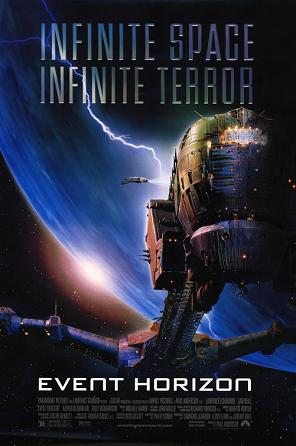
I saw Paul W.S. Anderson’s Event Horizon when it first came out in 1997. Preparing for a re-watch, I recalled really liking the premise but being less impressed by the execution, especially the ending. Though it received mostly negative reviews when it was first released, in recent years its reputation has grown and many genre fans appear look upon it fondly. With this in mind, I decided to give it another go, hoping I’d find more to appreciate this time around, as I have with some other 90s films like Wes Craven’s Scream (1996).

The premise is indeed intriguing. In the screenplay by Philip Eisner we follow a rescue crew who are investigating a spaceship called the Even Horizon that disappeared to the outer reaches of space and has now mysteriously returned. Unlike the 90s trend of sending franchise monsters into space for no good reason, here we have a legitimate premise for a sci-fi horror film. To my sincere disappointment, that’s where my favorable views of this film, like a real event horizon, end.

Instead of finding more to appreciate on my most recent watch, I found more criticize. A really cool idea is bogged down by poor dialogue, thin characterizations, and an incoherent plot. A character is smart one minute and stupid the next, depending on the needs of the story. In just one instance of idiocy, one woman goes chasing after what appears to be her son after we’ve already established that her son is safe back on Earth and that the ship is haunted and trying to kill them with mindfuckery.

What I remembered as being nods to Aliens (1986) and Hellraiser (1987) feel more like rip-offs, especially as Pinhead was killing people in a space station just a year prior (Hellraiser: Bloodline). Worst of all is Dr. William Weir’s change, which is wholly unconvincing and turns him into a poor-man’s Pinhead. Sam Neill is a fine actor, don’t get me wrong, but he’s simply not scary. Lastly, while the special effects are pretty good, the scares they serve often don’t make sense and, worse, are generally cheesy.

Anderson has claimed that there is about ten minutes of footage that was cut from the film to please producers and that, if put back in, would solve many of the pacing and narrative problems. Unfortunately, most of that footage has either been lost or damaged. As it currently stands, Event Horizon is a mess of a film kept afloat by a great sci-fi setting and good special effects. But it’s too much style over substance, and rather than only disliking the ending this time I found myself irritated with the movie shortly after the halfway point.

Grade: D+

Movie Review – Dead Snow 2: Red vs. Dead (2014)

Movie Review – Dead Snow 2: Red vs. Dead (2014)

2009’s Dead Snow, by Norwegian director Tommy Wirkola, told of a group of students fending off attacks from Nazi zombies at a cabin in the Norwegian mountains. The film was humorous and gory, but at the time I missed the overall joke, which is that these students were so enamored with American cinema that they mistook the undead Nazis for Hollywood zombies rather than as a draugr, a revenant of Norwegian folklore obsessed with protecting its treasure. Had they been more educated about their own culture, they may have fared a little better against the undead. Dead Snow is a cultural lesson that is easily lost in translation for foreign viewers.

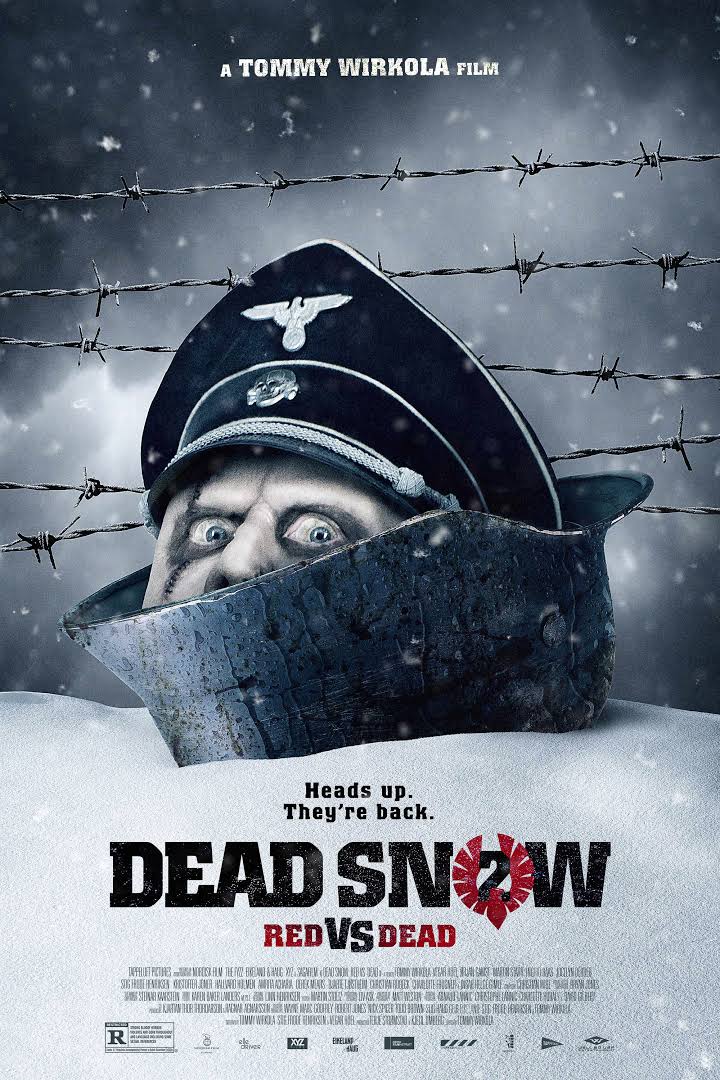
Dead Snow 2: Red vs. Dead (2014), filmed in Iceland, picks up right after the first film, and it does so with gratuitous gusto. It’s lighter in tone and heavier on gore. Want to see Nazi and Soviet zombies do battle? Want to see three American nerds – including a Star Wars fan girl and a Trekker – team up with a gay Norwegian to kick some zombie ass? Want to have hilariously disturbing images stuck in your head hereafter each time you hear Bonnie Tyler’s “Total Eclipse of the Heart”? Of course you do! And Dead Snow 2 brings it. It’s one of those movies where you keep asking yourself, “Are they really going to go there?” And the answer is almost always YES, and you’re glad that they did. Plus we get the hulking Derek Mears, who played Jason in the 2009 reboot of Friday the 13th, as the reanimated Soviet leader Stavarin.

Dead Snow 2 still
Stig Frode Henriksen in Dead Snow 2.

The references to American cinematic culture are more endearing this time around. Instead of lamenting its prevalence, it embraces and revels in it. My only real gripe with these movies is that I never felt a connection to the main protagonist, but the second film solves that by surrounding him with likable allies that we gladly root for. The first movie was filmed only in Norwegian, but this sequel was filmed in English as well. While I certainly recommend the first film, the plot is so thin that you don’t really need to see it to watch this movie, and if I could only recommend one it would be this sequel.

Grade: B

Movie Review – Doc of the Dead (2014)

Movie Review – Doc of the Dead (2014)

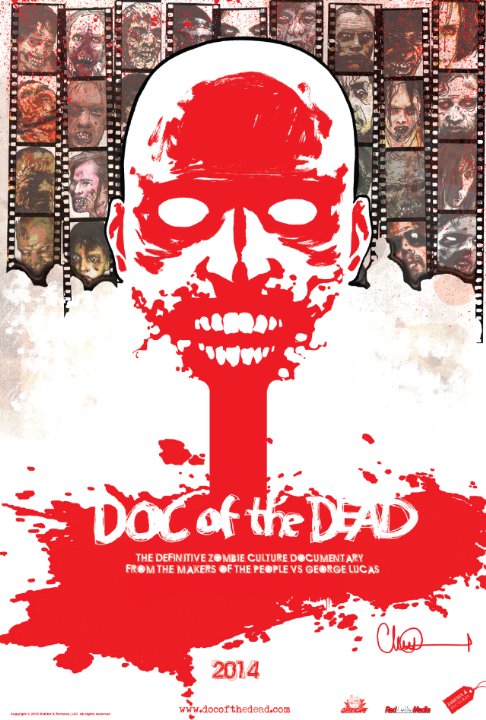
Doc of the Dead (2014), written and directed by Alexandre O. Philippe, who also directed 2010’s The People vs. George Lucas, is a documentary which focuses on the zombie subgenre and its cultural impact. Made with the help of Red Letter Media, whose YouTube channel features one of my favorite shows, “Best of the Worst,” and having interviews with the iconic Bruce Campbell and some of horror’s other greats, this film should have been a home run.

However, at least for my tastes, Doc of the Dead is too light on film history and too bloated with cutesy zombie-culture consumerism filler that I found myself quickly getting bored, and I don’t have a particularly short attention span. It’s not a bad movie but it’s about twenty minutes too long and about twenty IQ points too shallow to be really engaging. Not to mention, the perspective which it examines is purely American, missing the chance for some cross-cultural insight. In an era where we have superb horror culture documentaries like 2010’s Never Sleep Again: The Elm Street Legacy, horror fans can and should expect more from documentarians who choose to cover our genre. Doc of the Dead is light nonfiction that can be watched with the family around Halloween, but you won’t come away with a more than superficial understanding of zombies and their place in culture after viewing it, and for a film that markets itself as “the definitive zombie culture documentary,” that kind of misses the point.

Grade: C-

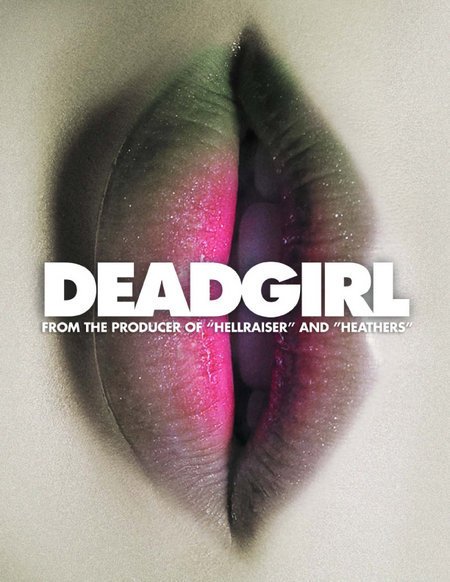
Movie Review – Deadgirl (2008)

Movie Review – Deadgirl (2008)

Discussion of a film like Deadgirl (2008) is the kind for which the phrase “trigger warning” was created. After watching it, considering its disturbing nature, I couldn’t shake a certain notion that I felt shouldn’t be there. I asked a friend to view it, warning him of the premise, so as to give me a second opinion. Despite its subject matter and all of its flaws, we both agreed, surprisingly, that the viewing had been worthwhile.

Two disenfranchised teens, Rickie (Shiloh Fernandez) and J.T. (Noah Segan), skip class and decide to break into an abandoned mental asylum. After drinking warm beers and vandalizing the premises they are chased by a stray dog into a remote section of the building from which there is no clear exit. They pry open a rusted door and find a woman naked, tied to a gurney and covered in plastic – and still alive. The two characters diverge at this point as Rickie wants to get help and J.T. wants to keep her as a sex slave. J.T.’s dominant personality wins out and Rickie, though not participating, keeps J.T.’s actions a secret. Audiences will certainly have their opinion of this movie germinating at this point, and much of this will rely on their ability to buy into the quick, horrific decision made by J.T. As a side note, I live in a fairly quiet New England town where, when I was in high school, a teenage girl was kidnapped, raped, drowned in a river, and had her corpse violated by her supposed peers – teens that remind me in many ways of J.T. As morally corrupt a decision as this character makes, it is certainly a possible one, and perhaps that’s what makes it truly horrific.

Soon J.T.’s violent nature leads to the discovery that the girl cannot be killed and that she seems to have an uncontrollable urge to bite anything that comes near her mouth. If the viewer as not figured out what she is at this point, maybe they’re not ready for this film. The situation, naturally, spirals out of control, and the plot takes the form of both the predictable and the surprising thereafter, including an unexpectedly hilarious kidnapping attempt gone awry.

Deadgirl is a film that deals directly with rape culture and the effects of misogyny. These teenage males have been raised to view women as commodities. “She’s like something out of a magazine,” says J.T. when first feasting his eyes upon the dead girl. He later takes this a step farther by placing a magazine photo over her battered face. Women are prizes to be won and possessed. Even Rickie, who should be our protagonist, wants to be a hero but is allured by the dark side. His attempts to help the dead girl and later his unrequited love, Joann, are motivated less by sympathy and more by an outdated chivalrous notion which sets him as a female protector. Manhood is continually defined by the males as having sex with women, and they are pressured to “man up” and not refuse to take advantage of the writhing corpse strapped to the gurney, no matter how cold, dry, or foul smelling she may be. This is not so much misandry as it is showing the terrible effects that misogyny has upon both women and men. In a world inhabited by a living dead girl, the teenage males become the real monsters.

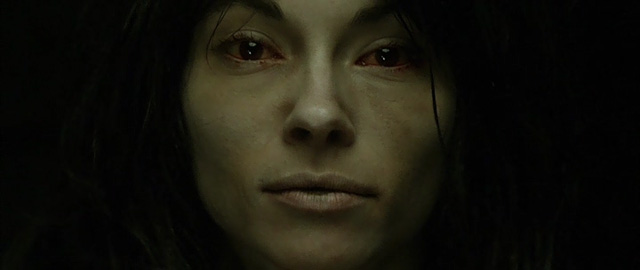
Deadgirl still
Jenny Spain in Deadgirl.

Other themes are explored in interesting ways, contributing to J.T.’s malicious motivations. Rickie and J.T. come from poor families, and though they appear to be on different paths, with Rickie looking to a life beyond his meager trappings and J.T. resigned to it, they are both too afraid to be alone to leave the other behind. Rickie’s pining for Joann, who dates jocks, is seen by J.T. as Rickie trying to rise above his class, and thus leave him behind. When trying to convince Rickie to choose the dead girl over Joann, J.T. declares that “this is the best we’re ever going to have!” For J.T. the dead girl’s chamber becomes his domain, and it’s appropriate that it’s located in the basement. For once he is in charge, no longer subject to the standards of school or society. “Think about it,” he tells Rickie, “Folks like us are just cannon fodder for the rest of the world. But down here we’re in control, and we call the shots down here, man. It feels good, doesn’t it?” The dead girl is J.T.’s trophy, a symbol of manhood his fellow male teens will recognize.

Lastly, Deadgirl is about that stage in a teenager’s life when they realize life won’t turn out the way they’ve dreamed. This realization has a profound effect upon Rickie, and gives insight into the seemingly strange ending which at first appears out of his character.

Deadgirl, written by Trent Haaga and directed by Marcel Sarmiento and Gadi Harel, is a movie that manages to rise above some of its more mediocre elements. It begins a bit shoddy but progressively becomes more eloquent and enveloping during the second half. Noah Segan won the 2009 Fright Meter Award for Best Actor for his performance as J.T., an award for which Shiloh Fernandez was also nominated. And of course, Jenny Spain’s performance as the titular dead girl is brave, compelling, and disturbingly convincing.

It’s not a film for everyone. If the subject matter it too disturbing, it is an easy film to pass up. But for those who do watch it, they may come away feeling surprised, and perhaps more than a little uneasy and guilty, for having enjoyed it.

Grade: B-

Blog at WordPress.com.

Up ↑