Search

The Revenant Review

Horror Film History, Analysis, and Reviews

Movie Review – The Cabinet of Dr. Caligari (1920)

This review is part of the A Play of Light and Shadow: Horror in Silent Cinema Series

Movie Review – The Cabinet of Dr. Caligari (1920)

From July 1914 to November 1918 the Great War raged – a tantrum of metal, fire, and pride that rent the earth and chewed flesh. A generation of men would be decimated, their views about life, government, authority, and mortality inextricably altered. Gone were the delusions of glory and nationalism and the jingoistic jingles to which they marched to the front. By the end more than nine million combatants and seven million civilian lay in graves, many unmarked. Anyone who reads the literature of this period, from Erich Maria Remarque’s unforgettable All Quiet on the Western Front to the potent poetry of Wilfred Owen, cannot but feel overcome with the profound sense of bitterness and betrayal these men felt toward society, authority, and their own families. The French war drama J’accuse (1919) dealt with this directly by depicting dead soldiers rising from the battlefield to confront their families and neighbors for their complicity in the war. Such resentment was felt by both sides.

The Parable of the Old Man and the Young

So Abram rose, and clave the wood, and went,

And took the fire with him, and a knife.

And as they sojourned both of them together,

Isaac the first-born spake and said, My Father,

Behold the preparations, fire and iron,

But where the lamb for this burnt-offering?

Then Abram bound the youth with belts and straps,

and builded parapets and trenches there,

And stretchèd forth the knife to slay his son.

When lo! an angel called him out of heaven,

Saying, Lay not thy hand upon the lad,

Neither do anything to him. Behold,

A ram, caught in a thicket by its horns;

Offer the Ram of Pride instead of him.

But the old man would not so, but slew his son,

And half the seed of Europe, one by one.

– Wilfred Owen (1918)

Caligari Millers Theater

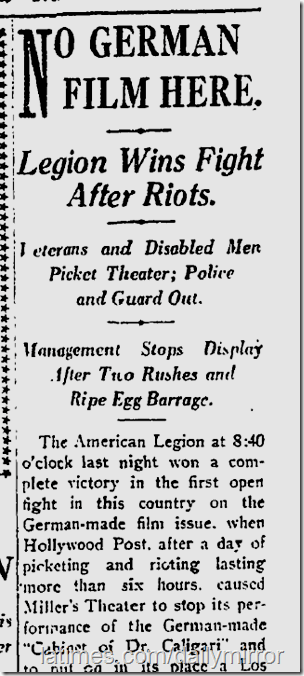
In the spring of 1921, though the war was over, American anger was still fresh, particularly toward the Germans. Veterans, many of them baring the tell-tale marks of battle-born disfigurement, marched on Miller’s Theater in Los Angeles to protest the opening of a German film for which the theater advertised, with a signature from the owner scrawled upon it, as “a fantastic European picture, which will… undoubtedly have a significant effect on American methods of Production. It brings to the screen an absolutely new technique, and its influence, I believe, will be tremendous.” For the protesters, it was not just that the film was German was their anger fueled, but also the implication that it was superior to America’s offerings. In the end the protesters won and Miller’s Theater pulled the film, but it was eventually shown in Los Angeles five years later when tensions had cooled. Nevertheless, 1920’s The Cabinet of Dr. Caligari was a film that changed cinema forever.
Caligari la times
The LA Times, May 8, 1921

As cultural historian David J. Skal writes in The Monster Show: A Cultural History of Horror, “It is difficult to overstate the kind of revelation Caligari represented to much of its audience, which felt it was witnessing an evolutionary leap in cinema, one comparable to the coming of sound…” for it was a film that “reconfigured the possibilities of space and form for the general public” (Skal, pg. 39). The movie hit contemporary critics like a gut-punch, exciting them to new possibilities in movie-making (and established countless precedents that the horror genre is still mining today). This new approach was as much a psychological reaction from the Great War, which will be discussed below, as it was a calculated move for German filmmakers who sought a style distinct from Hollywood, against which it knew it could not compete on equal terms with similar movies. As Erich Pommer, head of the Decla Bioscope production company which made Caligari, once explained:

“The German film industry made ‘stylized films’ to make money. Let me explain. At the end of World War I the Hollywood industry moved toward world supremacy… Germany was defeated; how could she make films that would compete with the others? It would have been impossible to try and imitate Hollywood or the French. So we tried something new: the expressionist or stylized films. This was possible because Germany had an overflow of good artists and writers, a strong literary tradition, and a great tradition of theatre. This provided a basis of good, trained actors. World War I finished the French industry; the problem for Germany was to compete with Hollywood” (as quoted by S.S. Prawer, Caligari’s Children, pg. 165).

Cabinet_of_Dr_Caligari_1920_Lobby_Card

The Cabinet of Dr. Caligari is not only the first great horror film; it is also the first German expressionist masterpiece. Expressionism was an artistic movement which emphasized the portrayal of emotion over realism, and was largely a reaction to the contemporary popularity of Naturalism and Impressionism. Heavily influenced by such works as Edvard Munch’s “The Scream,” expressionists blurred the lines between what is real and what is conceptual, often offering distorted visions of people and their environment. What they created is both beautiful and inherently grotesque. As German cinema began to adopt the style, with inklings to be found in 1913’s The Student of Prague, the subject matter became necessarily cerebral, and the skewed perspective naturally horrific.

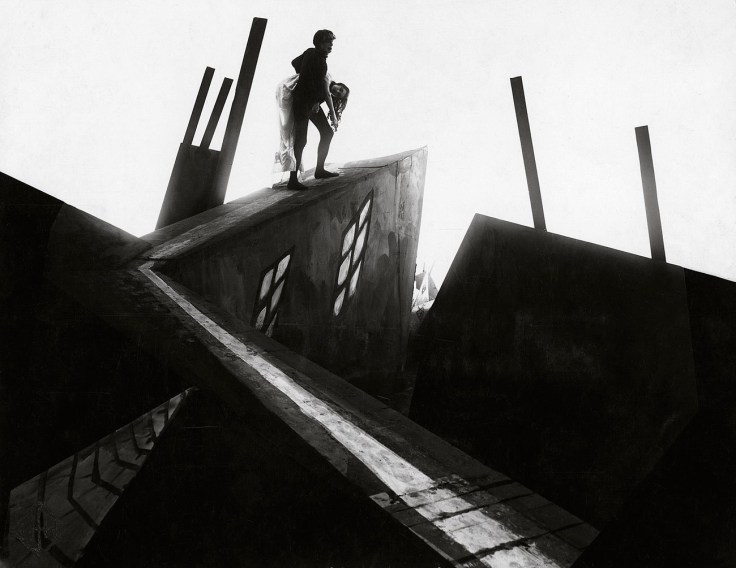
The highly stylized expressionist movement in Weimar Republic cinema, with its absurdly piercing angles, bold shadows, and leaning architecture that looks poised to crash down upon the inhabitants, was born as much by necessity as by creativity. As the Great War engulfed Europe, Germany banned all foreign films, creating an exclusive domestic market for its films. Due to effectively non-existent budgets and unreliable electricity, the closed sets had to be controlled. Instead of creating shadows with light they painted them in broad strokes that stabbed at the rest of the scenery. The themes of expressionism often understandably dealt with madness and matters of the psyche, as Germany particularly had just witnessed a war-torn world seemingly gone insane. Haunted by war, the film opens with the lines: “Spirits surround us on every side… they have driven me from hearth and home, from wife and child.”

Caligari-2

The roots of silent horror drink from many wells, with the Gothic literary tradition being the most obvious. However, less discussed is the role played by carnivals and their macabre attractions. Customers would pay to see the grotesque and the deadly, from the prevailing freak shows to a young Tod Browning’s own act of being buried alive for up to two days at a time, coining himself “The Hypnotic Living Corpse.” It is from this tradition that Caligari’s script, written by Hans Janowitz and Carl Mayer, partly takes inspiration, as we see the unhinged Dr. Caligari (Werner Krauss) present his somnambulist sideshow of the hypnotized Cesare (Conrad Veidt). It would also not have been forgotten by contemporary filmgoers that movies were once the subject of side-show curiosities, much like Cesare. Janowitz was also inspired by a macabre event in his life which occurred just before the war. He had been attending a fair and spied a beautiful girl. He was searching for the girl he had only glimpsed when he thought he heard her laughing in some nearby bushes. Suddenly, the laughing stopped. A man step out from the bushes and he briefly saw the shadowy face. The next day he saw a newspaper article recounting sexually tinged homicide of a girl at the fair and attended the funeral to see it was the same girl he had been admiring. There he saw the man who had stepped from the bushes, and the man seemed to recognize that Janowitz had spotted him. This eerie event lingered in Janowitz’s mind for years as he wondered how many murderers, if indeed this man was one, roamed free.

Janowitz and Mayer both became pacifists due to their experiences in World War I. Janowitz served as an officer in the Germany infantry regiment. Mayer’s early life had been tough – his father was a chronic gambler who committed suicide when Mayer was sixteen, leaving him to care for his younger siblings – and when the war arrived officials forced him to undergo traumatic psychiatric examinations to determine his fitness for service. Both gained a healthy distrust for those to whose will they were supposed to bend. Unsurprisingly, the script they conceived presented an image of authority drunk with power, sending a sleepwalking soldier to do its killing. The metaphor for the soldier’s experience, and the way they felt used by those they trusted, is apparent, even if it was clearer in hindsight than it was to them when they wrote it. As Janowitz would write: “It was years after the completion of the screenplay that I realized our subconscious intention… The corresponding connection between Doctor Caligari, and the great authoritative power of the Government that we hated, and which had subdued us into an oath, forcing conscription on those in opposition to its official war aims, compelling us to murder and be murdered” (as quoted by Steve Haberman, Silent Screams, pg. 36).
caligarikidnap

Fritz Lang was first signed on to direct the film and supposedly (accounts seem to differ) it was he who suggested the famous “twist” framing story – revolutionary for its time – of a mad man recounting his delusions. Sigmund Freud and his influential psychoanalysis, it may be noted, were then experiencing their heyday. Janowitz and Mayer claim to have protested the change, believing it diluted their pacifist message by revealing the maliciously insane authority to be the mere ravings of mad man. The writers appear to have been justified in their criticism for contemporary audiences focused on this later mental aspect, yet it also appears to have allowed them to more easily swallow the radically expressionist sets, performances and narrative. The anti-war message appears to have gone unnoticed, at least upon its initial release. Regardless, Lang left the project and Robert Wiene signed on, keeping the new framing story intact.

However, the framing device does not discount the cautionary symbolism of the film, it merely adds another level of unease, inviting the audience to question their own perceived reality. Additionally, these story elements are there for a reason, no matter what twist comes in the end. To illustrate by way of a more popular and beloved film, Dorothy awaking with her family around her bed does not make the messages about friendship, self-worth, and appreciating  one’s home now null and void. Even in delusions and fantasies can valuable lessons be learned.

It must also be recognized that the film’s last scene hardly lets the audience off the hook. The naturalistic framing scenes in the garden provide a contrast to the expressionistic visions of Francis’s insanity, which the audience has been made to share, but the cell in which he is placed at the end is identical to that which he envisioned in his supposed delusions. Add to this the last long shot of the film as the camera stays upon Werner Krauss’s face, where once we knew him as the insidious Caligari he has now been revealed to be the asylum’s supposedly benevolent director. Yet the look he gives is unfeelingly eerie, leaving the viewer to once again question his motives, his sincerity, and whether or not Francis was right all along – or whether we have not come to share Francis’s own paranoia. Perhaps it even serves to challenge the audience: Would you recognize insane authority, even if it’s staring you in the face? Is the destruction of evil authority merely an illusion, and do we actually remain beneath its boot-heel? Furthermore, the ambiguity of what we have witnessed serves to add a layer of paranoia as we’re compelled to ask if the hero who we’ve invested in is the true danger, or has our only hope been made impotent by the real threat? All these questions conspire to create unease, and they reflect with distorted clarity the anxieties and wounds of the era. As S.S. Prawer succinctly writes in his examination of the film’s terror iconography:

“[We may consider] the profound disorientation the film conveys, the questions it leads us to ask about authority, about social legitimation, about the protection of society from disrupting and destructive influences, and about the shifting points of view that convert enemies into friends and friends into enemies, whose origins may well be sought in the German situation after the First World War. Like any genuine work of art, The Cabinet of Dr. Caligari has its roots deep in the society of the time; but its significance, its appeal, and its influence far transcend its origins” (Caligari’s Children, pg. 199).

Wiene had directed Conrad Veidt’s first known appearance on screen in the 1917 horror film Fear, which deals with similar themes of madness, though most of his films up to this point had been dramas and comedies. Nevertheless, watching The Cabinet of Dr. Caligari – whose sets were designed by Hermann Warm, whose oft-cited credo was that “the cinematic work of art must become a living picture,” and influenced by the stage work of Max Reinhardt (of whom many of the film’s actors were former students) – is like watching a disturbing dream. Indeed, when I look back on it now I remember it like it was a dream of my own. The actors move through the surreal landscape, moving intentionally unnaturally, like ghoulish porcelain dolls. Conrad Veidt as the sleepwalking Cesare looks like he belongs in this nightmarish world, unnerving viewers as he slowly awakens and stares into the camera with his wide, expressive eyes. And yet Veidt is able to retain sympathy for the somnambulist assassin, no doubt influencing the pitiable monsters which would follow in the decades to come.

The_Cabinet_of_Dr_Caligari_Conrad_Veidt

The other performances, particularly by Werner Krauss as the titular Caligari and Lil Dagover as Jane, are equally strong. Krauss’s look was inspired by a photo of an elderly Arthur Schopenhauer, whose philosophical pessimism and belief that humans  were driven only by their own basic desires fits well with Caligari’s own selfish motivations.

Robert Wiene would create two more horror films, the largely forgotten Genuine, filmed the same year as Caligari, and 1924’s The Hands of Orlac, which also stars Conrad Veidt, and he would find success with many non-genre films. In the 1930s he left Germany, never to return, though it’s unclear if his reasons were political. He would die of cancer in 1938.

Hans Janowitz would retire from the film industry in 1922 and go into the oil business, eventually moving to the United States. Carl Mayer would write many other successful film treatments, including 1921’s The Haunted Castle, directed by Friedrich Wilhelm Murnau, and Murnau’s American work, the brilliant drama Sunrise (1927). Being a Jew and a pacifist, he fled to England to escape the Nazis but anti-German sentiments meant he could not find adequate work in the film industry. He died of cancer in 1944 practically penniless. His epitaph reads: “Pioneer in the art of the cinema. Erected by his friends and fellow workers.”

Werner Krauss specialized in playing villains, both on stage and in film. He appeared as an antagonist in Paul Leni’s Waxworks (1924) and in 1926’s The Student of Prague, both of which also starred Conrad Veidt. However, unlike Caligari’s pacifist writers or co-star Veidt’s defiant anti-Nazism, Krauss was an outspoken anti-Semite and supporter of the Third Reich, becoming a cultural ambassador for Nazi Germany and specializing in playing cruel Jewish villains. This is ironic as Veidt, who fled Germany and supported the war against Hitler, spent much of his later career playing Nazis in American and British films. The late Oxford scholar S.S. Prawer, whose own family fled to England to escape the Nazis in 1939, found an interesting insight into these two great actors’ on-screen choices that’s worth pondering, suggesting that each man donned the monster mask they feared the most. As he states:

“It is perhaps not without significance that of the two masters of macabre acting who combined their talents in Caligari Werner Krauss stayed in Germany during the Second World War and played a whole congregation of uncanny Jews… while Conrad Veidt went to Hollywood where the parts he was given included the sinister Nazis he played so well… In real life, of course, as these very performances serve to show, it was Werner Krauss who sold himself to the Nazis and Conrad Veidt who shared the lot of German Jews that managed to escape the holocaust. Some of the most effective screen performances may thus be seen as projections of inner fears and loathings, or of usually invisible aspects of their personality by the actors, as well as the writers and directors, of a given film” (Caligari’s Children, pg. 62).

After the war Krauss was banned from acting and forced to undergo de-Nazification. He died in Austria in 1959. (For more on the life of Conrad Veidt, see my review of 1919’s Eerie Tales.)

gabinetedrcaligari6

What The Cabinet of Dr. Caligari deals with is madness, abuse of power, and the ways in which people might be compelled to circumvent their better nature and commit acts of murder. It became the subject of 1947’s From Caligari to Hitler: A Psychological History of the German Film by Siegfried Kracauer, the first truly influential study in German film. Kracauer’s argument was largely teleological, arguing that one could see the coming of the Nazis through an examination of films from the Weimar Republic. Unfortunately, his reasoning is often undermined by his fuzzy recollections of the films (which he would not have had readily available to him) and by the subsequent findings of evidence that run counter to his claims. Nevertheless, he recognized the symbology of Caligari which affected Germans at the time and saw what the film said of their fears and anxieties. Fortunately, the twist only slightly softens these aspects while serving to explain the dreamlike quality of the film.

The Cabinet of Dr. Caligari transformed cinema in immeasurable ways, spreading its influence through generations of artists, musicians, and filmmakers. Even the late David Bowie in his last music video, “Lazarus,” evoked the film. We see Bowie dressed similar to Cesare, making exaggerated gestures in the way some silent film stars acted broadly, and in the end retreats into a wardrobe that looks eerily like Cesare’s box. These allusions and more are difficult to miss and impossible to dismiss, and what Bowie meant by them may be interpreted differently by individual viewers. Nevertheless, it proves that The Cabinet of Dr. Caligari still has the power to create unease and to fascinate, and the questions it raises, along with the disturbing answers it suggests, have lost none of their importance or potency.

Grade: A+

Movie Review – Hellraiser: Deader (2005)

Movie Review – Hellraiser: Deader (2005)

Hellraiser: Deader (2005) is the second directorial entry by Rick Bota and the seventh installment in the Hellraiser series. It is in many ways like the two previous movies as the script began as an unrelated horror spec but was adapted to accommodate the Hellraiser hallmarks. We once again get the psychological approach where someone opens the box, is tormented by nightmarish hallucinations, and then meets Pinhead who reveals the meaning behind it all – to varying success. This normally makes the narrative incomprehensible, however, Deader at least deserves credit for not becoming overly convoluted until the final act.

Kari Wührer plays Amy Klein, an investigative reporter who specializes in exposing the seedy underside of society. Klein is a breath of fresh air, being the most competent series protagonist since Kirsty Cotton. She makes some odd choices, such as not calling the cops when she comes across a corpse or not helping people who are seemingly bleeding to death in public, but the film allows Wührer time to react in other ways, such as an extended sequence where she tries to get a butcher knife out of her back, bloodying the bathroom as she’s slipping around. There are some good set pieces for her to work with as well, such as a corpse on a toilet that she must try to reach around.

The themes are also a welcome return to the original film, with the Lament Configuration reclaiming its position as an object of desire tempting those who would open it with promises of ultimate pleasures. The cult of “Deaders” which Klein investigates is comprised of young people who have grown weary of what life has to offer, seeking ever more extreme experiences, even courting death to gain them. Desensitization in a world of immediate gratification, reflected in Joey’s pleasure train, is once again fertile soil for the Cenobites. Doug Bradley returns as Pinhead, and refers not to Hell but to his realm, invoking the idea of the puzzle box containing not an entry into biblical hellfire but a pocket universe unto itself. This is complicated by certain aspects, certainly, but Pinhead’s victims are not targets because they’re sinners, but because they are intruding on his domain. It’s refreshing to see the series continue to drift towards its origins and further from Inferno’s Christian moralizing.

Of course, Deader has its problems. The movie was filmed in Bucharest, Romania, but doesn’t utilize its location at all – I think Klein only talks to one person with an Eastern European accent. For a movie filmed in 2003 and released in 2005, it feels outdated with its use of VHS tapes and aesthetics that feel much more akin to the 90s. The waking nightmare that Klein finds herself in is at first effective but becomes, as stated before, a jumbled mess in the last fifteen minutes (e.g., when did Joey join the “Deaders”?). The finale is a lazy, underwhelming closure to an otherwise, up until that point, competent and interesting film.

I’ve read many reviews that completely pan this entry, and admittedly the title is stupid. However, there’s a lot to respect in how many of the aspects were handled. If it hadn’t shit the bed in the last act, it would be my favorite sequel after Hellbound. Hell, considering what it’s up against, it might still be, but that’s jumping a hurdle whose bar is set so low it’s practically buried.

Grade: D+

Movie Review – Teeth (2007)

Movie Review – Teeth (2007)

(Oh-oh here she comes)

Watch out boy, she’ll chew you up!

(Oh-oh here she comes)

She’s a maneater!

 – “Maneater” (1982) by Hall & Oates

Vagina dentata – this Latin expression for “toothed vagina” is found in myths across the globe and is generally thought to stem from a fear of sexual intercourse, whether as a man entering an alien place where a piece of himself is left, or as a woman fearful of injury or rape. Female biology, for the vast majority of human history and unfortunately in some communities still today, was a source of mystery. As we all know, the woman’s sexual organs are on the inside, not exposed like a man’s. Therefore people asked: What could she be hiding? Why does she bleed each month? What mysteries are at the root of her ability to create and pass life through her body? Lack of scientific knowledge, coupled with age-old superstition, is at the root of the idea that a woman can house teeth in her vagina, ready to devour any man’s denim bulge who might be seduced into her hungry fly trap.

While female biology is little mystery to most modern Americans, or should be, there are still conservative segments who believe such knowledge is damaging to maturing teens, leading to temptation and spiritual corruption. They champion abstinence-only education and such puerile gimmicks as purity rings, despite a wealth of evidence that suggests such an approach is not only less effective in preventing unwanted results such as teen pregnancy, but may in fact help contribute to it.

Such a person is the central character to 2007’s Teeth. Dawn O’Keefe (appropriate last name), played by Jess Weixler, is a Christian creationist teen who is committed to saving her virginity for marriage and who champions purity rings at church youth groups. Her own body is an enigma and when she’s raped by a trusted love interest she finds that she possesses a special biological adaptation that quickly puts the forced entry to a mangled end. Such a situation is repeated throughout the film, giving the viewer many shots – mostly darkly humorous – of severed penises and shocked males holding their bloody, emasculated stumps.

As a male viewer this is horrifying stuff, but the film is filled to the brim with guys who want to take advantage of her so there’s no end to the justification for her castrations. Dawn goes from naïve innocent to feminist vigilante, embracing evolution and her own sexual prowess along the way. The depiction of men is decidedly negative – I half-expected her step-father, the only half-way decent guy in the film, to try to molest her, so prevalent was the male misogyny – and the film might have been better served to at least have one sympathetic young male to relate to, or a positive male sexual role model to at least let the audience know that they exist. Certain characters were arguably not entirely deserving of the level of malice she bit into them, though they were not at all sympathetic.

Despite this quibble, Teeth is elevated by a strong performance from its lead. Weixler plays the role just right, from perky good-girl teen to horrified man-eater to confident man-devourer.

teeth still

Writer and director Mitchell Lichtenstein smartly infuses his movie with black comedy and symbolism. Of the latter, there are the many references to serpents, which represent not only Satan’s temptation of Eve (“the serpent beguiled me and I ate”), signifying her drift from Christianity, but also Medusa, as Dawn herself becomes something that can be considered gorgonesque. As a visual metaphor, the cave opening in which she first discovers her power is dripping with toothy stalactites. An environmental message seems to also be at play. We repeatedly see two huge breast-like smoke stacks continually spewing smoke into the air. We can surmise that this is the source of Dawn’s mother’s cancer, and perhaps the cause of her mutation as well.

There were some choices made by the filmmaker that had me scratching my head. The cinematography is sometimes grainy, as though scenes were lightened significantly in post-production. Also, we see a lot of chewed man-meat, but despite the film partly addressing society’s fear in even acknowledging basic female biology (such as the anatomy textbooks having stickers covering the vagina), her weapon is never brought into the light. I am not saying this is a bad choice, but it is perhaps an odd one that undermines at least one of the film’s messages. Nevertheless, Teeth is a smart, funny, and entertaining film that will likely resonate with most women, but is a movie that guys should be sure to see too.

Grade: B-

Movie Review – Hellraiser: Hellseeker (2002)

Movie Review – Hellraiser: Hellseeker (2002)

Hellraiser: Hellseeker (2002) is the sixth installment in the Hellraiser franchise. Directed by Rick Bota, it marks the return of Ashley Laurence as Kirsty Cotton, heroine of Hellraiser (1987) and Hellbound: Hellraiser II (1988), albeit in a small role. It is also the last Hellraiser film to have any input from Clive Barker, who was outspoken in his dislike of its predecessor, Hellraiser: Inferno (2000) and the direction in which Scott Derrickson took the mythos. In small ways this story seeks to correct the moralizing direction of that entry and focus once again on the dualities of human existence, notably good and evil and pain and pleasure.

As Pinhead, played once again by Doug Bradley, asks Dean Winters’character, “Which do you find more exhilarating, Trevor, pain or pleasure?” As I prefer pleasure, we’ll start with the positive aspects of this film. Though her role is small, it’s great to see Kirsty again, and the direction her character takes, while very dark, is also entirely consistent with her actions in the first two movies, particularly her penchant to bargain. She’s a survivor who’s not above sacrificing a scumbag to save her own skin, and the skin of her loved ones. Truly, the film could have used more of her.

Likewise, Pinhead is neither the windbag bore speechifying solely about pain nor is he an agent for divine justice. He treats the main character Trevor as a character study – a curious plaything – and his intentions are purely business. The movie does not attempt to point its finger at the audience for our transgressions, but instead tries to show metaphorically that the potential for the sublime or the suffering or the noble or the cruel are within us in equal measure, and it’s up to us to balance these aspects. Those souls who fall victim to the Cenobites do so seemingly not because their sins damned them, though they may be morally bankrupt, but because they ran afoul of a very human vendetta.

These aspects work… mostly. Now for the pain. Like the last film, this one takes way too many notes from the excellent Jacob’s Ladder (1990). Trevor loses part of his memory after his car goes into a river, his wife Kirsty now missing, and hallucinations, dreams, and fragmented memories constantly intrude on his mind in a surreal manner. Yet Jacob’s Ladder knew when to stop. There are so many of these sequences that by the first act I knew that each time a moment of horror came on screen it would be revealed to be a delusion. You know the old horror trope of the horrible event that turns out to be a nightmarish dream sequence, the character sitting up in bed in a cold sweat? If you’re tired of those, imagine an entire film of it. The writers lean on this technique like a crutch – when they seemingly don’t know how to end a scene, they have Trevor grab his head in pain and forcibly transfer him to the next one. In addition, these transitions are so frequent and awkward that we have no sense of how much time is supposed to be passing. The twist ending partly explains this, but it makes it no less frustrating to watch.

Speaking of Trevor, all of this is not helped by Dean Winters’ flat performance. As a character who is a partial amnesiac, when he talks to people it’s difficult to tell what is supposed to be being conveyed to the audience: Does he remember this person? Does he remember sleeping with this person? Does he remember his lines? It was a performance I was unable to connect with, especially as his reactions to the endless hallucinations are so subdued – if he doesn’t seem to care, why should we?

There are also plot elements that don’t add up and in order to present them here spoilers will be found in this paragraph. For those wishing to avoid them, skip to the next one. Firstly, did Kirsty and Trevor live together in that shabby apartment? It looks like a bachelor pad and considering how women just show up to get boned, I have to wonder if this married couple ever lived under the same roof. The second plot problem lies in Kirsty’s bargain with Pinhead, which is to bring him five souls in exchange for her own. How is she bringing them to him? She may kill them but if they don’t open the Lament Configuration can Pinhead still claim them? It makes no sense that she could collect these souls for Pinhead simply by shooting people in the head without tricking them into opening the puzzle box, thereby rightfully making them the property of the Cenobites. The deal between Kirsty and Pinhead is a twist I actually really like but it simply does not hold up to any amount of scrutiny.

Thematically, I like Hellseeker, and I love seeing Kirsty again and following her along on her character arc. Nevertheless, it is a jumbled, frustrating movie and the plot doesn’t hold up to any degree of inspection. It’s an improvement from Inferno in spirit only.

Grade: D+

Movie Review – Dark Touch (2013)

Movie Review – Dark Touch (2013)

Dark Touch (2013) is an Irish film that deals with the heavy issue of child abuse and its harmful, often irrevocable effects. Written and directed by Marina de Van, the film follows eleven-year-old Niamh (Missy Keating) who has been systematically sexually abused by her parents, and one day the house appears to turn against them and kill them. Niamh goes to live with neighbors and finds that her emotional instability is linked to the paranormal violence of furniture and fixtures attacking people, made worse by her inability to read people’s often benevolent gestures toward her due to her past experiences. The film does a fine job, helped by Keating’s performance, of placing the viewer in Niamh’s perspective as she misinterprets the actions of those around her to their eventual detriment.

The film is strongest in its quieter, character-driven moments, but loses much of its power when it tries to handle horror. The subject of abuse can at times be heavy handed, such as when Niamh witnesses the abuse of two classmates by their mother and decides to intercede. Even after furniture has attacked the woman she immediately proceeds with beating her kids, and when the house goes haywire she lashes out at them more. At some point even a child abuser would look to alternative explanations or at least take a break from their attacking to figure out why inanimate objects are moving across the room at them.

In the final twenty minutes the film makes an awkward turn, opting for simplistic horror clichés over a more nuanced, psychologically convincing examination of Niamh’s journey. We get shock instead of ideas and the resolution feels forced and rushed as key characters fall by the wayside – one even disappears entirely and inexplicably. We’re left with plotlines which are either unresolved or rendered moot. Niamh’s inability to discern reality from her slanted perspective finally overcomes her at a birthday party, releasing her tenuous grasp on the real world; nevertheless, though a precedent has been set the transition feels sudden, unjustified, and unsatisfactory. If Niamh feels like Carrie White, prepubescent, Dark Touch feels like Carrie (1976), under-cooked.

Grade: D+

Movie Review – Satan’s Cheerleaders (1977)

Movie Review – Satan’s Cheerleaders (1977)

Debbie: Hey, what’s the matter with Patti?

Sharon: Nothing. She’s thinking.

Debbie: Why would anyone want to do that?

Oy vey.

Assuming you haven’t already seen this film, indulge me in a little mind game. Close your eyes for a moment and imagine what a film called Satan’s Cheerleaders, filmed in 1977, would be like. What did you see? I’m guessing blood, beasts, and most importantly, boobs (what Harley Poe refers to as “them sacred triple-Bs”). And why wouldn’t you? The title and era evoke the exploitation films that were still in their heyday.

What you actually get in Satan’s Cheerleaders, by low-budget director Greydon Clark, is an overabundance of cheese. Of course, a film should be judged on what it is and not on what one expected of it, but this movie doesn’t offer much, unless you count bad (even for) disco music and languid pacing. In addition to the cute actresses playing the four titular cheerleaders, we have the familiar genre faces of Yvonne De Carlo who, though only twelve years had passed since The Munsters went off the air, seemed centuries away from her charismatic turn as the somehow maternally-sexy Lily Munster, and John Carradine, who at this point in his career was sadly relegated to bit cameos. Carradine, however, as the bum probably puts in the best performance, which isn’t saying much. Also appearing is Sydney Chaplin, son of Charles Chaplin, in his last film role, as a Satanist monk, and he has what amounts to the film’s only successful intentionally humorous lines:

The Sheriff: That damn woman!

Monk: Yes, I know what you mean.

The Sheriff: What, you? You’re a monk!

Monk: Well, I’m very well read… and I dream.

[smiles]

Monk: I dream a lot.

Satan’s Cheerleaders is a lukewarm bit of low-budget comedy-horror that takes its plot cues from exploitation films but forgets to put in the actual exploitation, save for a brief bit of partial nudity. It becomes like watching a porno with the sex cut out, and all you’re left with is the awkward dialogue, stilted delivery, and unfunny sex jokes which remain – you know, the stuff you fast-forward through. If I had had any sense, I would have fast-forwarded through much of this film too.

Grade: D-

Movie Review – Stake Land (2010)

Movie Review – Stake Land (2010)

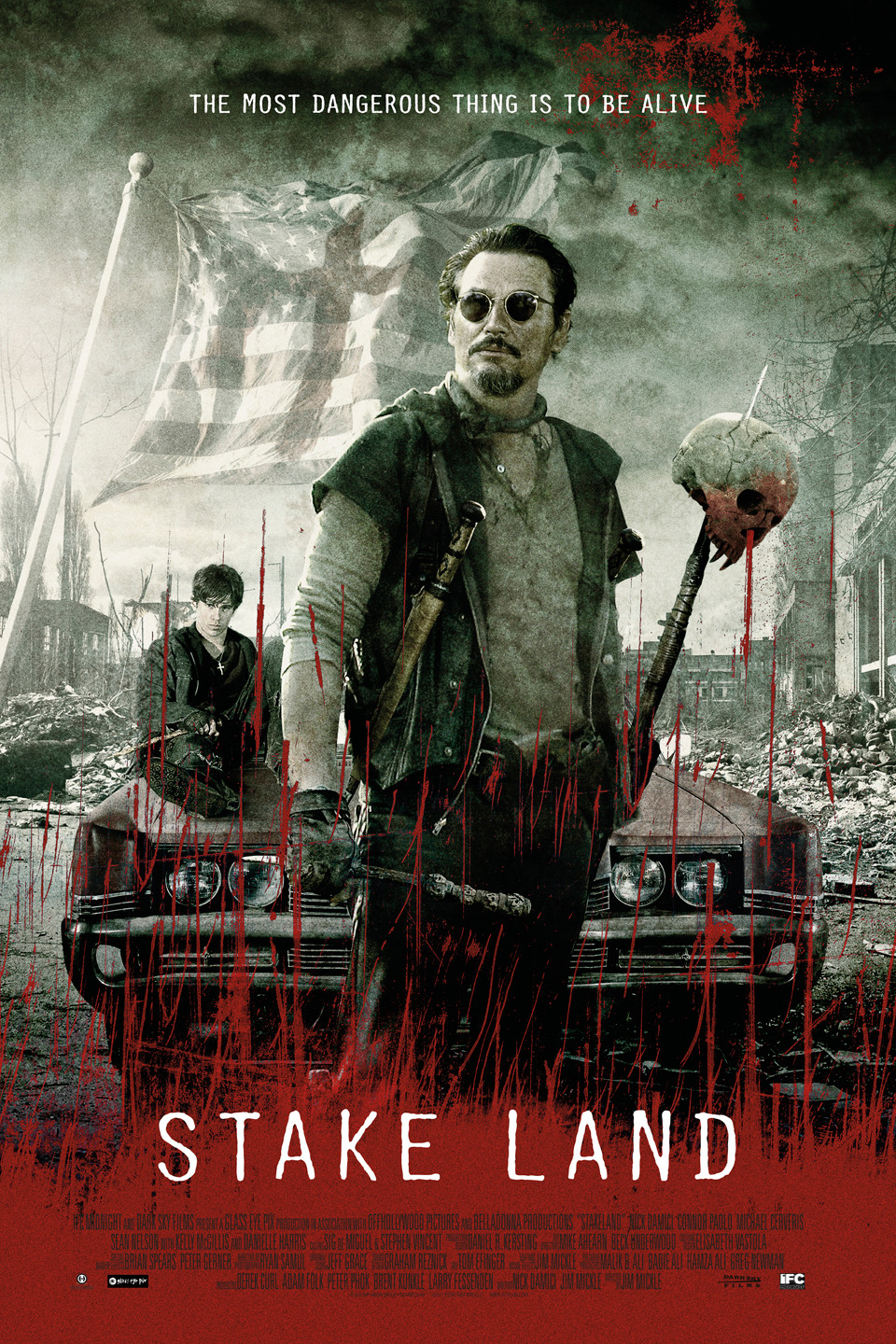
Borrowing heavily from the zombie apocalypse movies that came before, 2010’s Stake Land substitutes mindless zombies for nearly as mindless feral vampires. Displaced former citizens of a defunct United States wander the dangerous landscape, avoiding bloodsuckers at night and a fanatical portion of mankind during daylight. Taking a note from George A. Romero, the vampires are dangerous but they’re more of a backdrop – it’s the human drama that moves the story. The script, written and directed by Jim Mickle and co-written by Nick Damici, who stars as Mister, attempts to focus more on the characters and their relationships.

The soundtrack for the film consists of classic Americana, from gospel to bluegrass. The music and much of the fashion evokes images from the Great Depression, particularly migrant workers, hungry and haggard, pulling together in shanty towns. Boarded-up businesses blight the streets and people often eat from salvaged canned goods. The story owes as much to John Steinbeck’s The Grapes of Wrath (1939), with its “Okies” in search of work in California mirroring Stake Land’s inhabitants search for New Eden, as much as it does the plague-like vampire apocalypse of Richard Matheson’s I Am Legend (1954).

Stake Land summons the early twentieth century in other ways, notably in its depiction of race relations. Large areas have been taken over by a zealous cult known as The Brotherhood, which has adopted an Aryan form of vengeful Christianity. Crosses burn and the populace is terrorized. Additionally, a great deal of inspiration appears to have been taken from current Middle Eastern strife, where theocracies use religion as a weapon of oppression and terrorism. As Martin, our young narrator, laments after an attack: “And it was over like that. All of the goodness shattered by some Christian crazies…” Christianity runs amok – in a world of vampires, the cross is more terrifying to the living than to the undead. Religion has poisoned people’s minds and circumvented their empathy, making them as equally dangerous as the vamps.

Filmed with mostly realistic action, Stake Land succeeds in most of the things it sets out to do. The largest weakness of the film lies in its attempt to make The Brotherhood’s leader the main villain of the film, and in doing so it requires of its audience too much suspension of disbelief as the series of coincidences that need to arise to pull it off become ludicrous. Nevertheless, Stake Land succeeds in making vampires scary and wholly unsympathetic again, and for that I salute it.

Grade: C+

Movie Review – Hellraiser: Inferno (2000)

Movie Review – Hellraiser: Inferno (2000)

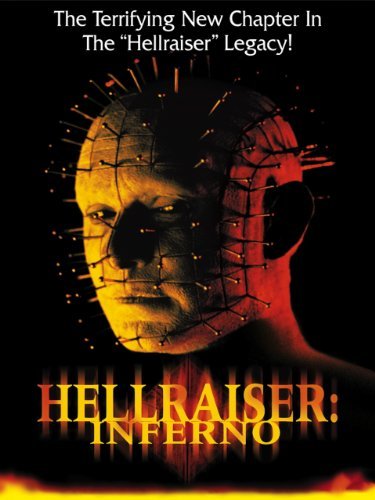
Scott Derrickson’s Hellraiser: Inferno (2000) is the fifth entry in the Hellraiser franchise and the first, but certainly not the last, to be released straight to home video. The story focuses on corrupt Detective Joseph Thorne (Craig Sheffer), who snorts cocaine and cheats on his wife with hookers. While investigating a crime scene which appears to involve ritual murder, he finds the Lament Configuration and a candle with a child’s severed finger in it. It isn’t long before the conveniently puzzle-loving detective solves the box and begins to be haunted by horrific images which lead him to question his sanity. The film’s narrative and imagery borrow heavily from 1990’s effectively psychological Jacob’s Ladder. Like the Hellraiser films which follow, this script was originally disconnected with the franchise until rewrites forcibly placed, to uneven success, the Lament Configuration and Pinhead.

Clive Barker, the franchise creator, had nothing to do with the movie and was very vocal about his dislike of it. He criticized the movie, especially, for the direction in which it took the Lament Configuration and Cenobite mythology. In August of 2000 he told an interviewer: “[Hellraiser: Inferno] is terrible. It pains me to say things like that because nobody sets out in the morning to make a bad movie… They said we really don’t want your opinion on it we are going to make the movie. So they went and made the movie, and it is just an abomination. I want to actively go on record as saying I warn people away from the movie. It’s really terrible and it’s shockingly bad, and should never have been made.”

In the following month Derrickson responded: “[Clive’s] reaction, I must admit, was not entirely unexpected. The Hellraiser franchise had (in my opinion) travelled too far in one direction and had quite simply run out of steam. The only interesting path to take in creating another sequel seemed to be the path of total reinvention. Of course Clive Barker isn’t going to appreciate that. I never expected that he would appreciate seeing the treasured iconography of his brainchild tossed out the window and replaced with a whole new set of rules. But it seems to me that I made a movie that is too good or at least too provocative for him to just simply dismiss… This is, in fact, a very good film. It is philosophically ambitious (unlike Hellraiser II, III, or IV), and it represents a moral framework outside that of the previous Hellraiser films and (apparently) outside that of Clive Barker’s personal taste. Quite simply, I subverted Clive Barker’s franchise with a point of view that he does not share, and I think that really pisses him off.”

To be honest, I had no knowledge of this feud prior to watching the film, but when it was complete I felt compelled to look into how Barker felt about the changes that were made to the Hellraiser mythos, and I found that his sentiments very much mirrored my own. In the first two films the Cenobites and Hell existed but we so no evidence of Heaven. Hell wasn’t a place to punish the wicked, but was a realm where people’s own desires and fears created a torturous prison perfectly suited to themselves. The Cenobites weren’t purposefully cruel, but were unable to distinguish pleasure from pain – it was the extremes of experience which they sought and in which they dealt. Concepts such as sin were irrelevant – there were only sensations in their varying forms. Pinhead’s God was the Leviathan, “God of flesh, hunger, and desire.”

In the next two films Pinhead took center-stage and was in turns defiant or dismissive of God and Christianity. He seemingly forgot about temptation and became obsessed with inflicting pain, and everyone appeared deserving of his particular talents. He mocked Christ’s passion and asked, “Do I look like someone who cares what God thinks?”

In Hellraiser: Inferno, the answer to the question above is a definite affirmative. At the heart of the problem is Derrickson’s and co-writer Paul Harris Boardman’s view of the Cenobites, which Derrickson describes as more philosophical but is more accurately categorized as theological. He shoe-horns Pinhead into the script and changes him yet again, making him into an agent of Hell whose seeming duty is to punish sinners. The Cenobites are here to inflict psychological torture on those who do not meet certain spiritual standards, and we must therefore assume their God is no longer Leviathan. Pinhead tells our protagonist that he is deserving of his punishment because “Your flesh is killing your spirit.” Thorne neglects his family and bangs hookers, and apparently choosing physical pleasure over maintaining personal relationships is cause for eternal damnation – harsh. Anyone else feeling preached at? The Cenobites have gone from being “explorers… in the further regions of experience” to enforcers of a God who deems sensual experience as sinful. This to me is not “philosophically ambitious” as Derrickson characterizes it, but rather conservatively backward-looking and not nearly as relevant to our modern culture as the first two films’ focus on desensitization in an era of immediate gratification. In 2002 Derrickson said of Inferno: “I wanted to make a movie about sin and damnation that ended with sin and damnation.” From the start, then, he missed the point of what made Hellraiser resonate with its modern audience, and makes it endure still.

The song which closes the movie clued me in to the director’s vision, whether intentionally or not. Called “From Eden,” it ends with the refrain, “We’re livin’ in the best of all possible worlds.” Derrickson studied theology, and I have to believe that this song was not an arbitrary selection. These lines evoke the famous argument of the philosopher Gottfried Wilhelm von Leibniz’s theodicy, which states, essentially, that because God is good and omnipotent and created all things, that all of creation must be good – the best of all possibilities, in fact – and that evil and suffering are therefore part of God’s plan and could not be removed or altered without diminishing His creation. You pull on one evil thread, the whole fabric unravels. This idea of course rests on too many assumptions and was lampooned by critics, sometimes inaccurately but not unjustifiably, and most famously by Voltaire in his still entertaining novella Candide, published in 1759. At the risk of looking too deeply into this connection, it sums up perfectly Pinhead’s place in the new Hellraiser mythos. He is no longer separate from or rebelling against the divine, as in previous films, but is now an agent of that divine plan, doling out righteous retribution to those who would hold the worldly over the spiritual. The problem of evil (Pinhead), in Derrickson’s Christianized account, thanks to Leibniz, is now solved.

This is all too moralizing for me, and that’s the similar reaction I had to another Derrickson film, 2005’s The Exorcism of Emily Rose. What he attempts to pass as thought-provoking comes off as preachy and tired to me. There are some things that Inferno does right. The Cenobites are creepy and many of the effects are well done, with few exceptions. Some scenes, such as those involving blood soaking through bedsheets, provide memorably set-pieces.

However, the first half of the film feels like it was filmed about a decade earlier and the main character, who is supposed to be fairly unlikable, is difficult to connect with or care about. The final twenty minutes, despite being visually interesting, did not move the plot along and quickly began to try my patience, especially after the umpteenth time I heard the little girl’s disembodied voice yell, “Help me!” It all culminates in a non-surprise and a major plot hole – without giving spoilers, ask yourself after watching it, given Pinhead’s revelation, whose finger was in the candle before he found the Lament Configuration? Lastly, there is the problem with the puzzle box itself. Without the theme of desire used so effectively in past films, one has to wonder what the point of the Lament Configuration is. If there is no longer the possibility for pleasure or power, why would anyone try to solve it if it’s only purpose is to summon demons to drag you to Hell? Ultimately, I find Derrickson a stronger director than screenwriter, and in this debate I have to side with Barker. Derrickson indeed changed the rules, and diminished the already weakened franchise in the process.

Grade: D

Source: http://www.clivebarker.info/hellraiser5.html

A Shout-Out from The HorrorCast Podcast

The HorrorCast podcast gave a nice shout-out to The Revenant Review in its latest episode, where they review Deathgasm (2015) and 1985’s Demons.

Thanks to The HorrorCast for the support!

The HorrorCast is made up of three members of the former Killer Flicks podcast. They’ve brought the structure of that now defunct show to this new podcast along with their intelligent conversations and good-natured personalities. Their latest episode can be downloaded on iTunes.

Movie Review – Fido (2006)

Movie Review – Fido (2006)

“Another Pleasant Valley Sunday
Here in status symbol land
Mothers complain about how hard life is
And the kids just don’t understand”

– “Pleasant Valley Sunday” (1967) by The Monkees

Fido (2006), directed by Andrew Currie and written by Currie, Robert Chomiak, and Dennis Heaton, is a Canadian satire which mixes George Romero’s zombie motifs, Lassie, and 1950s American sitcom television tropes.

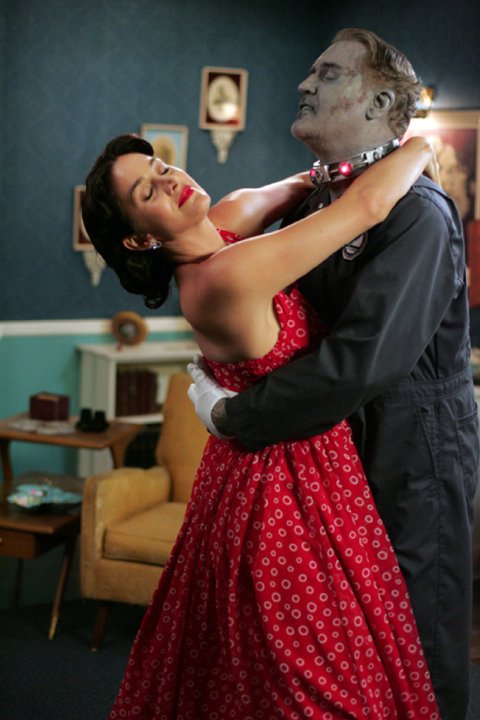
The film takes place in an alternative universe where the “Zombie War” has wiped out most of the population and people now live in 1950s-esque communities run by a corporation called Zomcon, who monitor, enforce, and expel undesirables (undead or not). The community is enclosed in a Zomcon fence and beyond is the zombie-infested wilds. Some zombies have been caught and domesticated through the use of collars that inhibit their devouring impulse, making them fit for manual labor and menial tasks. One such zombie, played by Scottish comedian Billy Connolly, is dubbed Fido by his boy owner and bonds with him in a manner typical of “a boy and his dog” films, and we get tongue-in-cheek scenes of them roaming through open fields with the kid yelling, “Come here, boy!” and trying to play fetch with him.

The strong cast, particularly Carrie-Anne Moss and Dylan Baker who play the boy’s parents, Helen and Bill Robinson, are great, mixing complex character emotions with impeccable comedic timing. Their character arcs are the real heart of the film and they embody them perfectly. Connolly gives Fido just enough cognizance to make him sympathetic, no doubt garnering inspiration from Day of the Dead’s (1985) Bub. Henry Czerny provides a charmingly conservative menace as the Zomcon security chief Jonathan Bottoms. However, it is the Robinsons’ neighbor Mr. Theopolis (Tim Blake Nelson) and his zombie girlfriend Tammy who threaten to steal the show in the end.

Fido 2006 still

Overall, he characters kill with a developed casualness, the kids practicing their shooting during recess while singing the mantra: “In the brain and not the chest. Head shots are the very best.” The juxtaposition between the supposedly idyllic and the gory is hilarious. Much of the humor comes from 1950s television call-backs including the I Love Lucy’s his-and-hers beds, the invocation of Lassie with the boy being named Timmy, and the use of rear-screen projections to add scenery while the characters are driving. Instead of Life magazine they read Death, and we get the schlocky sensationalism of educational videos of the time.

However, the film calls back that era in theme as well. The culture is defined by its commodities and consumerism, and neighbors are judged by the numbers of zombies they own. Appearance is everything and suppression of various kinds is a well-honed skill. When a zombie outbreak threatens, Mr. Bottom tells Bill that “These little problems are all about containment.” This was, of course, America’s Cold War policy, and like the zombies and undesirables in Fido that must be eradicated for the betterment of society, McCarthyism and Red paranoia sought to eliminate their ideological enemies from within. In the 1950s artists, especially Hollywood filmmakers, were blacklisted; in Fido, undesirable families are exiled into the wilds. Conform… or else. This goes with sexual politics as well. Helen is expected and willing to play the dutiful housewife to her aloof and insecure husband who fears intimacy, but gradually finds her own strength and independence while he reexamines his efforts as a husband and father.

However, these 1950s trappings are merely a smokescreen to satirize the American policies of the mid-2000s. As Currie told Rotten Tomatoes in 2007, “On a deeper level, [Fido is] also about homeland security. Mr. Bottoms comes in at the start, they’re building the fences higher, there are security vehicles on every street and ‘We’re gonna take everybody’s picture just in case one of you gets lost.’ That idea of playing with a corporation that’s also the government, Zomcon, and how they push fear as a way of controlling the masses.” Xenophobia reigns supreme and we even see reflections of the immigration debate as zombies are collared and relegated to the tasks that no other characters – all of whom are white – want to do.

The overall theme, though, is not as strictly political, and it is that love is a far better basis for humanity than fear. Fido is light on horror but heavy on charm, and it is a film that uses satire and gore to say something about the world in which we live, and the world in which we want to live.

Grade: B

Valentine’s Day 2016

My wife got a good laugh out of her Valentine’s Day “card” this morning.

I got the idea from something I saw on the web.

Movie Review – Hellraiser IV: Bloodline (1996)

Movie Review – Hellraiser IV: Bloodline (1996)

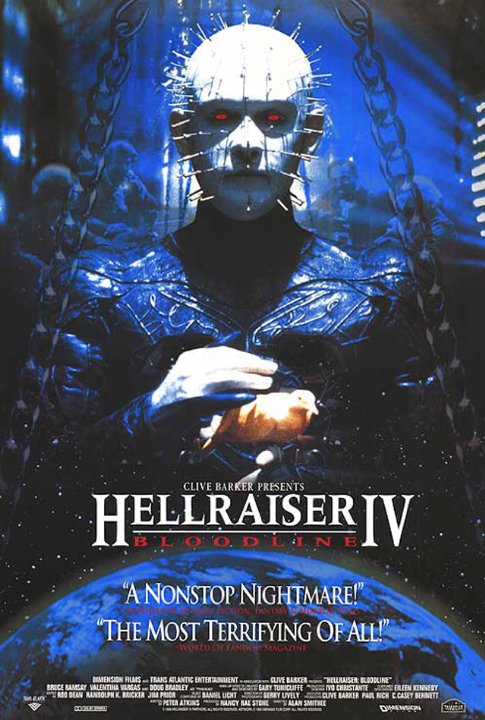
Released in 1996, Hellraiser IV: Bloodline is the fourth installment and the last of the Hellraiser franchise to be released in theaters, and it is the last to have involvement from Clive Barker, who served as executive producer. Directed by Alan Smithee… oh shit, wait, that can’t be good. For those familiar with Hollywood lingo, Alan Smithee is the pseudonym directors use when they wish to have their names disassociated with a project. This immediately raises red flags that warn that the road ahead is likely to be treacherous. Primarily directed by Kevin Yagher, known for his special effects work on such iconic monsters as Freddy Krueger, the Crypt Keeper and Chucky, until he found out that Dimension Films was re-editing the movie behind his back. Yagher wanted to tell Peter Atkins’ story, which is both a prequel and a sequel to the previous films spanning centuries, in chronological order, but producers insisted on the appearance of Pinhead, which was not to happen until about half-way in, to be ever earlier in the film. Frustrated, Yagher walked out and the producers brought in Joe Chappelle to salvage the film on a limited budget. Ultimately, both Yagher and Chappelle were dissatisfied with the final feature and chose to be credited as Alan Smithee – making two directors being dissociated from the film.

The end product is indeed uneven. The wrap-around story is set on a future space station, and even the dim lighting can’t hide that the sets look cheap. By this time we’ve had Critters and Leprechaun go to space, and this can safely be seen as part of the general downward trend of 90s horror (Jason would follow soon after), as it doesn’t really add anything to the story except for exposing budget limitations. As it is, the story is often disjointed with narrative gaps, no doubt due to re-editing as entire sequences were removed to hasten Pinhead’s arrival, such as a scene in which a party of eighteenth-century aristocrats are transformed into Cenobites (never mind trying to figure out the rules of who is turned into a Cenobite and why, as the franchise doesn’t appear to know either).

The acting, too, is generally poor, with the exception being Doug Bradley’s embodiment as Pinhead. Nevertheless, Pinhead is more like the last film than the first two. No longer are the Cenobites “explorers… in the further regions of experience.” Gone are the themes of desensitization and un-fulfilled desire. In fact, Pinhead declares that “temptation is worthless… suffering is the coin of the realm.” While I enjoy seeing Pinhead, he spends most of the movie pontificating endlessly about pain to the point where he begins to become a bore.

Hellraiser IV 1996 still

However, with all of these festering flaws, there are some things that the film does right. While the primitive CGI looks dated even by the standards of 1996, the practical effects, particularly the gore ones, are superb, no doubt due to Kevin Yagher’s extensive experience. Also, while the execution is largely crippled, I whole-heartedly applaud the ambition and scope of the film. Indeed, the space scenes look cheap, but they look cheaper still when compared to the scenes set in eighteenth-century France. The sets here are exquisite and are filmed with the beauty of soft firelight. The skinning of the peasant girl and subsequent birth of the demon Angelique look terrific, and the powdered face and wig of the Duc de L’Isle, especially when paired with the chains and blood that would deface him, are menacing and haunting. In terms of aesthetics alone, the combination of aristocratic foppery and Coenobitic sadomasochism is an intriguing one at which even the Marquis de Sade might tremble.

We are introduced to the Enlightenment when the toymaker Philippe (Bruce Ramsay) talks of a hellish discovery to his medical friend who is casually carving up corpses. His friend says, “This is the eighteenth-century, Phillippe, not the Dark Ages. The world is ruled by reason – we’ve even got rid of God. And if there is no heaven, then it follows reasonably that there is no hell.” So much potential could have been made of just this simple statement: Is there a God? If so, what role does He play? If not, what is Hell’s purpose? Did man truly abandon God, or did He abandon us? Is there Salvation, or is life its own reward and Pinhead’s realm the only hereafter? Had this film been as thoughtful as the first two franchise entries, we may have had another script that tackled some very deep human questions.

Woe to us that we didn’t. Hellraiser IV: Bloodline is, in my opinion, still a step up from the previous film. It tries to be something more and mostly does not succeed, but there are still moments of great horror punctuated throughout. Like the light that emanates through the wall slats when the Cenobites arrive, inklings of what could have been a truly great movie shine through on occasion. Those flashes are short-lived and ultimately snuffed, but if ever there was a Hellraiser movie I’d like to see remade smartly, it is this one.

Grade: C-

A Shout-Out from the LOTC Podcast

The Land of the Creeps podcast gave a really nice shout-out to The Revenant Review in its latest episode, where they discuss listener reactions to their previous episode about silent horror cinema and review Some Kind of Hate (2015) and We Are Still Here (2015).

Thanks to GregaMortis for the support!

LOTC is a great show for those looking for a fun horror movie podcast. The episode can be found here: Land Of The Creeps Episode 120 : We Are Still Here And Some Kind Of Hate

Movie Review – Under the Skin (2013)

Movie Review – Under the Skin (2013)

Art-house horror films seem to divide genre fans. Their emphasis on symbolism, aesthetics, experimentation, and their unconcern for traditional narrative can frustrate viewers who are used to or reliant upon films that are more straightforward and designed for larger markets and mass appeal. Ironically, horror is rarely made for large markets or mass appeal, but many fans go to the genre for the comfort of the usual tropes. This is not a criticism, but merely an observation. 2013’s Under the Skin is exactly the kind of movie one talks about when discussing art-house horror, and it’s therefore a film that generates strong reactions from viewers, with them either loathing or loving it. Count me in the latter party.

Expertly directed by Jonathan Glazer, and based on the 2000 novel of the same name by Michel Faber, Under the Skin is an alien abduction movie like no other. The film opens with what we at first assume is a solar system aligning, only to find that it is actually the construction of an eye, all the while hearing Scarlett Johansson’s voice play over as she practices human speech. This immediately invokes themes of interplanetary travel and physical transformation, appropriately though enigmatically telling the audience the origins of our central character. Johansson plays the mysterious alien posing as a woman who drives around Glasgow, Scotland, luring unsuspecting men back to a dilapidated house where they submerge into a reflective, meniscus fluid. The purpose of these abductions is unclear, but they’re also beside the point. Instead the lens and the narrative focus on Johansson and what she sees and how she sees it, the camera at first viewing the world around her as dispassionately as she does. At one point the street scenes layer into chaos, mirroring her own inability to process what she is seeing, and we ultimately see ourselves through her objective perspective. She is aware, perhaps even trained, to understand that her body is a lure for men, yet she does not fully understand the function or potential of that body, at least not for the first half of the film.

Under the Skin 2013 still

The character arc, however, is really about awakening to human experience. The alien begins to become aware of the sensations of her new skin, both the pain and the pleasure, as well as of sympathy. At first her gaze is reserved for her male victims, seeking them out on the city streets, but then the gaze turns towards women. These women are not potential victims, but role models for the alien as she comes to gradually recognize her own femininity. Nature plays a heavily symbolic role, as we see her begin at an empty industrial zone and enter the city, yet as she becomes conscious of a growing humanity she moves to the suburbs and then to the dense forests – that is, closer to the natural world.

Other themes float through the film. For a change we follow what amounts to a female serial killer prowling for male victims, placing men in the position usually reserved both in fiction and actuality for women. The men she meets have no concern for their own safety, revealing a patriarchal culture in which men have nothing to fear from women; though, as the film shows, women have much to fear from men.

Under the Skin lives up to its name. Though it’s a quiet film that’s patiently paced, it manages to be wholly unnerving by hitting the viewer in emotional places that horror often attempts but rarely succeeds in capturing. As a father of a young son, the scene of the toddler crying on the beach, struggling to stand as the alien walks by him as unemotionally as the approaching waves, haunts me. Likewise, the void in which the male victims are suspended nude as if in a womb, looking at each other with a seeming curious apathy, is disturbing. The viewer can hear the clicks of eyelids shutting as though we were floating with them, airless. And the climax of the scene, when we see what becomes of these men, is both horrifying and mesmerizingly beautiful. It pokes at our fears of being used and discarded, which is once again usually a theme reserved for female victims.

Under the Skin 2013 still 2

The narrative of the film is not an obvious one, as the importance of scenes is often not apparent until several more have passed. The filmmaking process, too, is nontraditional. Many scenes, including those in the nightclub and shopping center, were filmed covertly so as to capture some authenticity. The men who are lured by Johansson are unaware of the cameras, allowing them to act naturally. Despite these hidden cameras the gorgeous cinematography is never compromised. The special effects, which are mostly done in camera, are visually stunning. Input was also added from significant cast members to gain realism, particularly with regard to a victim played by Adam Pearson, who has neurofibromatosis, as he told the director what things Johansson might do to effectively seduce him.

As mentioned above with the audio of the void, the sound design and score add another layer of discomfort. The score itself sounds alien at times, the noises invoking natural forces or contrasted with the synthetic sounds of synths or changing radio frequencies. We are thus reminded of alien technology and our central character’s own artificiality, as well as the natural impulses which are making their presence known upon her.

Lastly, a word must be said about Scarlett Johansson, upon whom the film by necessity rests. She gives either a great performance, or an equally and appropriately great nonperformance – I’m still not sure which. Either way, it’s a difficult and brave role and she is up to the task entirely. This film marks Johansson’s first full frontal nude scene, and it says something to the film’s power and to her performance that her exquisite body did not distract me – a red-blooded heterosexual male who has certainly admired her form often in the past – from the symbolism and importance of the moment. Indeed, it perhaps speaks to the strength of the film that a famous sex symbol’s nude scene attracted such little fanfare, as the scene, in the context of the film, is less sexy than it is contemplative.

Under the Skin is the kind of film that excites me as a horror fan. It invokes the best of David Lynch and Lars von Trier and it goes to places artistically where the genre rarely treads, revealing whole new potentials for future filmmakers. As an art-house horror it’s not for everyone, but it’s an experience I’d gladly crawl beneath the surface of again.

Grade: A-

Movie Review – Hellraiser III: Hell on Earth (1992)

Movie Review – Hellraiser III: Hell on Earth (1992)

Hellraiser (1987) and Hellbound: Hellraiser II (1988) were fantastical landmarks in horror. Together they created a dark, unique atmosphere weaved around a hellish mythos that explored mature, complex themes. They gave us new horror icons in the form of leather-wrapped Cenobites, most notably the frightening figure of Pinhead, who were summoned and controlled by a mysterious puzzle-box, giving the illusion of a nightmarish, macabre fairytale. They are admittedly large footprints in which to follow, and unfortunately 1992’s Hellraiser III: Hell on Earth, directed by Anthony Hickox, stumbles with nearly every step.

Instead of a script in which the Cenobites are a supporting cast, the film unfolds as a lackluster showcase for the popular Pinhead, and the mortals that fill the space around him are flat and uninteresting. Had Pinhead been well-written, this could have been forgiven, but his extensive dialogue (compared to the first two films) amounts to one-liners in the ilk of Freddy Krueger, in the end making Pinhead less of an ominous presence and more of a farcical showman. This becomes apparent in an unnecessary church scene in which Pinhead drags out a blasphemous passion parody that feels too gratuitous to be effective.

Instead of an unsettling atmosphere and macabre wit this production seeks to please a younger audience with gratuitous violence (some well-done, most not so much), a high body count, attractive women, as little thinking as possible, and some shallow displays of heavy metal culture. This may be acceptable fare for your middling horror entertainment, but the Hellraiser franchise already established higher standards. The storyline awkwardly attempts to connect to the other films, however, in doing so it manages to change their rules and precedents, and even the puzzle-box seems like an afterthought. Tension and dread are lost to mindless spectacle, especially as we are given no reason to care about the underdeveloped protagonists (particularly Terri, who had the most potential for depth).

Perhaps the biggest crime, though, is Pinhead’s new Cenobites, which include one that shoots seemingly razor-sharp CDs and a former camera man that has a deadly punching lens protruding from his eye-socket. While I understand these are supposed to be minions Pinhead has haphazardly assembled, the result is beyond ridiculous and the audience will be too busy laughing at these wisecracking Borg knock-offs to care about what happens next. (Speaking of Borgs, this film marks the second time a Star Trek: Deep Space Nine actor has appeared in a prominent role in a Hellraiser film, the first being Andrew J. Robinson and now Terry Farrell.)

Even without the weight of its predecessors, Hellraiser III cannot stand. It’s too heavily saddled with poor dialogue, weak plotting, thin characterizations, and some conspicuously bad performances. It’s all thoughtless spectacle directed toward what it believed the MTV crowd wanted, which is a shame when one considers the mature ambitions of the first two. Doug Bradley’s obvious joy at playing Pinhead is reason enough that the franchise deserves better.

Grade: D-

Blog at WordPress.com.

Up ↑