Search

The Revenant Review

Horror Film History, Analysis, and Reviews

Category

Movie Review

Movie Review – The Unborn (2009)

Movie Review – The Unborn (2009)

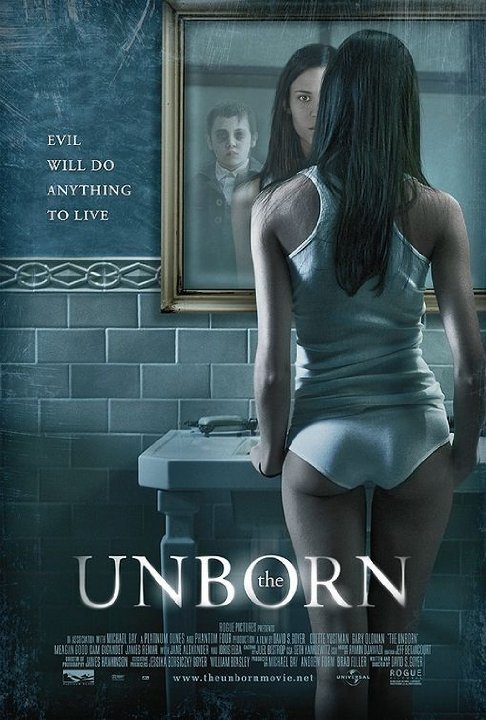
2009’s The Unborn brings with it many reasons to expect a satisfying horror film, just two being that it stars the incredible Gary Oldman and is written and directed by David Goyer, one of the writers of Christopher Nolan’s Batman Begins (2005) and The Dark Knight (2008). Unfortunately, these expectations only add to the disappointment. Goyer’s previous directing forays, The Invisible (2007) and Blade: Trinity (2004), might have foretold this, though I had hoped that after the Batman reboots he might have learned a few new tricks. He might have, but far too few.

This film had some promise. The cinematography is appropriately moody, some of the creature effects are impressive (if not entirely original), and the story, though deriving inspiration from Kabala mysticism, nobly attempts to not be confined by any one religion or creed.

However, in the end The Unborn is formulaic and forgettable. After a decent first third the movie loses steam and becomes dull and convoluted. It relies on tired clichés and ineffective jump-scares to irritating degrees. These tactics have been rehashed countless times that even casual horror fans are completely desensitized to it. Rather than make the audience jump it instead clues us into the fact that what we are about to watch is stale and unimaginative. When this is done over and over early on in a film, before we even know the characters or what we’re supposed to be afraid of, it becomes infuriating. Sadly for The Unborn, the characters are so thin and clichéd that we never fear for their well-being or care for their fate – tension and true horror is therefore lost. It does not help that the acting is also poor, including the uneven performance by Odette Yustman, who plays the lead, Casey, a role that has her posing between scares in her underwear just to keep our attention.

The plot follows Casey as she begins to be haunted by a ghost child who repeatedly tells her, “Jumby wants to be born now.” Casey begins having a pigmentation change in her eye, leading her to discover that she was a twin and that her brother (said Jumby) died in utero from her umbilical cord. We assume that the ghost child is Jumby until we meet Casey’s long lost grandmother, an Auschwitz survivor, who tells her it is a dybbuk, an evil spirit wanting to inhabit this world. Actually, the grandmother seems to be living across town in a nursing home, though for unexplained reasons nobody, even her father, seemed to tell Casey. The grandmother explains that her own twin brother was possessed by the dybbuk, perhaps after the experiments of Dr. Josef Mengele (though he is not named), in the concentration camp before she had to kill him. It’s telling in a supposed horror film when not even Auschwitz looks scary. The dybbuk has been haunting the family ever since, even driving Casey’s mother to suicide.

So just forget about all that Jumby stuff, I guess. As the story progresses, it becomes ever more of a struggle to buy into it, and makes me think that Goyer started off with a good idea but ran into a wall when he needed closure. Not even Gary Oldman as an exorcist rabbi can elevate this movie. There are so many clichés and borrowed elements that it is difficult to know when Goyer is paying homage to the genre’s alumni or plagiarizing them. With so much missed potential, The Unborn lives up to its name.

Grade: D

Movie Review – The ABCs of Death (2012)

Movie Review – The ABCs of Death (2012)

Earlier this year a 58-year-old substitute teacher in Ohio was convicted on four felony accounts for disseminating matter harmful to juveniles. She played The ABCs of Death (2012) for five consecutive Spanish classes. It’s reasonable she began playing it the first period not knowing its contents, but to continue playing it and then showing it again and again? Apparently, when an administrator got wind of it and walked in during the last period she reached for the button to stop it and inadvertently paused the screen on a pair of bare breasts. I’m sure the students’ laughter was deafening.

This story is probably the best publicity imaginable for this type of film. After having now seen it myself, I can’t help but sympathize with the court.

The horror films I watch can generally be split into two categories: those that I watch with my wife, and those that I don’t. The reasons for the latter are normally as follows:

1. I think it might suck and I don’t want to over-saturate her with genre crap and ruin her good will.

2. It may contain a level of misogyny best not watched with the woman with whom I share a bed.

3. She’s not a fan of graphic torture or violence – The Texas Chainsaw Massacre (2003) remake was a theater experience the memory of which still makes her shudder.

The ABCs of Death, at one point or another, fulfills all of the above criteria. At its core it’s a simple but clever idea for an anthology horror film. They gave $5,000 and a letter of the alphabet to 26 different filmmakers from around the world, and those filmmakers created a short film based upon a word they chose which corresponded to their letter. The word isn’t revealed until after the film, leaving the viewer guessing as they watch.

As is to be expected with this type of project, the quality of filmmaking varies. There are some which I’m convinced the filmmaker must have $4,990 still in their bank account. Some are of a very hardcore nature, featuring disturbing subject matter and graphic representations. Some are art-house. Some are hilarious and clever. More than a few are about poop. Some are thought provoking and intense. While I strongly recommend some of these films, a sensitive viewer may want their finger primed on the fast-forward button.

Bottom line: understand what you’re getting into and, by the wisdom of Odin, do not watch this with anyone you hope to sleep with in the near future.

Grade: C+

Movie Review – Autumn (2009)

Movie Review – Autumn (2009)

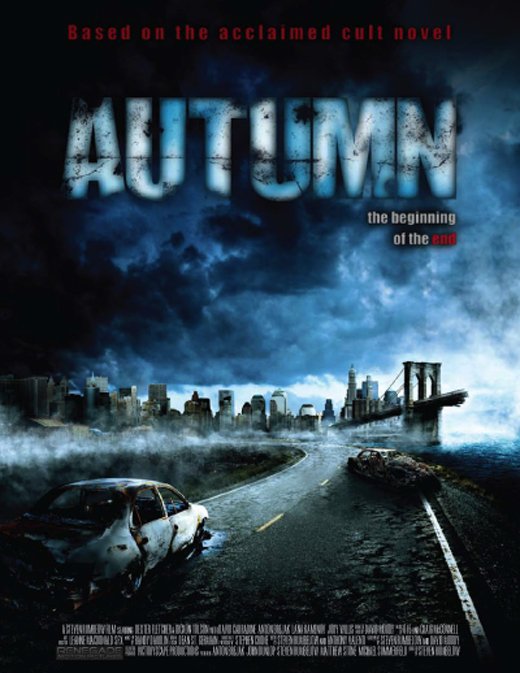
Autumn (2009), a Canadian film directed by Steven Rumbelow, is a film that, though showing promise in some respects, is unable to break free from its low-budget confines. In the beginning of the movie we see a mysterious virus kill off most of the human population and watch as the survivors try to come to terms with their new world as the dead begin to rise. The zombies (though they are never called this in the film) are benign at first, but slowly begin to become more cognitive and dangerous, giving time for tension-free character development for the first half of the story. Autumn is a slow-burn, which is partly what makes it almost work, and there is certainly a noble effort to become more than a simple zombie film, but it never quite achieves this. Even the make-up effects, which do their job in making the zombies look progressively rotten, do little to help.

Choppy editing, overly long sequences (which make it difficult to gauge the passing of time), and a lack of focus on the main characters work against the final product. The acting, too, ranges from adequate to Community Theater, and some performances are out of place with the mood of the film. There is also the curious mix of accents which makes it difficult to place the setting. The main characters consist of an American and two Brits, and early on there is a character who sounds like an Irishman attempting an American accent (note to such actors: Americans don’t say “bloody” unless we mean the red stuff). It is not until a good way into the story when a character speaks of visiting American cities that one can assume that the U.S. is the setting. This is not helped by the lack of location shots, as the movie essentially concentrates on a single devastated street on which we see the characters traveling a half-dozen times throughout the film – obviously another drawback to a low budget. We never really feel the scope that the film attempts to convey.

Unfortunately, even if the finances had been unlimited this film still would not rise above the superior zombie films which came before. Indeed, had this film come at the forefront of those competitors it may have been more relevant, but as it stands there is nothing new offered here. It is not scary, gory, dramatic, well-shot, or even terribly interesting. The script, which is based upon the David Moody novel of the same name, is predictable. We have seen it all done before, and we have seen it done better. Without giving away too much, the movie even culminates with a besieged farm house, offering us little variation even on Night of the Living Dead (1968), the classic film which established the modern zombie over forty years ago.

There is certainly a lot of heart in this film, but it is ultimately an unnecessary work that contributes nothing new to the genre. Nor is it able to recreate familiar genre elements in a way that warrants its viewing. It is easy to respect the efforts made in this film, but that unfortunately is not enough to recommend it.

Grade: D-

Movie Review – Triangle (2009)

Movie Review – Triangle (2009)

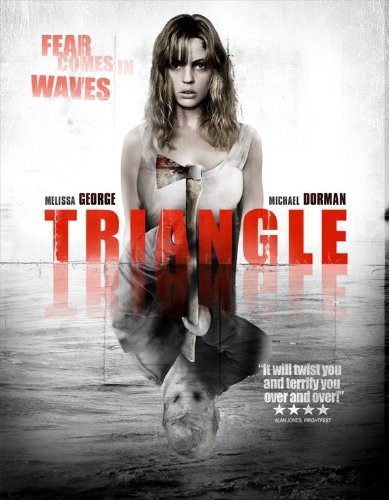
I knew nothing about 2009’s Triangle, a film by Christopher Smith, before watching it, and I must say that that is probably the best way to approach this movie. If you plan to watch it, don’t even watch a trailer, as it gives too much away. Triangle is a mind-twisting mystery which smartly employs both supernatural and slasher elements while never venturing too far into either subgenre. Each time I expected the movie to take a turn for the worse, it only became more interesting.

Triangle is about a group who board a seemingly deserted cruise vessel after their yacht is capsized by a freak storm. To say any more about the plot would be giving too much away, making this review torturous to write as this is the kind of movie you want to share with others and discuss.

Melissa George in Triangle.

The script is tight and intelligent – don’t blink or you may miss something – and supposedly took two years to write. The casting is great and the cinematography beautiful, filled with appealing, vibrant colors. The direction reveals an expert storyteller on the rise in the mold of Christopher Nolan, who similarly messed with our sense of time and perspective in films like Memento (2000). Smith’s love of the horror genre is apparent as Triangle conveys a veiled homage to Kubrick’s masterpiece, The Shining (1980). Additionally, Melissa George ties the film together in a terrific lead performance, playing a distraught mother trying to get back home to her son.

For fans of shows like The Twilight Zone, who like to bend their minds to wrap around an unfurling mystery, I recommend Triangle most highly.

Grade: B

Movie Review – The Haunting of Molly Hartley (2008)

Movie Review – The Haunting of Molly Hartley (2008)

2008 was a year in which true horror was released upon cinema in the unholy trinity of sub-par, terrible tween horror. Including One Missed Call and Prom Night, The Haunting of Molly Hartley, directed by Mickey Liddell and written by John Travis and Rebecca Sonnenshine, is probably the best of these three films, and that is all that can nicely be said about it. The story follows a teenager whose mother tried to kill her, and as she enters a private school and copes with the trauma she begins to believe that she is destined to become an agent of Satan unless she can do something to stop it. Think a prettier Damien: Omen II (1978), but less competent.

The plot of this film can be found in about the first and last five or ten minutes of this overly long film and the rest is simply teen drama filler fit for an ABC Family Channel series. Just in case you begin to fall asleep or forget you are supposed to be watching a horror film, there is a fake jump-scare at regular intervals, and you can safely guess that a bathroom mirror is involved in at least one. Each attempt at generating fear fails under the oppressive weight of its ineffective clichés and from a story line that is impossible to become invested in. In all fairness, Haley Bennett as the titular Molly makes a valiant effort as the lead but cannot hope to save a film which has her jumping at shadows every couple of minutes. The characters – attractive, privileged white kids – reflect who the target audience is.

It also helps if said audience belongs to a fundamentalist Christian youth group. Though the only Christians in the movie are extreme caricatures, they are also justified for their fanaticism and paranoia. The movie is light on horror enough, but religiously overtoned enough, to play well at a conservative Christian teen sleepover. Just for the record, that wasn’t a compliment. Truly, the movie’s biggest crimes are that it’s terribly dull and uninteresting, because by the time Molly is begging to accept Jesus as her savior we are merely begging for the film to end, and are willing to sell our souls to the Devil to see it done.

Grade: F

Movie Review – Prom Night (2008)

Movie Review – Prom Night [remake] (2008)

2008’s Prom Night, directed by Nelson McCormick, would have us believe that it is a remake of the 1980 Jamie Lee Curtis Canadian slasher, but the similarity goes only so far as the name. I admittedly am not a fan of the 1980 film as I find it fairly dull (I much prefer Terror Train, which Curtis had starred in that same year). This new film follows Donna, played by Brittany Snow, whose family was murdered by an obsessive teacher. Three years later she’s preparing for prom and, of course, the madman escapes custody and goes searching for her.

While I get bored with the original, it’s nonstop quality entertainment when compared with this new teen-targeted commodity. The acting is bland, the dialogue nauseating, the plot formulaic and predictable, the characters flat, and the directing uninspired. It’s amazing how the instantly forgettable killer is able to take out most of her friends in the most bloodless of methods. Truly, it is astounding that he can continually stab people in places that they will not bleed.

If one had to endure this film for whatever unfortunate reason, a good drinking game would be to take a shot each time a fake, clichéd jump scare occurs (two shots if a mirror is involved). You will be seeing double halfway through the film, and it might not only make the viewing endurable, but you may even see what the psycho-stalker killer sees in Donna, because my sober self didn’t buy it.

This review is a lazier attempt than most of my others, but this is the only way I can manage to keep thinking about this awful, awful film. So as to spend less time on this film, I’m going copy and paste a portion from my review of One Missed Call because the same message applies: I have seen countless terrible, mostly low-budget horror films that are easily forgettable and often times laughable. However, these bombs are usually made with the best intentions, and even though they are lacking in almost every other way, they contain some heart in their creation. This film, however, is nothing more than a cold, calculated profit machine meant to separate young teens from their parents’ money. It is the horror genre’s equivalent of a boy band.

Prom Night might even be able to take the tiara from One Missed Call for worst horror film of 2008, so there’s an accomplishment.

Grade: F

Movie Review – One Missed Call (2008)

Movie Review – One Missed Call [remake] (2008)

One Missed Call (2008) is directed by Eric Valette, written by Andrew Klavan and starring Shannyn Sossamon. It is a remake of Takashi Miike’s 2003 Japanese film of the same name, seeking to capitalize on the late 2000’s J-horror remake craze. It is probably the worst among them, and that’s saying something. I never thought that I would see a horror film that was so bad that making fun of it lost its appeal.

While watching it I couldn’t help but imagine aliens observing our planet through our horror films and trying to communicate with us by making their own, except that they do so without possessing any understanding of the human psyche or why these films scare us. One Missed Call would be the result. It is a paint-by-numbers wreck with poor acting, annoyingly frequent but ineffective fake jump scares, terrible CGI, and a script that is unable to tell even a simple, coherent story. What the plot is supposed to be about, though the film makes every effort to make you not care, is a group of college students who receive phone calls in which they hear their own deaths, and then die a few days later in that same way, which in turn prompts ghostly phone calls to be sent from their phone to those in their directory, repeating the pattern. I have not seen the original on which this is based, but I must assume it was far more competent.

The opening scene illustrates the ineptitude perfectly. After some shots of a hospital fire we switch to a girl talking on her cell phone in a backyard garden which has a small pond. The girl is startled by her cat (the cliché of clichés) who is near the pond and then turns back to her homework. When she looks toward the cat again it is gone, and for some reason she seems to think it fell in the water and drowned and so goes to investigate, which proves this scene was written by someone who has never owned a cat. The cat appears at the other side of the water and, just as the girl is visually relieved, a hand pulls her into the water. As silence again settles, the cat is then pulled into the water as well, and the girl’s phone begins to magically dial her friends. Aside from the fact that this is all much more funny than scary, it is also angering how the movie cannot even stick to its own rules in the first few minutes. Did the cat receive a phone call? Did the killer hand not want feline witnesses?

I have seen countless terrible, mostly low-budget horror films that are easily forgettable and often times laughable. However, these bombs are usually made with the best intentions, and even though they are lacking in almost every other way, they contain some heart in their creation. This film, however, is nothing more than a cold, calculated profit machine meant to separate young teens from their parents’ money. It is the horror genre’s equivalent of a boy band. One Missed Call is one call from Shannyn Sossamon’s agent that she should have missed.

Grade: F

Movie Review – Sorority Row (2009)

Movie Review – Sorority Row [remake] (2009)

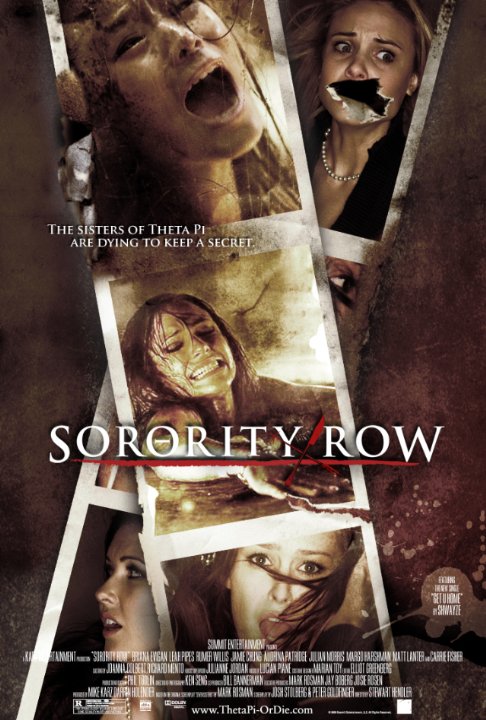
It doesn’t take a great stretch of the mind to anticipate what a slasher movie entitled Sorority Row will offer. Cute girls? Check. Bare breasts? Check. College parties? Double-check. Oral fixations? Quadruple-check. Said cute girls being taken out one-by-one? You get the idea. This is an unoriginal (it is a remake, after all) and formulaic entry into the slasher genre that will largely be forgotten in the years to come (if it hasn’t been already).

However, while this usually works to the detriment of a horror film, it becomes a rather endearing quality here. This loose remake, directed by Stewart Hendler, of the 1983’s The House on Sorority Row has no delusions about what it is and what it plans to offer. The script is fast-paced, the kills are entertaining and bloody without being gratuitously excessive, and the dialogue offers jokes based on well-rounded character interaction. The capable cast certainly helps in this regard. There is no pretension here; the movie practically begs its viewer to relax, enjoy, and to not read too much into what is going on. If one can do this, even a discerning horror fan like me can enjoy the film.

Had other aspects of the film been better, this could have been more memorable. Much of the movie’s appeal rides on the satisfaction of seeing snobby, shallow individuals being disposed of with extreme prejudice. That’s a start. The killer, unfortunately, is a bland figure stalking his/her prey cloaked in a graduation gown. The weapon of choice is a tire-iron which, in the words of one of the catty characters, has been “pimped-out,” though it could be more accurately described as impractical. The film-makers seemed conscious of all other aspects of exploitation slasher films except for what is perhaps the most important element – the creation of a visceral killer that will stay engrained in the audience’s minds for years to come. In slasher films it’s the killer’s show, after all.

Grade: C

Movie Review – The Quiet Ones (2014)

Movie Review – The Quiet Ones (2014)

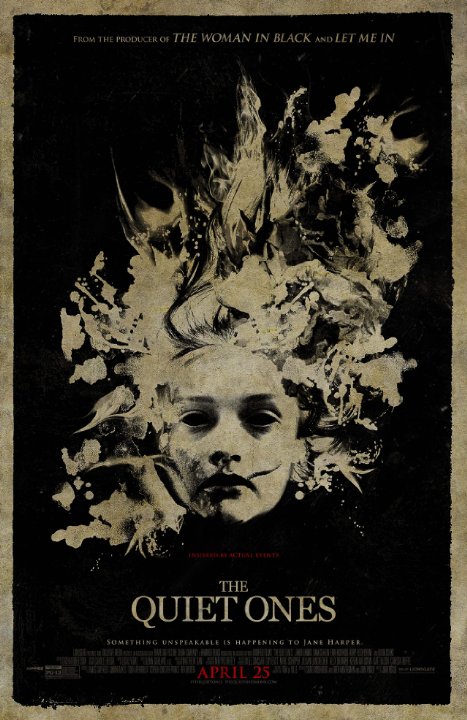
The Quiet Ones (2014) is another installment of the Hammer Film Productions revival, coming two years after the generally well-received The Woman in Black (2012). The earlier film dripped with superb sets and exquisite costume designs but was too reliant on jump scares, including those damned fake ones, to be anything truly remarkable for me. What could have been a new tension-filled Gothic classic instead became an incessant assault of things flying at the screen to the point where tension was too often lost. Directed by John Pogue, The Quiet Ones falls into many of the same traps.

The story is set in 1974 where an Oxford professor and three young people set out to use science to help a young woman tormented by what she believes is a spirit. It is loosely based upon the actual 1972 parapsychological Philip experiment which was conducted in Toronto, Canada. Philip was the name of a fictionalized ghost that the researchers sought to manifest by the sheer will of the experiment’s participants, helped by traditional séance conditions. Perhaps not surprisingly, the experiment was considered a failure by critics.

The film is largely seen through the eyes of the working-class local hired to film the girl’s treatments, and so the film continually transitions from traditional narrative to his docu-style footage. Once again, the sets are nicely done and at times the cinematography and lighting is very appealing. Additionally, the acting is good, particularly by Olivia Cooke, who plays the tortured girl. She’s able to transition from menacing to a sweet vulnerability in a convincing manner.

When the film is restrained it excels, but too often it seems to seek to meet a jump scare quota every three minutes. This is often achieved by ratcheting up the volume to an absurd decibel which stops being scary and quickly becomes annoying, making the movie’s title an irritatingly ironic misnomer. Plus, the film’s promising first two acts are squandered on a disappointing ending that is not really worthy of what came before.

I wish that these Hammer films, which show so much potential, would also show more confidence in their craft and allow the audience, meaning us, to immerse ourselves in the film. Instead they keep us at a distance by throwing things in our faces or battering our eardrums. By doing continuous jump scares, whatever tension that was built is immediately lost. Sure, the person watching the movie involuntarily jumped, but a second later they’re laughing and not at all scared.

A jump scare should be earned and it should be a part of the danger, such as in the way James Wan employs them in Insidious (2010). That film has plenty of jump scares but they are always something worth getting scared about. They increase the sense of danger because they are dangerous – they’re not cats or birds or idiot friends bumbling unexpectedly into the camera shot. Anything else is the stuff of amateurs or charlatans, in my opinion, with very few exceptions. It shows a filmmaker who is not confident that they have their audience, or one who is strictly making a film for teens looking for an assault on their senses. Either way, I’d like to see Hammer Film Productions do better, because they keep hinting that they have it in them to do so.

Grade: C

Movie Review – Sharknado 2: The Second One (2014)

Movie Review – Sharknado 2: The Second One (2014)

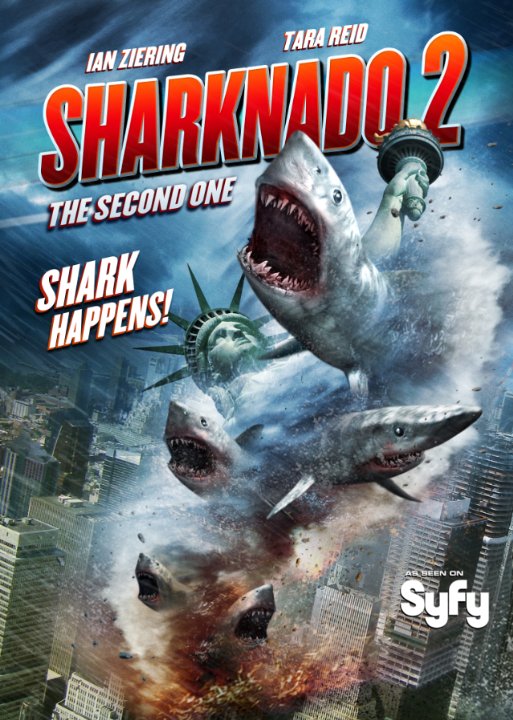
Sharknado 2: The Second One (2014) is another intentionally campy made-for-television movie and is the second installment in the Sharknado series. In sitting down to watch this I hoped that the second time around for director Anthony C. Ferrante would reveal that he has learned some new tricks in keeping the movie interesting and solving the slower, duller moments of the previous entry. Overall, he has, but Sharknado 2 is only slightly more watchable than its predecessor.

The kills are actually less numerous, but this time around the script writers give us things to watch in between, like E-list celebrity cameos (Wil Wheaton and Biz Markie) and horror homages that include the Twilight Zone and, of course, Jaws (1975). It’s still intentionally bad filmmaking and the gag always threatens to wear too thin, but it does a better job at ratcheting the absurdity to comedic levels.

Sharknado 2 still isn’t something I’d recommend, but for anyone who’s curious I’d say watch this one rather than the first one.

Grade: D

Movie Review – Sharknado (2013)

Movie Review – Sharknado (2013)

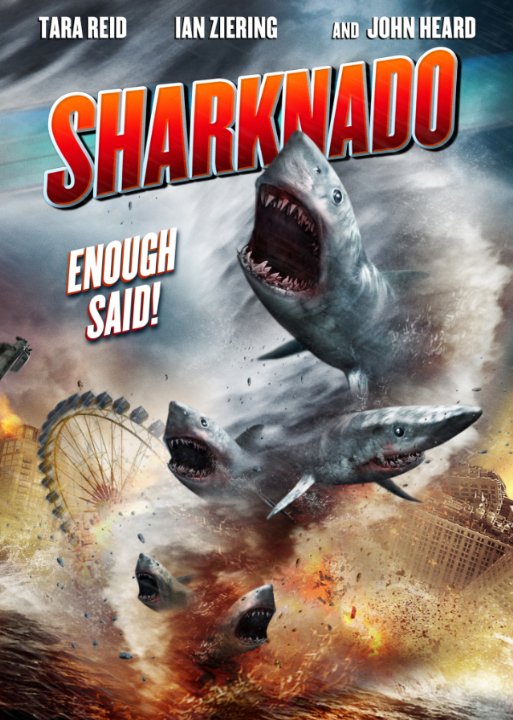
Should one critique a film that’s bad on purpose? If so, how? I guess the real measure is whether the film is bad while still being entertaining. Sharknado (2013), a made-for-television entry directed by Anthony C. Ferrante, is certainly bad, and at times it’s entertaining. However, it’s a joke that gets old quick. Some of the kills are funny, but in between we have to spend time with lame characters and dumb filler scenarios that didn’t hold my attention. This isn’t a film I was able to sit down and watch through one sitting. I had it playing over three evenings while doing chores in the kitchen. I’d chuckle here and there, and then my eyes would glaze over and I’d have to turn it off.

What the film lacks that would have made it more enjoyable is characters and actors I actually don’t mind spending time with. Instead we get Tara Reid.

And what about the sharks? Meh. When I hear “sharknado” I picture a swirling vortex of blood and teeth that’s sucking in bodies and spitting out bones. Instead we get a tornado with sharks flying around and occasionally landing on people and eating them. Yeah, that’s funny, but not enough to fill up 90 minutes.

I’m glad I live in a world in which Sharknado exists, as I do love campy, bad horror films. But the best bad movies are the ones that were made with good intentions that for whatever reason failed miserably, and Sharknado never had those good intentions.

If you haven’t seen it and plan to watch it, and I entirely sympathize if you don’t, make sure you’ve got a large, loud group that can talk during the dull parts and laugh when the guy on the basketball court gets his arm ripped off by a falling shark, then gets his leg eaten, then has a hammerhead fall on his face.

Am I a snob for criticizing an intentionally bad film for not being better? Bottom line: give me a terrible horror film any day, just don’t bore me.

Grade: D-

Movie Review – Joy Ride (2001)

Movie Review – Joy Ride (2001)

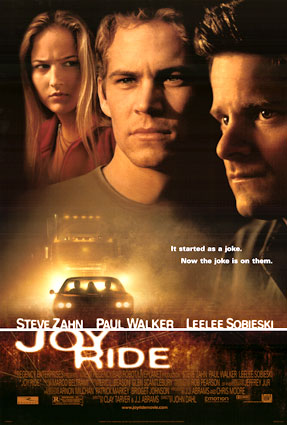
When I first rented 2001’s Joy Ride years ago, back when video rental stores were still a thing, I did not expect much from it. Despite the mantra to not judge a book by its cover, we all do it, and the same goes for DVD covers. This one was bland and the synopsis offered nothing to distinguish it from the plethora of other terrible B-movie thrillers that have always abounded, but especially so in the 90s. I was surprised, then, at just how enjoyable and well done Joy Ride, directed by John Dahl, actually is. I have seen it several times since then, and with each viewing I grow to appreciate it more.

In an intelligent script, written by J.J. Abrams and Clay Tarver, two brothers on a cross-country road trip to pick up a girl have a moment of lapsed moral conscience and use a CB radio to play a cruel prank on a randy truck driver. However, their plan goes awry when it turns out the trucker is an unhinged maniac who does not like to be shamed, and who has a dedicated sense of vengeance. The unseen villain is clever and genuinely menacing, and is expertly voiced by an uncredited Ted Levine, whose voice still brings back flashes of Jame “Buffalo Bill” Gumb. The plot closely resembles and pays homage to Steven Spielberg’s first directed TV film, Duel (1971), but is certainly not a remake. Surely, there are some genre tropes, but they’re done so well you don’t mind.

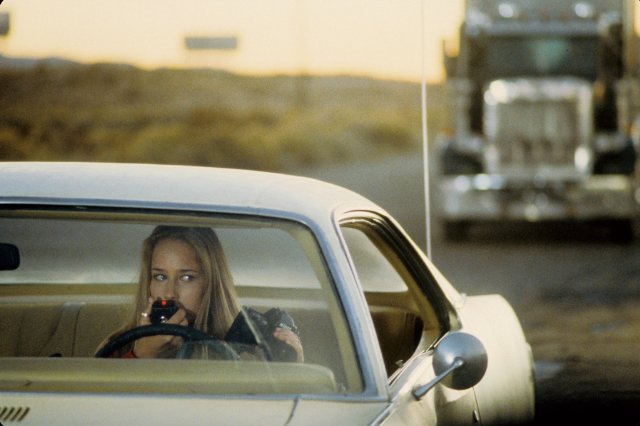
Leelee Sobieski in Joy Ride.

What really shine in the movie, however, are the performances of the three protagonists, who carry the dialogue and tension of the scenes well. Especially noteworthy is Steve Zahn, who allows the film some comic relief and provides a nice balance to the late Paul Walker’s straight-laced character.

Joy Ride is not a classic, and the premise only allows for the plot to go so far. Nevertheless, it is a thoroughly entertaining thriller.

Grade: B-

Movie Review – The Happening (2008)

Movie Review – The Happening (2008)

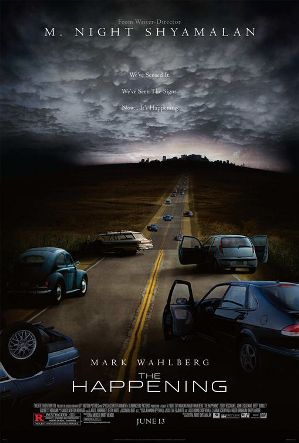
2008’s The Happening, M. Night Shyamalan’s fifth film after his critically acclaimed The Sixth Sense (1999), opens with scenes of beautiful brutality. A woman on a park bench near Central Park looks off camera and says that she sees people clawing at themselves. Her friend then takes a silvery hair-pin and jabs into her own neck. Meanwhile at a construction site the camera pans to see workers falling violently and voluntarily to their death, smacking and crunching on the pavement. Considering what is later found to be the film’s subtext, these suicides could be seen as a metaphor for mankind’s actions toward the environment, effectively sealing its own doom. However, it may more accurately describe M. Night Shyamalan’s career.

What follows these memorable first scenes is a steady decline in quality, logic, and continuity. The film’s first and most evident weakness is that it is badly miscast, made obvious by Mark Wahlberg’s first scenes as a high school science teacher named Elliot. Shyamalan apparently wrote the lead role with the actor in mind, but Wahlberg, while a capable actor in certain scenarios, was not made for this. His delivery is almost comical, and at many times in the film you question whether or not it is all supposed to be intentionally campy. He speaks with a high, light voice, almost a loud whisper, and never diverges from this tone no matter the situation. One scene in particular, towards the end of the movie, involves an old, disturbed woman accusing his character of plotting to kill her (played by a genuinely creepy Betty Buckley in one of the film’s few good performances). I cannot adequately portray the hilarity of how Wahlberg’s answer, “What?! … No!” is delivered, but I will say that if he had then added, “Gee whiz, ma’am, that would be bonkers!” it would have been fitting.

Mark Wahlberg adds physical presence to a role that does not call for it. He is not the only actor miscast, as Zooey Deschanel, who plays Elliot’s wife, Alma, wanders throughout the film doe-eyed and dazed. She seems as confused about her character as we are about the director’s decisions. Shyamalan can without a doubt frame a beautiful shot, but his constant use of close-ups demands actors who can convey subtle emotions. John Leguizamo, as Elliot’s friend, whose performances are often criticized by viewers, is the only other convincing player and is sadly underused.

The Happening also suffers from continuity issues. Remember that description of people clawing at themselves? We never see it. Instead, those affected by the phenomena become confused and then calmly commit suicide.

At one point the characters are riding a train that stops in the middle of nowhere. When Elliot asks what’s happened, the conductor tells him they have lost contact, and when he asks with whom, the conductor answers, “Everyone.” Color me confused, then, when a few moments later the characters are in a diner where people are using cell phones and watching news broadcasts – is Amtrak communication technology really that inept? This diner scene also demonstrates just how incoherent and badly constructed this film is when a woman announces she has received a video from her daughter on her phone. The video shows a man in a zoo being mauled by tigers in the most unrealistic and unnatural manner reminiscent of a Monty Python sketch, and again I wonder if I have been tricked into watching a comedy. Other frustrations abound: twice the movie shows us people who are unaffected by the “happening” with no explanation or acknowledgment. Also, the ending, which I will not give away, is so cheery and unbelievable that it is almost nauseating – just pay attention to the passage of time to realize why and be prepared to feel like your intelligence has been viciously assaulted.

The film, no matter how well-acted it could have been, could still not be saved due to its atrocious script. The dialogue is unnatural and the film’s pacing is awkward. The very premise, too, becomes more ridiculous the more one thinks about it. In a terribly convenient scene where a greenhouse owner solves the mystery halfway through the film, we find that the plants are releasing a neurotoxin which changes people’s self-defense instinct into a self-destruct one, and each time the wind blows it gets carried. So Shyamalan seeks throughout the film to make us afraid of wind. It should come as no shock that he does not succeed. For better eco-horror with nature fighting back, stick with Alfred Hitchcock’s brilliant The Birds (1963) or the slew of “big creatures attack” films from the 1950s, which even with their camp factor are more entertaining.

The Happening calls back to the paranoia films of earlier decades and makes one wish they rewatched them instead, or at least had an MST3K soundtrack to turn to. Shyamalan has made some great films in the past, but as for this movie… well, to take inspiration from This Is Spinal Tap (1984), shit happens.

Grade: D-

Movie Review – The Uninvited (2009)

Movie Review – The Uninvited [A Tale of Two Sisters remake] (2009)

I was thoroughly impressed with Kim Ji-woon’s 2003 horror film, A Tale of Two Sisters, known in South Korea as Jangwa, Hongryeon. It was an effective psychological thriller that weaved the supernatural and natural in unexpected ways, creating an almost suffocating, dreamlike world. As with most PG-13 American remakes, I expected 2009’s The Uninvited, directed by the British-born Guard Brothers, to butcher the strengths from the original story and delude them with tired Hollywood jump scares and clichés. Despite my low expectations, or perhaps due to them, The Uninvited is actually a well-done horror targeted to teens that is, on most levels, a superior entry when compared to the horror films generally offered to that demographic. It tells of a girl named Anna, played by Emily Browning, who returns home from a mental hospital and tries to hold onto her sanity as she comes up against her new stepmother and a possible haunting.

The script does indeed stray from its source material – the characters are quite different and the plot plays out more like a simplified mystery/thriller, and it does not demand the attention or intelligence that its predecessor did. Certain elements have been added that allow a few more surprises, and the twist plays out in a way different enough to warrant a viewing by fans of Two Sisters. One scene which stands out features a broken back, and the effects and lighting make for an effectively intense scenario.

The real strength in this film, however, lies in the performance of Elizabeth Banks. Admittedly, when she was cast in the stepmother’s role I was skeptical, but her acting goes against type and perfectly treads the fine line between sinister and sincere in a role that demands the delicate balance of ambiguity. Likewise, Emily Browning pulls off the lead role without difficulty and Arielle Kebbel, who plays the other sister, steals several scenes. Pulling the whole film together is a haunting musical score that adds an atmosphere of whimsical sorrow.

With all these strengths going for it, the truth of the matter is that there is not much new here to offer the genre, and it rather succeeds more in not screwing things up. What it excels at, however, is being a stepping stone for teens into the world of horror that genre fans won’t have to cringe at, and in that respect it is most welcome. It is not a great film, but it is an adequate one, and considering its peers, that definitely counts for something.

Grade: C

Movie Review – Orphan (2009)

Movie Review – Orphan (2009)

I really expected to dislike Orphan (2009), directed by Jaume Collet-Serra, though he had previously helmed the underrated House of Wax (2005) remake. What appeared from trailers like a rip-off of The Bad Seed (1956) and The Omen (1976), trying to profit from yet another “creepy kid” story, offered little to whet my appetite. It tells the story of a couple who adopt a little girl who, of course, turns out to be a psycho. I was pleasantly surprised to find, then, that Orphan too turns out to be much more than I had anticipated.

The film’s biggest asset is the convincing performance of its lead child star, Isabella Fuhrman, who plays the cunning and murderous Esther. This talented young actress carries the film and really does exude wisdom and understanding beyond her years, and creates a worthy counterbalance to Vera Farmiga in her role as Kate, Esther’s adoptive but suspicious mother. The rest of the roles are also well-cast, particularly the adorable Aryana Engineer, who plays the deaf and mute Max, the couple’s youngest daughter.

Orphan’s script has many strong elements within it. The film opens with a dream sequence that plays on its illogical nature through set changes and by having Peter Sarsgaard play both the doctor and the husband simultaneously as Kate is in labor. In the title credits the letters change from traditional print to chaotic, black-lit smears, in a way which ties nicely into the story later on. Also, the relationship between Esther and Max is very believable, and the use of sign language is implemented throughout the plot to great effect.

When scenes take a turn for the macabre they do so with a vengeance. Kids are not always scary in horror films, even when they’re supposed to be, for it is difficult to imagine a kid being able to accomplish too many grisly tasks before being stopped by a well-placed kick to the head. However, it is Esther’s cunning which is her greatest strength. She is smarter than those around her, expertly manipulating people and situations to her advantage – and the best part is that her plans sometimes go awry and she must think quickly to resolve new threats.

However, despite all these strengths, the film is not without weaknesses. For every great scene, and there are many of these, there is an awful one, or at least enough which are so mediocre and clichéd as to bring down the intensity of the film. How many times are we to watch someone close a medicine cabinet only to find someone standing next to them in the mirror’s reflection, providing yet another tired and ineffective jump scare? We even get the cue music to let us know we were supposed to be scared just then, in case we missed it. This happens, mind you, in the beginning before anything remotely creepy has happened. Likewise, when one of Esther’s bullies sees that she is no longer on a swing she suddenly feels threatened and creeps through a playground structure cautiously. The audience knows that Esther is dangerous, but there is no reason for this character to believe so. The tension of the film gets comically cranked to eleven as we see quick shots of kids on monkey bars, and a boy coming down a slide is used as yet another jump scare, and the whole scene comes off as fairly ridiculous. I claim no deep knowledge of filmmaking, but as a viewer these tactics signal that the director lacks the confidence that he has effectively captured his audience. Other scenes, and especially the final one, tumble into ever more Hollywood clichés, and this is unfortunately after a very creepy, effective twist.

I can’t help but imagine what a masterpiece this could have been if characters and their personal demons had trumped the Hollywood ending and fake scares. Orphan is a movie worth seeing and deserving of respect, but in the end it is a missed opportunity.

Grade: C+

Create a free website or blog at WordPress.com.

Up ↑