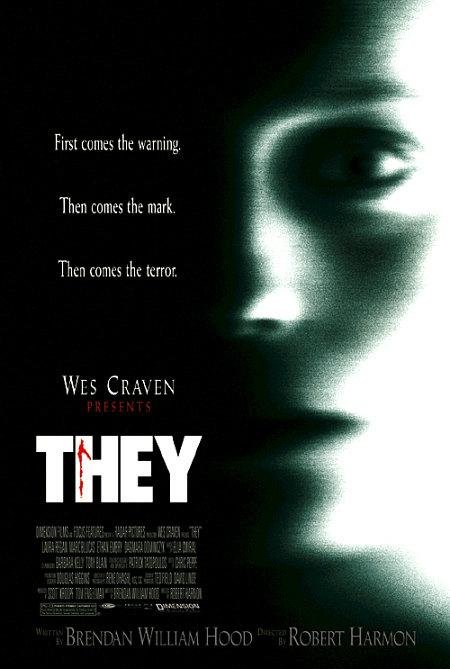
Julia, a psychology grad student, meets a childhood friend, Billy, at a diner late at night who, after babbling about “they” and the night terrors they shared as children, unexpectedly shoots himself. At the funeral Julia meets two of Billy’s other friends who also had night terrors, and they begin to suspect that what terrorized them as children might be real and is returning to get them now. This is actually a great premise for a film, exploring childhood fears and what could lurk in the dark places. Unfortunately, They (2002), directed by The Hitcher’s (1986) Robert Harmon, never rises above mediocrity, despite providing a few jump scares and an atmospheric setting. It is a ready-for-cable, PG-13 horror movie that never really tries to break from the formula and trappings that so often plague movies of that rating.
They does well at creating tension-filled scenes without relying on sex and gore to keep our attention, and the CGI creatures are actually quite good, but the thinly-written characters and plot ensure that we care nothing for the fate of the victims. Julia is played by a capable Laura Regan whose performance nevertheless lacks the depth needed to empathize with the audience. Other characters do little except provide for a predictable body count. Indeed most of the scares, though some being effective, are of the clichéd variety. Nevertheless, rare moments of genuine creepiness, such as the face of a little girl paused on a television screen, rarely shine through.
The script is credited to Brandon Hood, but is actually the result of numerous rewrites by many authors, and it shows as it is, overall, uninterested in providing explanations for what is going on, and may explain the presence of so many plot points that go nowhere. Truly, the story continually forgoes following interesting plot-lines in preference for hitting the tired old horror steps. For instance, rolling blackouts are mentioned many times throughout the film, but they are never used within the script. The fact that the creatures can affect light makes the mention entirely pointless. Additionally, the characters make absurd decisions which ensure they put themselves in harm’s way even when they know danger is lurking. This is most illustrative when Julia abandons the security of her boyfriend’s well-lit apartment for a deserted subway at two in the morning, knowing full-well that the creatures coming to get her move in darkness. It is difficult to care for such a profoundly stupid character.
Similarly, Julia being a psychology student is significant in alluding to the possibility that the events she is witnessing are merely playing out in her mind, and that her sanity is in question. This aspect is explored more fully in an alternate ending which is ultimately more interesting and helps to fix some of the narrative shortcomings of the rest of the film.
They is a film that might have been promising, but is ultimately forgettable.
John Carpenter’s Prince of Darkness (1987) is an interesting amalgam of classic horror films, offering us some of their best aspects while also giving viewers a fresh take on the “demonic” story. Horror fans will quickly recognize the overall plot here: a group of people are trapped in a building while malevolent entities try to destroy them from without and within. The group at hand is a research team made up of scientists, a priest, and a theologian. A mysterious, liquefied evil is infecting people, turning them into violent zombie-like soldiers controlled by a malevolent will and who in turn are empowered to infect others. From these elements one can see the influences of the genre’s classics, including The Haunting (1963), Night of the Living Dead (1968),The Legend of Hell House (1973), and even Carpenter’s own earlier masterpiece, The Thing (1982). In fact, this film is the second installment of what Carpenter refers to as his “Apocalypse Trilogy,” which begins with The Thing and ends with In the Mouth of Madness (1994). I have always been a sucker for ensemble horror, and this is no exception. And rather than be distracted by these similarities, they instead pay homage in endearing ways.
The script is smart as it interweaves quantum theory, religious philosophy, and a healthy smattering of pseudoscience in a way that is believable and compelling. The result is not your average tale of good versus evil, or even God versus Satan, but rather a dystheistic scenario in which man is confronted and endangered by the forces of the universe. It takes what man understands of reality and spirituality and turns it upon its head, calling into question the nature of evil and God’s role in the world. There are some genuine scares in the movie and Carpenter builds the tension well, adding some shocking, unsettling imagery. The cast, too, is compiled of capable actors, though there are no stand-out performances.
Unfortunately, the film is sometimes clunky and has begun to show its age. Its pacing, for instance, is unnecessarily slow to start. Carpenter shows some good direction by establishing some character relations, but in the end those relations do not matter much or contribute to any real emotional impact. Despite these relatively minor flaws, however, Prince of Darkness is a horror film with a truly interesting premise. Besides, it’s got a cameo of Alice Cooper as a possessed homeless “schizo,” so what more could you ask for?
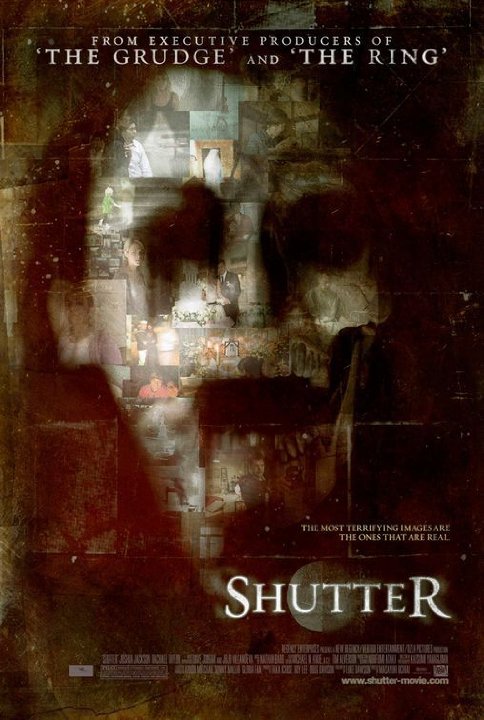
Shutter (2008) is yet another Americanized remake of a well-received, ghost-in-the-machine Asian horror film. It is not the worst by a long shot, and that’s the extent to which it can boast. I have not seen the original Thai film on which it is based, and therefore cannot tell which story elements can be credited to its predecessor, but Shutter is a movie with some intriguing plot qualities that unfortunately become buried in a timid approach with mediocre scares.
Directed by Masayuki Ochiai, the plot tells of a newlywed American couple who move to Japan so the husband, played by Joshua Jackson, can resume his work as a photographer. While driving they hit a woman in the street who mysteriously disappears, and thereafter they begin to see apparitions in photos and a ghostly presence which malevolently stalks them and kills their friends. The setting of the film is an attempt to recreate the success of 2004’s The Grudge in establishing the foreboding atmosphere of an outsider in a foreign land, but this effect is nullified when nearly every “Japanese” character with extensive English dialogue speaks with a perfect American accent.
The characters are never deeply developed in the film and the overly pretty actors are used more as models to showcase fashion. We care absolutely nothing for their fate, and therefore there is no tension. This is particularly true for the couple’s friends who are killed shortly after we meet them in quick succession in ways that are both laughable (a spirit-bullet-of-sorts through the eye) and/or boring. Unfortunately, the film’s approach to the now familiar techniques of Asian horror that were used with such gusto in the past is so tame that they’re stale.
I have to wonder, too, if there is more to the script than made it to the screen, for some elements are unclear. For instance, is their friend Bruno in his underwear because he’s too distraught to dress, or because of some sexual implication? Such ambiguity and reliance on suggestion are important for a film like this, the target audience of which is teens, to maintain a PG-13 rating, but too often these suggestions seem muddled or are missed entirely. This is also glaringly obvious when the couple hits the girl with their car on a rainy night, and the scene fades to black. When it fades back it is snowing, and when they get out of the car a moment later the snow has stopped falling and there is a thick layer of it on the ground. I have to assume that they both were knocked unconscious, though this is unlikely and the actors don’t indicate it, and it instead comes across as a mistake in editing continuity, which it still may very well be. Other elements of the script itself are unintentionally laughable, such as the way in which the “spirit photography” angle is worked into the script in an absurdly convenient way.
There is an interesting twist to the film’s ending and I will give the movie credit for not trying to rely exclusively on fake jump-scares, which is rare in a teen-targeted horror, but the air of dread it tries to muster is ultimately tired and ineffective.
Movie Review – The Woman in Black 2: Angel of Death (2014)
The Woman in Black 2: Angel of Death (2014) is a sequel to 2012’s The Woman in Black and the first Hammer Film Productions sequel since 1974’s Frankenstein and the Monster from Hell. Directed by Tom Harper and written by Jon Croker, the plot is adapted from a story written by Susan Hill, author of the original The Woman in Black novel. In it we follow Eve Parkins in WWII, played by Phoebe Fox, who as deputy headmistress is charged with escorting and caring for London orphans whose homes were destroyed during the Nazi blitz. With housing scarce and the attack of bombers ever-present, the government commandeers the abandoned Eel Marsh mansion as a makeshift orphanage, unknowing that the place is inhabited by a malevolent entity that targets children.
In my review of Hammer’s previous offering, 2014’s The Quiet Ones, I praised the detail of the period set designs while condemning its over-reliance on fake jump scares. With Angel of Death, Hammer moves further into both territories. The period setting of the film is beautiful, brought to life by crisp cinematography, nice costumes, and impressive set design. However, sometimes scenes are so dark and murky that making anything out, scary or mundane, was an unnecessary chore. The war is incorporated in interesting ways, especially in regard to the character of Harry Burnstow, played by Jeremy Irvine. Performances are generally strong, with Helen McCrory as Headmistress Jean Hogg being the notable example.
There are a few genuinely creepy moments in Angel of Death, but they’re diluted by a constant assault of irritating false scares. Remember the last time you were watching a beautiful scene and someone needlessly jumped out and scared the crap out of you? Remember how much fun that was for you? Me neither. Jump scares are fine in horror films when they are something we should be genuinely afraid of – after all, the thrill of being scared is partly why we watch them. But here we get a crow flying in front of a window, Parkins tripping over bells, people popping up quickly for no damn reason constantly, each time with the sound blaring to announce their arrival, as though we could miss it. It distracts us from the story. It’s annoying. It’s insulting. It ruins a tension-filled experience as the heart is sent racing for the dozenth time for no purpose at all pertaining to the plot. Towards the end we get a few jump scares used right, but by this point the viewer’s good will and patience has been worn too thin.
Please Hammer, don’t squander that good will. I love your sets and your attention to period piece horror. Your camerawork is beautiful and the stories have been promising. But lay off the damn fake jump scares; it’s beneath you. It makes the kind of movie that nongenre critics would be genuinely surprised by into exactly the sort of movie they lay hate upon the genre for, and in cases like this I can’t blame them.
John Carpenter’s The Fog (1980) is considered a minor horror classic, though an imperfect one. Among Carpenter’s impressive early outings it is, by his own admission, the one with the largest possibility for improvement. It’s a thoroughly enjoyable film, not so much for its effects, and it’s not a very scary film, but the story that it tells of a leper colony being betrayed by the founders of a quiet island town that returns after one hundred years in a thick fog to exact revenge upon the descendants, is a fantastic backdrop to a ghost story. If any horror movie could be improved with modern technology, with the potential to be greater than the original, it is this one.
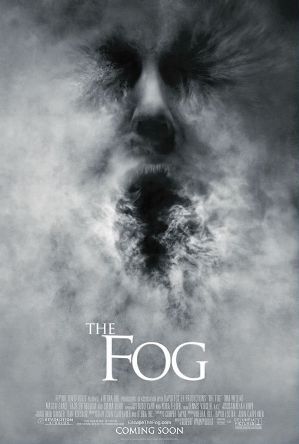
What a profound disappointment, then, is the lifeless, boring remake that is 2005’s The Fog, directed by Rupert Wainwright. Wainwright had directed 1999’s Stigmata which, although not a great film, showed more promise than this offering. Though the basic story remains the same, save for a few tweaks, all other elements have been dumbed down and tamed for the adolescent crowd. The film is a perfect example of the same manufactured, generic, formulaic celluloid that is continuously churned out of the Hollywood horror factory, complete with beautiful actors in their underwear ready for the teenage consumer market.
In addition to the audience’s target IQ, the film has also lowered the ages of its main protagonists, which works only to its detriment. Instead of the everyman Tom Atkins, who is easy to relate to and identify with, we get the handsome, jockish Tom Welling, who adds nothing to the film and who unfortunately has no screen chemistry with the female lead, played by Maggie Grace. The characters are paper thin and are made to fit their stereotyped roles, including the token black friend who exists only for comic relief. Other problems persist, such as that the film cannot seem to decide on the motive of the mist and the final scenes leave the viewer dumbfounded and feeling cheated.
I have very little interest in the fashion world, but I am aware that designers will create budget-friendly, off-the-rack clothing based upon their top-of-the-line, thousand-dollar pieces. Movies such as this remind me of those identical, ten-thousand-of-a-kind blouses. They are of a lesser quality and made for the maximum number of consumers possible, marketed as the latest thing when really it’s the same crap they sold you twenty years ago, maybe even twenty days ago. Most buyers know they are not paying for the best. Unfortunately, though, too many young people being introduced to horror will not know that this new version may have capable CGI and a hot blonde, but it is a poor, dollar-store quality film when compared even to its flawed original. It is New Coke. Please, if you must see one, stick with the recipe that worked the first time around.
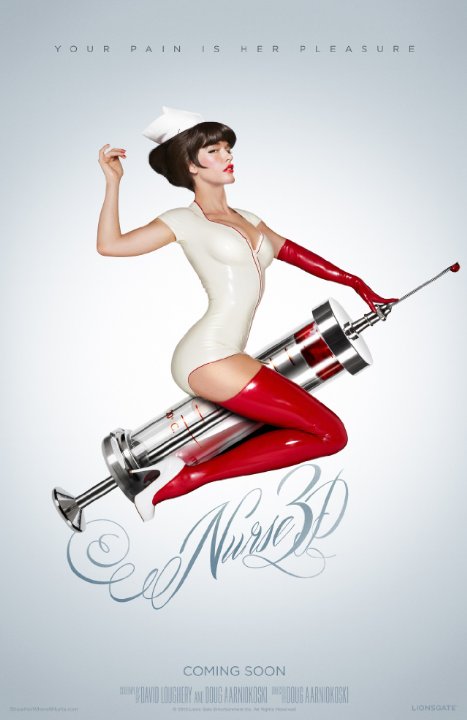
In July of 2015 actress and model Paz de la Huerta filed a lawsuit against the makers of Nurse3D (2013) for ruining her career. De la Huerta played the lead role of Abby, a nurse who kills unfaithful men until she forms an unhealthy obsession with a fellow nurse. When the nurse is unresponsive to her advances she sets out to ruin her life. De la Huerta claimed that she was injured on set, treated badly by the director, Douglas Aarniokoski, and that her career has suffered since.
Nurse 3D is not what anyone would call a good film, though it did meet with mild success. The script is rather rote and poorly conceived, borrowing elements of Single White Female (1992) and American Psycho (2000), yet the direction never seems to truly embrace the trashy B-movie nature of its premise and plot. It appears written as a parody but takes itself too seriously, and therefore it’s never as fun as it should be. Even the potentially good gore is ruined by excessive CGI blood sprays (or were those supposed to be funny? The confused tonal nature doesn’t help the viewer to decide).
The movie is marketed as an erotic thriller, but it’s hardly erotic. De la Huerta tries very hard to be sexy with pouting lips, swinging hips, and a constantly breathy voice, as well as being gratuitously nude much of the time, but these tricks never truly mask her monotone performance. She does a serviceable job, which is the most that can be said for the rest of the cast, but looks bored throughout much of the film. I can’t deny that I was too.
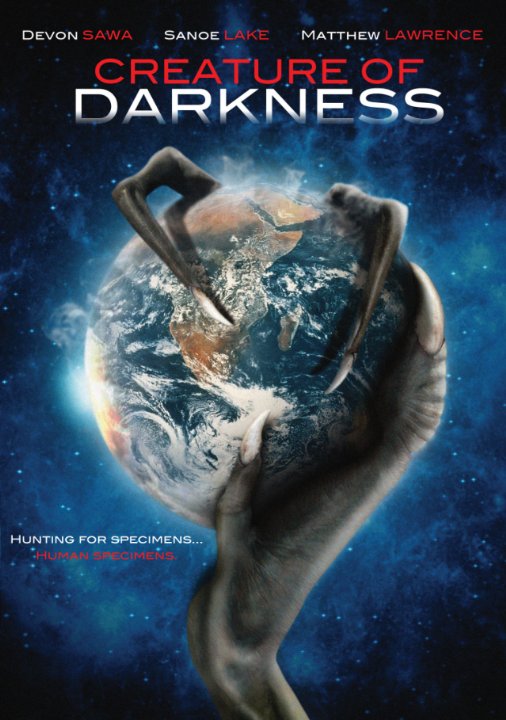
Horror is a genre that, when a film is done badly, can easily morph into comedy. Perhaps if I had watched Creature of Darkness (2009), directed by Mark Stouffer, with some buddies and a few judgment-impairing drinks it may have been funny, but viewing it alone and sober was nothing short of painful.
In it, we see a group of campers being slowly picked off by an alien known as The Catcher – and it makes me shudder to think just how wrong the direction of a masterpiece like Predator (1987) could have gone. Apparently, this cloaked and hooded creature has the ability to travel through time and across light-years in an advanced ship with the purpose of collecting human specimens for an intergalactic museum. However, its weapon technology is effectively limited to sticky spit and tripping tongues, some terrible CGI openings in the ground, and a hand-axe that it takes from the campers. There are some capable animatronics in the (overly used) close-ups of the monster, but the CGI is subpar even for the video-games of a decade ago.
The performances are confused and awkward (as I imagine the actors must have been and felt) and the long expositions are ridiculous, and I’m someone who has watched televangelists for laughs. The film is subpar even for SyFy originals. It would be one thing if this was all done intentionally for laughs, but there’s no reason to think this.
There are two 90s teen stars in the cast, being Matthew Lawrence and Devon Sawa, who many will remember from Final Destination (2000). As a bit of trivia, Sawa played this film’s director, Mark Stouffer, in the 1997 biopic Wild America, about the director’s childhood. Indeed, Stouffer is an award-winning nature film-maker. Unfortunately, that talent doesn’t cross genres here.
Movie Review – Scream (1996)/ Wes Craven In Memoriam
Yesterday, horror lost a legend. Wes Craven passed away at the age of 76 after a quiet battle with brain cancer. When I read the article heading last night while lying in bed, scrolling through my newsfeed, it hit me like a gut punch. Wes Craven’s career was certainly a varied one. For every hit there was a miss, but when he got things right he redefined the medium and made his colleagues up their game. The Last House on the Left (1972), though not a great film, is still a visceral experience and a post-Vietnam genre touchstone. A Nightmare on Elm Street (1984) is an undeniable classic, arguably giving modern culture its most iconic monster in Freddy Kruger. The dream-dwelling killer pierced every facet of pop culture. As a kid I had a plastic Freddy glove and rubber mask (and I now have a beer koozie bearing his scarred face). However, Craven’s strongest directorial effort was yet to come.
Wes Craven
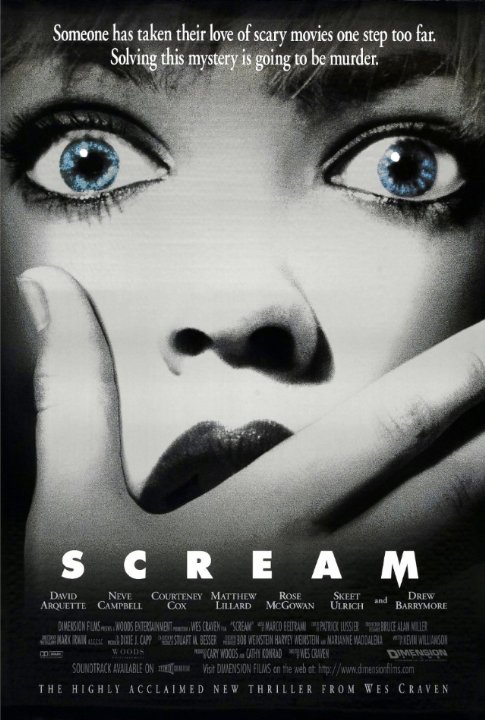
It was tough being a young horror fan in the early and mid-nineties. Most of the offerings were mediocre and formulaic save for a few gems like The Silence of the Lambs (1991), Candyman (1992), or Se7en (1995). Then 1996 came and a wave of imaginative horror flowed in, including From Dusk Till Dawn, The Frighteners and The Craft. Though all were strong entries, none had the impact on the genre, and certainly not on Hollywood’s hunger for profit, like Wes Craven’s Scream.
Note: While I will avoid outright spoilers, even a casual reading of the following paragraphs will likely suggest important plot points better experienced by a watching of the film.
I saw Scream when it was first released. Though it did not invent the self-referential “meta” subgenre, as we had prior entries like Gremlins 2: The New Batch (1990) and of course WesCraven’s New Nightmare (1994), it quickly became the subgenre’s standard. As a fifteen-year-old I had not seen many of the movies that Scream references. Though I loved horror movies, my knowledge of slashers was limited, so while I knew there were jokes and nods being made, I failed to appreciate many of them. My impression of the film was that it was decent, but I felt that its blockbuster status was overblown and unwarranted. The next two sequels were of diminishing quality and the dull teen slashers that the movie spawned as Hollywood hopped on the blood-red gravy train only reaffirmed and deepened my view that the movie was overrated.
Fourteen years later I’ve matured as both a general film viewer and as a horror fan. I’ve seen many more slashers, particularly the pioneering films of the late 1970s and early 1980s, and I’ve come to respect them much more than I did in the past. It’s still not my favorite subgenre, but they’ve grown on me. I felt it was time to go back to Scream and give it another chance.
Scream was penned by Kevin Williamson, who would later go on to create Dawson’s Creek, and was inspired by the real life Gainsville Ripper who killed five teenagers in Florida back in the late 1980s. Wes Craven, of course, was already a horror legend who had twice before revolutionized the genre and this film would once again be credited with the same, revitalizing horror marketability and giving us thus far the last true slasher icon in Ghostface, who unlike his predecessors was klutzy and seemed to get his victims more by perseverance than by skill or craft. Some give Scream too much credit in putting horror films back on track, when really it was the terrible events of 9/11 and the fears which followed that inspired the latest creative renaissance of movie horror. But Scream made money, and for Hollywood, that counts for everything.
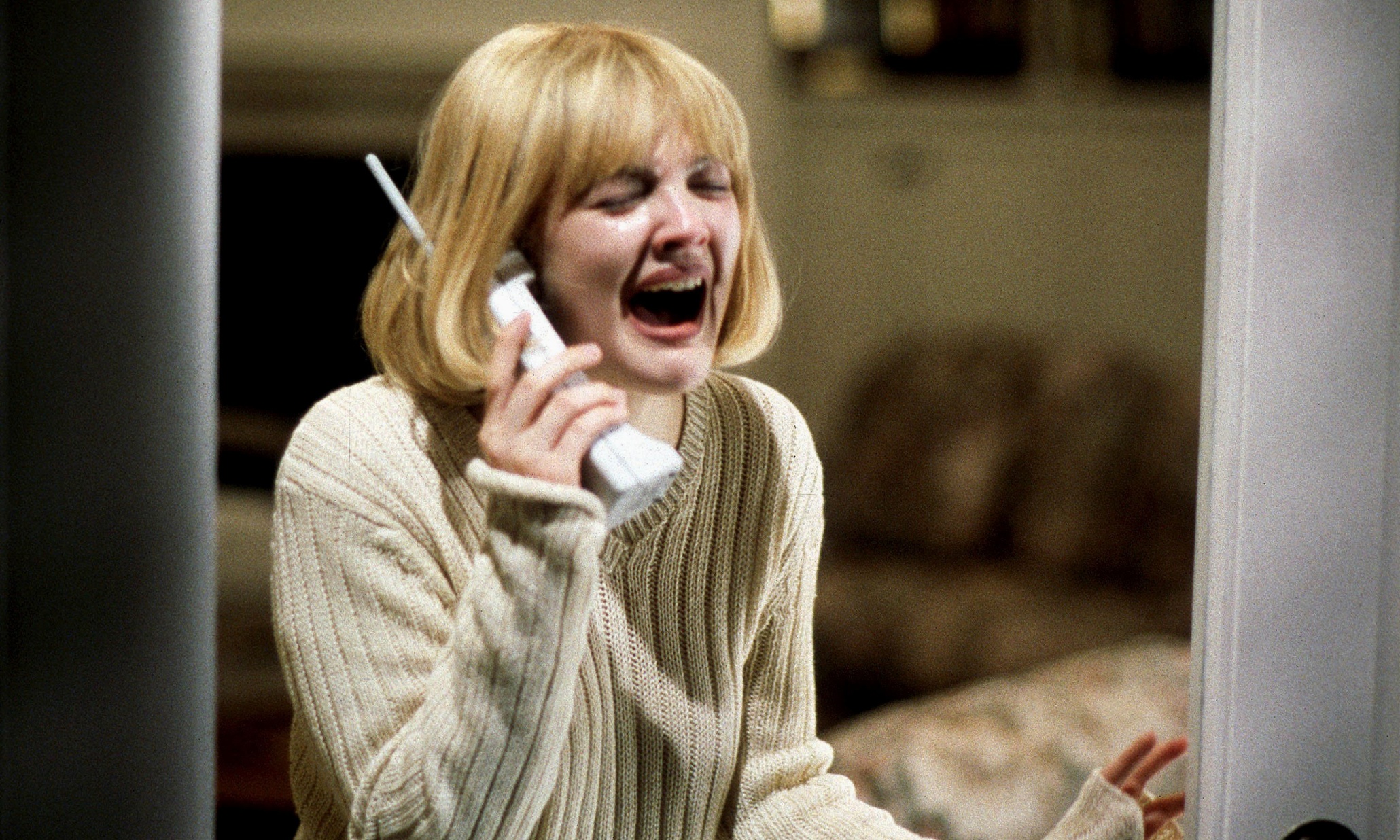
Drew Barrymore in Scream (1996)
The film pays homage to horror’s history in sometimes subtle, and sometimes obvious, ways. It opens with a move inspired by Hitchcock’s Psycho (1960), supposedly at Drew Barrymore’s suggestion, and then follows teen Sydney Prescott, played by Neve Campbell. We find her dealing with the repercussions of her mother’s murder and the prospect that she accidentally falsely accused a man now on death row. And now a serial killer who may be connected with her mother’s death is loose on the town. He’s harassing his next victims with phone calls and seemingly taking cues from slasher movies. Everyone around Sydney is the possible killer – her boyfriend Billy, his friend Stu, the film-geek Randy, the dorky Deputy Dewey, the tabloid reporter Gale Weathers, and even her own missing father.
The script is tight and witty and first time viewers are expertly enticed down forking trails of suspicion, constantly second-guessing themselves. As Randy explains of horror movies to Stu, “There’s a formula to it. A very simple formula. Everybody’s a suspect!” Wes Craven exploits that formula with his visuals. The twist at the end was ingenious for its time and one I recall not seeing coming when watching it in 1996. Watching a second time is still entertaining as comments and looks between characters take on different meanings. One can appreciate just how fine a line needed to be walked to keep the mystery alive and its success makes it highly rewatchable.
In Scream the teenage victims know they are in a horror film without breaking the fourth wall. They know the rules and either willfully obey or disregard them at their own peril. They deconstruct the film for the audience as it moves along in a manner that perfectly encapsulates late mid-nineties cynicism. Movies make up the characters’ language, relationships, and understanding of the world. As Sydney says to Billy, “But this is life. This isn’t a movie.” To which Billy responds, “Sure it is, Sid. It’s all, it’s all a movie. It’s all one great big movie. But you can’t pick your genre.” The movie acknowledges and eviscerates the previous decade of sub-par slashers that had been fed to fans. It works to twist our expectations and bring the subgenre to another level with smarter victims, both potential and actual. It serves as both a criticism of horror’s state and a celebration of its tropes. It fulfills this promise with Sydney, who as a final girl turns the tables and deals out punishment to those who would harm her with a hefty dose of their own medicine. She doesn’t merely survive – armed with her horror knowledge, she triumphs. Even with all its self-analysis Scream still manages to be an effective slasher in its own right.
The acting is relatively strong throughout, though sometimes overacting creeps in. This is the case with Matthew Lillard’s Stu, however, his performance in the last act becomes the movie’s highlight as he steals the scenes with a delivery that is both humorous and perfectly pathetic. Jamie Kennedy is memorable as Randy, and I can’t help but love the scene where he’s watching Halloween (1978) while Ghostface is behind him and he’s saying to the screen, as if to himself, “Jamie, turn around. Turn around, Jamie!”
Scream poignantly captures the youth of the era. The nineties were a time of teen angst, not derived from hardship, but from cynicism and boredom and a reaction to the frivolous popular culture of the 1980s. There were no wars in which to be swept up. Clinton was in power and our only oval office anxieties revolved around cigar placement. The internet bubble was expanding and the economy was strong. Yet grunge and industrial music were popular, music that was disillusioned with and questioning of society, which then gave way to bratty pop punk, the purposefully obnoxious style of which began to dominate airwaves. It was a period of transition as Gen X gave way to Gen Y. There was an arrogance and entitlement that emerged in the youth. Combined with anger, the villains of Scream embody this spirit entirely. They’ve got it all figured out, or so they think.
Obviously, I appreciated Scream far more this time around. It has aged surprisingly well. I recognized and understood more references, laughed at the cameos, and I found respect in Craven’s direction of the material. Truly, there are many, many allusions to, references to, and scenes inspired by horror film history. And it’s genuinely funny, but the laughs never come at the cost of the horror.
It’s not without its shortcomings, certainly. The film begins strong and ends strong, but the middle is a bit uneven. Also, Ghostface tends to pop up in odd locations without regard to logic, such as the girls’ restroom or a grocery store, and I’m uncertain if this is meant to be yet another jab at slasher tropes or simply the film failing to learn from its own lessons.
Regardless, Scream is filled with scenes, both gory and funny, that become emblazoned into the consciousness, such as Casey’s opening sequence, the blood-red windshield, or Stu’s “Ow! You fuckin’ hit me with the phone, dick!” (which was apparently just one of Lillard’s many adlibs that Craven found hilarious and kept in).
When I first began making a list of the horror films I’ve seen and grading them, I gave Scream a “C+” because I thought it was only slightly above average but, as I said before, ultimately overrated. Unlike many other nineties horror films that I originally disliked and have since revisited, I am now convinced that Scream’s exalted status is warranted. Unlike the previous fourteen years, the next fourteen will undoubtedly be filled with many, many rewatches.
Thank you for the nightmares, Mr. Craven. You will be missed.
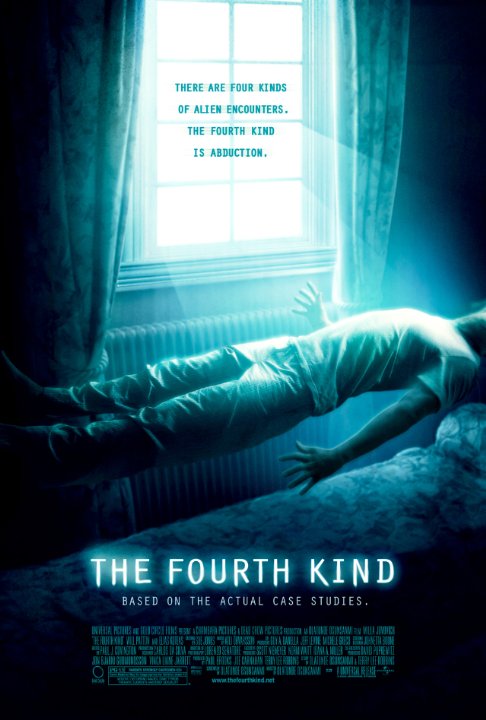
The Fourth Kind (2009) partly employs the successful found footage approach of The BlairWitch Project (1999) and Paranormal Activity (2009) to the largely neglected horror subgenre of alien abduction. Splicing supposed “actual footage” with Hollywood quality dramatizations, often in split screen, the film manages to create a unique and effective viewing experience that really allows the audience’s imagination to run wild.
Most of the genuine scares are relegated to the “archival” footage which the film claims was taken in 2000 (my reason for using quotations marks will be explained below). This includes the psychiatric therapy sessions conducted by the protagonist, Dr. Abigail Tyler, which eventually show disturbing body-bending levitations. Assumingly due to magnetic disruptions of some sort from the aliens, each time the footage begins to show the evidence of an abduction the video will distort and obscure the audience’s view, leaving only glimpses of what is transpiring accompanied by an unsettling audio. Those hoping to see advanced CGI or monstrous aliens will be disappointed, as the director wisely leaves the majority of the thrills up to the viewer’s imagination, understanding that what we envision in our minds is always more frightening than what he could show us.
The film opens with Milla Jovovich, who plays Dr. Abigail Tyler in the dramatizations, talking directly into the camera, telling us that the story we are about to see is based on actual (though conveniently unspecified) case studies and that what we ultimately believe is entirely our choice. This potentially sets the audience up to be more accepting of the scenes that follow – the possibility that what they are seeing is real likely increases the terror factor considerably. The strong performances by the cast help in pulling the audience in (although Jovovich, who I credit as a good actress, can be distractingly attractive).
Of course, this is all a Hollywood gimmick to make the experience more potent (and it’s admittedly more sophisticated and cheaper than William Castle’s vibrating seats), and all of the events are in actuality fictional. The “actual” Dr. Abigail Tyler who is seen in the interview session throughout the film with the director, Olatunde Osunsanmi, is in turn merely another talented, though lesser known, actress.
While I commend the film for taking this psychological approach, and executing its scares with a less-is-more attitude, the director unfortunately does not follow that same wisdom when it comes to selling his story as being based on actual events. He is too heavy-handed in beating it over the viewer’s head. Particularly in the end, which is understandably abrupt considering the movie’s nature, when we are told of an imaginary character still missing, given the current whereabouts of fake people, and then are still told to take the “evidence” into account and make up our own minds. There is a point at which a film asks us to suspend disbelief for entertainment purposes and a point in which it flatly begins to lie and mislead, and the line begins to be crossed in the last moments of the film, which I will not spoil here. It can lose people just when it really has them. Osunsanmi should have started the credits a minute earlier before he showed us too much.
The Fourth Kind is a creative film that works best when it centers on the fears of invasion and violation, where not even one’s locked home is a refuge. (There are also allusions in the film linking alien abductions to demonic possessions and religious experience – i.e. the intervention of a deity – which is an interesting idea that I wish they had explored further.) However, just when I think a director understands and trusts his audience enough to be confident that his scares will resonate, he instead relies too heavily on exhaustively selling the truthfulness of his fiction, and in turn distracts us from enjoying what could have been a more effective story.
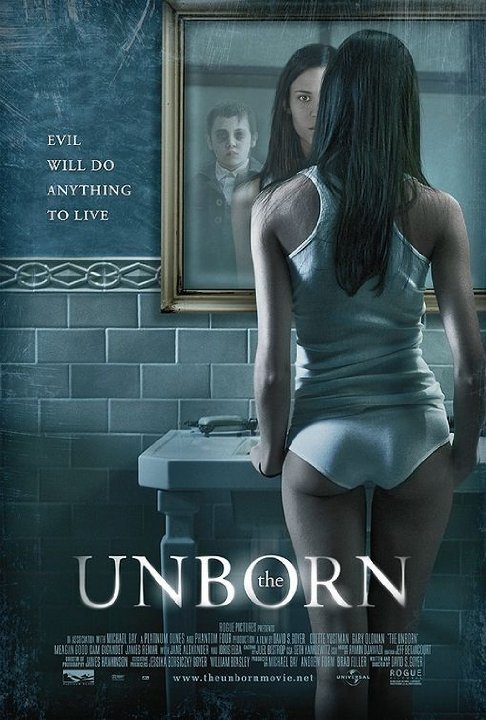
2009’s The Unborn brings with it many reasons to expect a satisfying horror film, just two being that it stars the incredible Gary Oldman and is written and directed by David Goyer, one of the writers of Christopher Nolan’s Batman Begins (2005) and The Dark Knight (2008). Unfortunately, these expectations only add to the disappointment. Goyer’s previous directing forays, The Invisible (2007) and Blade: Trinity (2004), might have foretold this, though I had hoped that after the Batman reboots he might have learned a few new tricks. He might have, but far too few.
This film had some promise. The cinematography is appropriately moody, some of the creature effects are impressive (if not entirely original), and the story, though deriving inspiration from Kabala mysticism, nobly attempts to not be confined by any one religion or creed.
However, in the end The Unborn is formulaic and forgettable. After a decent first third the movie loses steam and becomes dull and convoluted. It relies on tired clichés and ineffective jump-scares to irritating degrees. These tactics have been rehashed countless times that even casual horror fans are completely desensitized to it. Rather than make the audience jump it instead clues us into the fact that what we are about to watch is stale and unimaginative. When this is done over and over early on in a film, before we even know the characters or what we’re supposed to be afraid of, it becomes infuriating. Sadly for The Unborn, the characters are so thin and clichéd that we never fear for their well-being or care for their fate – tension and true horror is therefore lost. It does not help that the acting is also poor, including the uneven performance by Odette Yustman, who plays the lead, Casey, a role that has her posing between scares in her underwear just to keep our attention.
The plot follows Casey as she begins to be haunted by a ghost child who repeatedly tells her, “Jumby wants to be born now.” Casey begins having a pigmentation change in her eye, leading her to discover that she was a twin and that her brother (said Jumby) died in utero from her umbilical cord. We assume that the ghost child is Jumby until we meet Casey’s long lost grandmother, an Auschwitz survivor, who tells her it is a dybbuk, an evil spirit wanting to inhabit this world. Actually, the grandmother seems to be living across town in a nursing home, though for unexplained reasons nobody, even her father, seemed to tell Casey. The grandmother explains that her own twin brother was possessed by the dybbuk, perhaps after the experiments of Dr. Josef Mengele (though he is not named), in the concentration camp before she had to kill him. It’s telling in a supposed horror film when not even Auschwitz looks scary. The dybbuk has been haunting the family ever since, even driving Casey’s mother to suicide.
So just forget about all that Jumby stuff, I guess. As the story progresses, it becomes ever more of a struggle to buy into it, and makes me think that Goyer started off with a good idea but ran into a wall when he needed closure. Not even Gary Oldman as an exorcist rabbi can elevate this movie. There are so many clichés and borrowed elements that it is difficult to know when Goyer is paying homage to the genre’s alumni or plagiarizing them. With so much missed potential, The Unborn lives up to its name.
Earlier this year a 58-year-old substitute teacher in Ohio was convicted on four felony accounts for disseminating matter harmful to juveniles. She played The ABCs of Death (2012) for five consecutive Spanish classes. It’s reasonable she began playing it the first period not knowing its contents, but to continue playing it and then showing it again and again? Apparently, when an administrator got wind of it and walked in during the last period she reached for the button to stop it and inadvertently paused the screen on a pair of bare breasts. I’m sure the students’ laughter was deafening.
This story is probably the best publicity imaginable for this type of film. After having now seen it myself, I can’t help but sympathize with the court.
The horror films I watch can generally be split into two categories: those that I watch with my wife, and those that I don’t. The reasons for the latter are normally as follows:
1. I think it might suck and I don’t want to over-saturate her with genre crap and ruin her good will.
2. It may contain a level of misogyny best not watched with the woman with whom I share a bed.
3. She’s not a fan of graphic torture or violence – The Texas Chainsaw Massacre (2003) remake was a theater experience the memory of which still makes her shudder.
The ABCs of Death, at one point or another, fulfills all of the above criteria. At its core it’s a simple but clever idea for an anthology horror film. They gave $5,000 and a letter of the alphabet to 26 different filmmakers from around the world, and those filmmakers created a short film based upon a word they chose which corresponded to their letter. The word isn’t revealed until after the film, leaving the viewer guessing as they watch.
As is to be expected with this type of project, the quality of filmmaking varies. There are some which I’m convinced the filmmaker must have $4,990 still in their bank account. Some are of a very hardcore nature, featuring disturbing subject matter and graphic representations. Some are art-house. Some are hilarious and clever. More than a few are about poop. Some are thought provoking and intense. While I strongly recommend some of these films, a sensitive viewer may want their finger primed on the fast-forward button.
Bottom line: understand what you’re getting into and, by the wisdom of Odin, do not watch this with anyone you hope to sleep with in the near future.
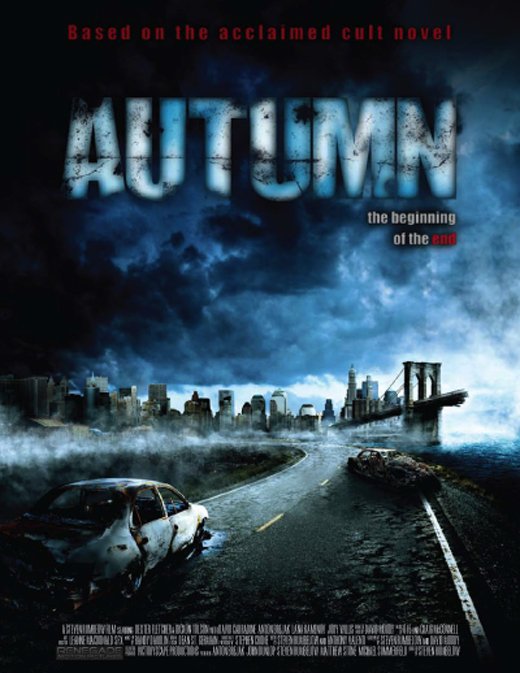
Autumn (2009), a Canadian film directed by Steven Rumbelow, is a film that, though showing promise in some respects, is unable to break free from its low-budget confines. In the beginning of the movie we see a mysterious virus kill off most of the human population and watch as the survivors try to come to terms with their new world as the dead begin to rise. The zombies (though they are never called this in the film) are benign at first, but slowly begin to become more cognitive and dangerous, giving time for tension-free character development for the first half of the story. Autumn is a slow-burn, which is partly what makes it almost work, and there is certainly a noble effort to become more than a simple zombie film, but it never quite achieves this. Even the make-up effects, which do their job in making the zombies look progressively rotten, do little to help.
Choppy editing, overly long sequences (which make it difficult to gauge the passing of time), and a lack of focus on the main characters work against the final product. The acting, too, ranges from adequate to Community Theater, and some performances are out of place with the mood of the film. There is also the curious mix of accents which makes it difficult to place the setting. The main characters consist of an American and two Brits, and early on there is a character who sounds like an Irishman attempting an American accent (note to such actors: Americans don’t say “bloody” unless we mean the red stuff). It is not until a good way into the story when a character speaks of visiting American cities that one can assume that the U.S. is the setting. This is not helped by the lack of location shots, as the movie essentially concentrates on a single devastated street on which we see the characters traveling a half-dozen times throughout the film – obviously another drawback to a low budget. We never really feel the scope that the film attempts to convey.
Unfortunately, even if the finances had been unlimited this film still would not rise above the superior zombie films which came before. Indeed, had this film come at the forefront of those competitors it may have been more relevant, but as it stands there is nothing new offered here. It is not scary, gory, dramatic, well-shot, or even terribly interesting. The script, which is based upon the David Moody novel of the same name, is predictable. We have seen it all done before, and we have seen it done better. Without giving away too much, the movie even culminates with a besieged farm house, offering us little variation even on Night of the LivingDead (1968), the classic film which established the modern zombie over forty years ago.
There is certainly a lot of heart in this film, but it is ultimately an unnecessary work that contributes nothing new to the genre. Nor is it able to recreate familiar genre elements in a way that warrants its viewing. It is easy to respect the efforts made in this film, but that unfortunately is not enough to recommend it.
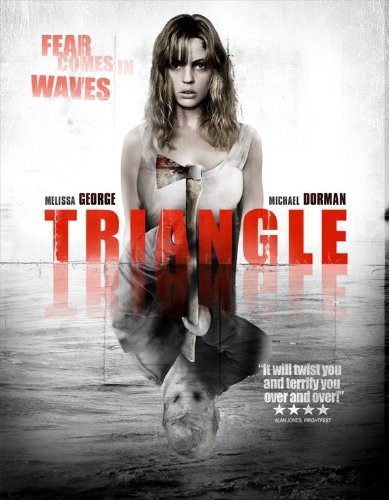
I knew nothing about 2009’s Triangle, a film by Christopher Smith, before watching it, and I must say that that is probably the best way to approach this movie. If you plan to watch it, don’t even watch a trailer, as it gives too much away. Triangle is a mind-twisting mystery which smartly employs both supernatural and slasher elements while never venturing too far into either subgenre. Each time I expected the movie to take a turn for the worse, it only became more interesting.
Triangle is about a group who board a seemingly deserted cruise vessel after their yacht is capsized by a freak storm. To say any more about the plot would be giving too much away, making this review torturous to write as this is the kind of movie you want to share with others and discuss.
Melissa George in Triangle.
The script is tight and intelligent – don’t blink or you may miss something – and supposedly took two years to write. The casting is great and the cinematography beautiful, filled with appealing, vibrant colors. The direction reveals an expert storyteller on the rise in the mold of Christopher Nolan, who similarly messed with our sense of time and perspective in films like Memento (2000). Smith’s love of the horror genre is apparent as Triangle conveys a veiled homage to Kubrick’s masterpiece, The Shining (1980). Additionally, Melissa George ties the film together in a terrific lead performance, playing a distraught mother trying to get back home to her son.
For fans of shows like The Twilight Zone, who like to bend their minds to wrap around an unfurling mystery, I recommend Triangle most highly.
Movie Review – The Haunting of Molly Hartley (2008)
2008 was a year in which true horror was released upon cinema in the unholy trinity of sub-par, terrible tween horror. Including One Missed Call and Prom Night, The Haunting of Molly Hartley, directed by Mickey Liddell and written by John Travis and Rebecca Sonnenshine, is probably the best of these three films, and that is all that can nicely be said about it. The story follows a teenager whose mother tried to kill her, and as she enters a private school and copes with the trauma she begins to believe that she is destined to become an agent of Satan unless she can do something to stop it. Think a prettier Damien: Omen II (1978), but less competent.
The plot of this film can be found in about the first and last five or ten minutes of this overly long film and the rest is simply teen drama filler fit for an ABC Family Channel series. Just in case you begin to fall asleep or forget you are supposed to be watching a horror film, there is a fake jump-scare at regular intervals, and you can safely guess that a bathroom mirror is involved in at least one. Each attempt at generating fear fails under the oppressive weight of its ineffective clichés and from a story line that is impossible to become invested in. In all fairness, Haley Bennett as the titular Molly makes a valiant effort as the lead but cannot hope to save a film which has her jumping at shadows every couple of minutes. The characters – attractive, privileged white kids – reflect who the target audience is.
It also helps if said audience belongs to a fundamentalist Christian youth group. Though the only Christians in the movie are extreme caricatures, they are also justified for their fanaticism and paranoia. The movie is light on horror enough, but religiously overtoned enough, to play well at a conservative Christian teen sleepover. Just for the record, that wasn’t a compliment. Truly, the movie’s biggest crimes are that it’s terribly dull and uninteresting, because by the time Molly is begging to accept Jesus as her savior we are merely begging for the film to end, and are willing to sell our souls to the Devil to see it done.
2008’s Prom Night, directed by Nelson McCormick, would have us believe that it is a remake of the 1980 Jamie Lee Curtis Canadian slasher, but the similarity goes only so far as the name. I admittedly am not a fan of the 1980 film as I find it fairly dull (I much prefer Terror Train, which Curtis had starred in that same year). This new film follows Donna, played by Brittany Snow, whose family was murdered by an obsessive teacher. Three years later she’s preparing for prom and, of course, the madman escapes custody and goes searching for her.
While I get bored with the original, it’s nonstop quality entertainment when compared with this new teen-targeted commodity. The acting is bland, the dialogue nauseating, the plot formulaic and predictable, the characters flat, and the directing uninspired. It’s amazing how the instantly forgettable killer is able to take out most of her friends in the most bloodless of methods. Truly, it is astounding that he can continually stab people in places that they will not bleed.
If one had to endure this film for whatever unfortunate reason, a good drinking game would be to take a shot each time a fake, clichéd jump scare occurs (two shots if a mirror is involved). You will be seeing double halfway through the film, and it might not only make the viewing endurable, but you may even see what the psycho-stalker killer sees in Donna, because my sober self didn’t buy it.
This review is a lazier attempt than most of my others, but this is the only way I can manage to keep thinking about this awful, awful film. So as to spend less time on this film, I’m going copy and paste a portion from my review of One Missed Call because the same message applies: I have seen countless terrible, mostly low-budget horror films that are easily forgettable and often times laughable. However, these bombs are usually made with the best intentions, and even though they are lacking in almost every other way, they contain some heart in their creation. This film, however, is nothing more than a cold, calculated profit machine meant to separate young teens from their parents’ money. It is the horror genre’s equivalent of a boy band.
Prom Night might even be able to take the tiara from One Missed Call for worst horror film of 2008, so there’s an accomplishment.









 The Revenant Review