Search

The Revenant Review

Horror Film History, Analysis, and Reviews

Tag

Horror

Movie Review – To Catch a Virgin Ghost (2004)

Movie Review – To Catch a Virgin Ghost (2004)

To Catch a Virgin Ghost (2004) is the international release name of the Korean horror-comedy Sisily 2 km and is the directorial debut of Shin Jung-won. The film is about a gangster in search of stolen diamonds at a farming commune, one that also appears to be haunted by a ghost. It attempts the melding of horror with the gangster genre to mixed success. A lot of the humor is found in the morbid situations the characters find themselves in and the script tries to turn horror conventions on their head, particularly the prevalent and overused J-horror ghost girl whose pale skin and stringy black hair have become readily recognizable tropes.

The movie is a lot of fun with some genuinely funny scenes, especially those of the main protagonist hanging out with the ghost, but the film as a whole doesn’t really mesh. Characters are underdeveloped and what should be plot twists are telegraphed far too early. Additionally, certain plot elements are never explained and feel more like they were inserted to simply move the film along to the next scene.

Despite these faults, the way To Catch a Virgin Ghost makes the audience shift in its loyalties makes it a film worth watching.

Grade: C

Movie Review – Kill List (2011)

Movie Review – Kill List (2011)

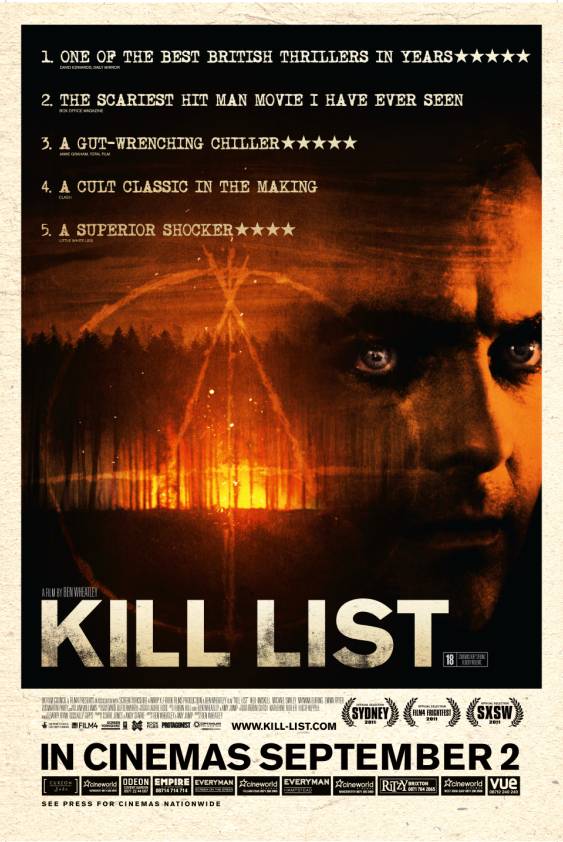
Kill List (2011) is an overall impressive piece of British horror directed by Ben Wheatley that almost feels like three different movies. The film’s first act focuses on the marital troubles of Jay (Neil Maskell), who hasn’t worked in eight months. The financial strains are causing him and his wife to squabble as his young son tries to understand it all. Jay at first appears meek and docile but we soon discover he’s a former hitman with a nasty violent streak, and being in need of money it isn’t long before he teams back up with his partner and best friend Gal (Michael Smiley) for a few more contract kills. This turns the film in its next act into a twisted buddy road trip that is as wonderfully filmed and acted as it is brutal, particularly a certain hammer scene.

Of course, things aren’t what they seem and either Jay’s sanity is slipping or something more is going on. The final act is strongly reminiscent of The Wicker Man (1974) with the revelation of occult machinations and, for me at least, the film here feels too divorced from what came before, both in terms of quality and plausibility. The final shots leave more questions than answers, and I was ultimately underwhelmed and dissatisfied with where the story went. I can see where the seeds were planted for the final twist, and while I respect the effort the narrative lost a lot of its impact on me.

Nevertheless, this is all very subjective and I acknowledge that many, if not most, will disagree with me, and I can certainly see why some would really find the ending effective. I still strongly recommend Kill List as there is some undeniably good filmmaking to be found throughout.

Grade: C+

Movie Review – The Sinful Nuns of St. Valentine (1974)

Movie Review – The Sinful Nuns of St. Valentine (1974)

Believing I was embarrassingly uneducated on the vaunted subgenre of nunsploitation, I decided to give the Italian film The Sinful Nuns of St. Valentine (1974), directed by Sergio Grieco, a go. The film stars Françoise Prévost and Jenny Tamburi, who appeared in many giallo films.

What surprised me is actually how reserved much of the film is and how seriously it takes itself. Truthfully, I found the plot, set during the Inquisition and dealing with such concepts as corruption, zealotry, bigotry, and betrayal, not to mention lust and desire, oddly compelling at times. I expected to laugh and give my eyes a roll but I found myself interested in the characters and their fates. That’s not to say this film is a great movie by any stretch of the imagination. It certainly has its budget constraints and the exploitation aspects are oddly handled, but Grieco actually tried to tell a story amid the naked nuns, which don’t really appear until the end.

The film even throws in a sober message or two, such as when the High Inquisitor states that “Fanaticism is often nothing more than the other face of madness.” What I thought would be a schlock-fest was actually quite watchable, which admittedly may say more about me than it does about the quality of this film.

Grade: C-

Movie Review – The Student of Prague (1913)

This review is part of the A Play of Light and Shadow: Horror in Silent Cinema Series

Movie Review – The Student of Prague (1913)

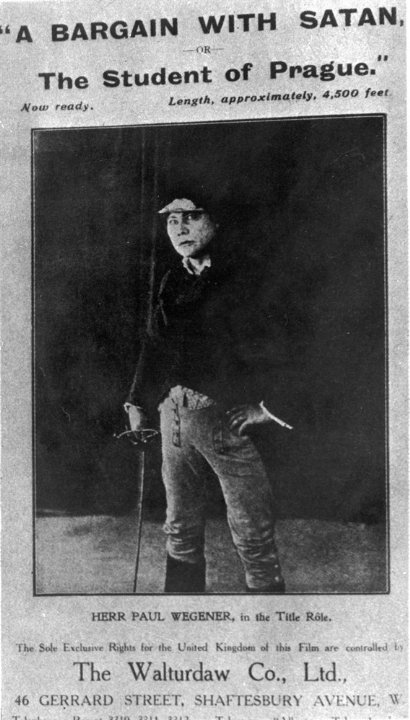
1913’s The Student of Prague is cinema history’s first feature length horror film, and some historians have argued it to be the first feature length film, in general. Earlier filmmakers certainly played with elements of the macabre, most notably George Méliès who incorporated Gothic tropes as early as 1896, but their intentions were almost always to titillate their audience rather than disturb them. Some early short films, particularly by D.W. Griffith, or 1910’s Frankenstein, played with dark elements and could easily qualify today as horror.

The Student of Prague poster

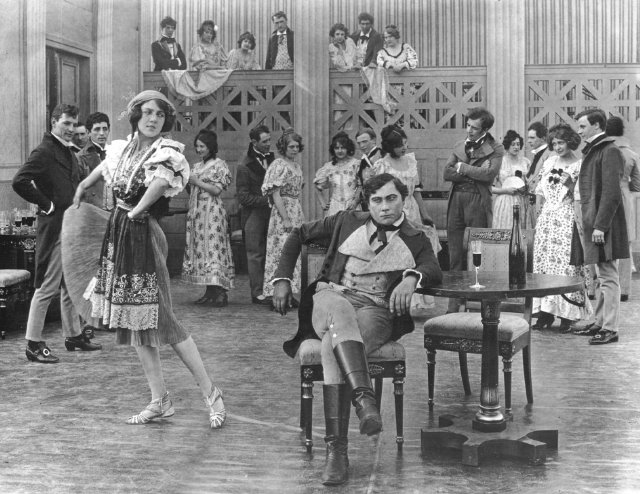
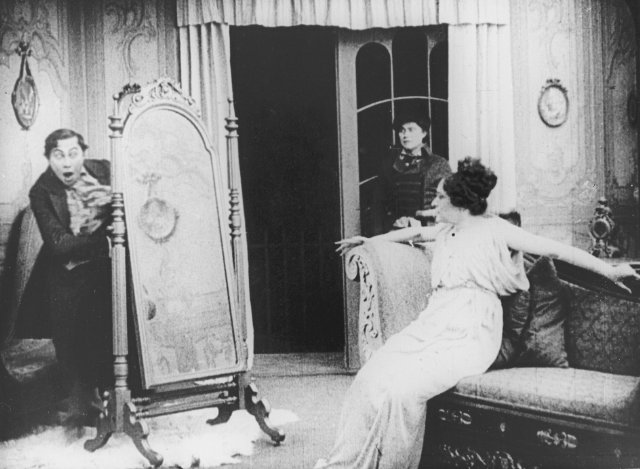
It was the pre-war The Student of Prague, however, that helped to launch the German Expressionist movement and first employed camera effects to create ghostly images meant to shock and frighten with a longer running time, attempting to create more complex characters than the short film model allowed. Drawing inspiration from E.T.A. Hoffmann’s “A New Year’s Eve Adventure” (1814) and Edgar Allan Poe’s “William Wilson” (1839), with a bit of the Faustian mythos added, the original script, written by novelist Hanns Heinz Ewers, revolves around a student and accomplished fencer named Balduin. The cash-strapped student agrees to exchange anything in his mostly barren boarding room to a mysterious man named Scapinelli in return for a magical change-purse which produces endless amounts of gold coins. Scapinelli, to the student’s and contemporary audience’s horror, chooses the student’s reflection, which leaves the mirror and becomes a haunting, murderous doppelganger bent on ruining the student’s life.

The Student of Prague 1913 still 1

The Student of Prague is an intriguing film which uses camera effects that are impressive for the time. The scenes in which Balduin, played by Paul Wegener, is interacting with himself through use of split screen look great, actually better than most other films I’ve seen that attempt this same illusion. His character, though, is the only one that fully succeeds in getting fleshed out. Unlike the source materials which inspired the story, or the popular contemporary interpretations of Dr. Jekyll and Mr. Hyde, Balduin’s double does not represent an unsavory element of his personality. The real horror of the tale is that Balduin’s decency means that he is wholly undeserving of the malicious machinations which haunt him. It is a cautionary tale, but not necessarily a moralizing one.

The Student of Prague 1913 still 2

Shot on location in Prague, though the film influenced post-war German Expressionism it is distinct from it in important ways. Notably, the realism of the locations is emphasized – the supernatural is seen to be imposing on a believable reality. This is typical of a story inspired by Hoffmann, whose writing attempted to produce the same effect. This devotion to realism, however, effects the film’s pacing, which can be languorous, lingering too long on location shots. About halfway through watching I sped the film up to 1.5 speed, improving its pacing considerably for this modern viewer’s sensibilities. Other films had already begun to effectively employ close-ups, but the stationary camerawork and wide angles used here sometimes leave you squinting to see just who is on the screen and what they’re doing. Overall, aside from the doppelganger effects, the direction takes a great deal from the stage, perhaps too much, as it’s still early in German filmmaking whereas American filmmakers like Griffith had already begun to master and evolve the film medium to a considerable degree. The film was remade in 1926 by many of the people involved in both The Cabinet of Dr. Caligari (1920) and Nosferatu (1922), but the present state of that film, which is superior in many ways, makes it less watchable than this earlier version.

It is worth pausing and taking note of the men involved in making this film, and what they say about early German cinema and what was to become of it. The screenwriter was Hanns Heinz Ewers, a famed German horror writer who is virtually unknown today due to his eventual ties with the Nazi Party, although his criticism of the party’s anti-Semitism and his own homosexual leanings lost him favor with the National Socialists. Nevertheless, he was among the first to take screenwriting as seriously as literary writing.

The director, Stellan Rye, would die the following year at the outbreak of the war as a POW in France.

The Student of Prague 1913 still 3

The film’s star, Paul Wegener, would go on to make horror history by creating the Golem trilogy (1915, 1917, and 1920), only the last of which survives, which propelled the monster subgenre and served as a major influence upon James Whale’s Frankenstein (1931), which was also influenced by 1926’s The Magician, which also starred Wegener. He was horror cinema’s first real star and was among the earliest to take the film medium seriously, seeing it as distinct from and not dependent upon either literature or drama. He would appear in some Nazi propaganda films while secretly financing resistance movements and harboring fugitives from the Nazis. After the war he would help to rebuild Germany’s art scene until his death a few years later.

And finally, the tragic John Gottowt, who played Scapinelli, and who was Jewish, would be banned from German entertainment by the Nazis and eventually murdered by the SS in Poland in 1942.

The Student of Prague will be of interest to those dedicated to seriously exploring the roots of film horror, like myself, but offers little to those not so predisposed. It doesn’t have the strengths of the silent horrors of the 1920s, and while it’s a great effort, it does show its age. Regardless, the scenes of Balduin facing his doppelganger are still impressive and will stick with the viewer long after the film is over.

Grade: C+

A Play of Light and Shadow: Horror in Silent Cinema

A Play of Light and Shadow: Horror in Silent Cinema

Introduction to the Review Series

Any devotee of horror movies will eventually crawl their way to the classics. A small number will tread through the Universal era of Bela Lugosi and Boris Karloff, finding endearment in their depictions of Dracula and Frankenstein’s monster. Fewer still will explore further back to the silent era, and those that do generally only watch a meager selection of films, notably The Cabinet of Dr. Caligari (1920) and Nosferatu (1922). Most conversations about silent horror cinema begin with these films, yet there are over twenty years of macabre movies that precede them, including feature length offerings beginning in 1913.

For eighteen years these silent feature films laid the foundation of horror before audiences would actually be able to hear Lugosi in his signature voice utter the lines, “There are far worse things awaiting man than death.” It took filmmakers of the 1930s several years to adjust to the advent of talkies, and in many ways some of the films which preceded them were more ambitious and better crafted. This is mainly because silent filmmakers didn’t need to worry about lugging around heavy sound recording equipment or concern themselves with the noises of the sets. They were artists who could focus purely on their visual aesthetic and tell rich tales of nightmares projected upon screen canvases, their only paints being light and shadow.

In this series of reviews I will dedicate myself to watching every feature length silent horror film I can access from 1913’s The Student of Prague to the dawn of the talkies. Where I am able to I will examine the people who made these films and the part they played in horror movie history, the techniques and focuses of the films and their impact, what these stories meant to contemporary audiences, and what, if anything, these films have to offer a modern audience. On this last point a note should be made about my grading system, which is of course subjective: I am someone who enjoys silent films and I assume the audience for my reviews does so as well. Silent films require more attention from viewers. Often scenes are left to interpretation and the person watching must fill in elements of the narrative with their own logic and imagination. Anyone new to watching movies of this era should be aware that it is hardly a passive experience, though it is, in my opinion, a rewarding one.

I hope that readers will find these reviews helpful, whether in pointing them to unknown selections, finding renewed passion for the movies they already love, or in offering reasons to respect and appreciate the movies of this era, all of which we are extremely fortunate to still be able to enjoy after a century.

Reviews can be found on the site’s pages for 1910-1919 and 1920-1929.

Featured post

Movie Review – Stage Fright (2014)

Movie Review – Stage Fright (2014)

Stage Fright (2014) is a Canadian musical slasher film written and directed by Jerome Sable. It attempts to meld the sensibilities of Glee with the post-Scream (1996) teen slasher. Starring Allie MacDonald and Meat Loaf, it opens with a brutal kill and rolls to the opening credits, then entering into a campy musical number with genuinely hilarious lyrics:

Sam Brownstein: [singing] All of us have heard these names of hate, but let me get one thing straight: I’m gay, I’m gay, but not in that way / Musicals move me and touch me in ways I can’t say.

Liz Silver, Sheila Kerry, Bethany: [singing] He’s gay, but not in that way.

Sam Brownstein: [singing] I sleep with women but musicals make me feel gay!

David Martin: [singing/butting in] I’m gay, I’m actually gay. I don’t get hard when I see T and A / Could be my DNA or how I was raised.

Liz Silver, Sheila Kerry, Bethany: [singing] We don’t distinguish here at Center Stage.

Entire Camp: [singing/dancing] We’re all gay, we’re gay in all kinds of ways!

Sheila Kerry: [singing] Some in the bedroom.

Sam Brownstein, Liz Silver, Sheila Kerry, Bethany: [singing] And some ’cause of musical plays!

It is a great opening and a promising start.

Alas, the rest of the film doesn’t quite live up to this opening. It doesn’t effectively maintain either the campy humor or the slasher violence. This latter aspect, especially, falls flat. Nevertheless, the film is entertaining throughout and Meat Loaf in particular gives a committed performance. Truly, the movie is a better musical than horror film, and Sable undoubtedly has an ear for melody. Even when I was yawning at the kills I was tapping my finger to the songs and smiling at the gusto with which some of the young actors were singing them. Had Sable pushed the horror farther, and at least threatened to have that horror visited upon the earnest young campers, it might have made the film far more potent.

Stage Fright doesn’t offer much beyond the novelty of mixing the two unlikely genres, but it makes me hope more filmmakers will attempt the marriage and succeed. It comes close but comes up short, but if another filmmaker digs a little deeper they may hit real pay dirt.

Grade: C+

Movie Review – The Devil’s Carnival (2012)

Movie Review – The Devil’s Carnival (2012)

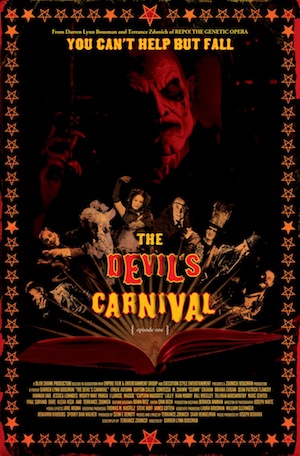
The Devil’s Carnival (2012) is the second collaboration of Darren Bousman and writer Terrance Zdunich, who also stars, after 2008’s Repo! The Genetic Opera. After years of talk about a possible sequel to that film, the pair decided to instead embark on another horror musical entirely. The Devil’s Carnival’s approach is less rock opera and more cabaret, and it presents a scenario in which three damned souls are sent to a carnival run by the devil, their tales each being based upon one of Aesop’s fables.

Like Repo!, there’s a lot to like about this film, not the least of which is its very premise. The costume designs are fun and seemingly meant to once again appeal to the Goth crowd and one of musical numbers really intrigued me, likening the story of “The Scorpion and the Frog” to a girl who dates an obviously abusive man, complete with references to his stinging “prick.” Also, there’s a really well done number during the credits which tells the story of a girl on a ship who tries to stay awake because she’s convinced she’ll drown in her sleep, and I wish it had been included in the actual film.

All that being said the movie as a whole left me underwhelmed. The other songs are mediocre and the set is more cluttered than sinister. Nivek Ogre from Skinny Puppy makes a cameo, but his number is cut in half and unremarkable. The script suffers from too many characters and too little development, and the horror payoffs are unfortunately predictable and anti-climactic. Even at only 55 minutes the film still seems padded, and it feels like the actors weren’t always sure what to do within a scene, or the director for that matter. (To be fair, I read that Briana Evigan was cast just hours before shooting her musical number).

It’s not a bad film, and I actually like it slightly better than Repo!, but one that doesn’t meet the potential of its style or premise.

Grade: C-

Movie Review – Repo! The Genetic Opera (2008)

Movie Review – Repo! The Genetic Opera (2008)

I love horror. My wife loves musicals. Why not mix the two?

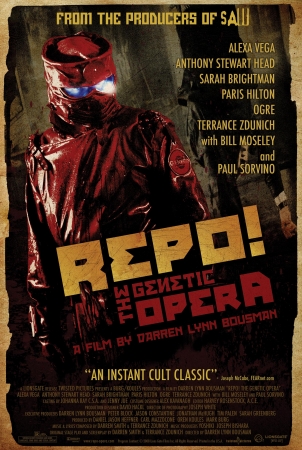
Repo! The Genetic Opera (2008) is a horror Goth-rock opera based on the 2002 musical of the same name, which was written and composed by Darren Smith and Terrance Zdunich. Directed by Darren Lynn Bousman, the film depicts a dystopian future where organ failure is epidemic and society is saved by a megacorporation called GeneCo. However, the corporation’s intentions are not altruistic – for those who cannot maintain their payments hitmen known as Repo Men hunt them down and repossess their organs. Amidst this nightmare world are grave robbers who steal an addictive painkiller from corpses to sell on the black market. Add to this some coming-of-age teenage drama, blood feuds, and a Repo Man with a tortured conscience and you’ll have a decent idea of what this film is about.

The film bombed at the box office and received mostly negative critical reviews, but over the years it has gained a niche cult following in the vain of The Rocky Horror Picture Show (1975). There’s a lot to like about this film: the splatter punk gore, the Goth visuals – particularly Blind Meg, the interesting premise, and, in my opinion, Anthony Stewart Head’s performance. Even Paris Hilton, who then was at the height of her unfathomable celebrity, puts in a decent showing. There is enough to keep my interest most of the time, and only one song I actively dislike (“Seventeen”).

That being said, the film runs too long and the convoluted story, especially when it comes to the central character of Shiloh (Alexa Vega), feels stretched too thin. However, the movie’s biggest failing is that for a musical of fifty-plus songs there are very few melodies or lyrics that are any good. Most of the music is simply mediocre and when they have something good going it’s over too soon, transitioning to a new, less interesting piece. Also, the ending involving Head’s character is rather anti-climactic, especially for a splatter punk movie. They build up an ultra-violent confrontation and end it with a whimper.

I can understand why audiences are divided on this one, with one half loving it and the other half loathing it. I’m in the middle. Ultimately, it’s a forgettable film. Nevertheless, it makes me curious to see what else is out there for horror musicals, as the combination is an intriguing one. Bousman and Zdunich collaborated twice more for 2012’s The Devil’s Carnival and its sequel Alleluia! The Devil’s Carnival (2015), and those are films that, based on Repo!, at least have me curious.

Grade: D+

Movie Review – Bad Kids Go to Hell (2012)

Movie Review – Bad Kids Go to Hell (2012)

The initial premise of Bad Kids Go to Hell (2012), directed by Matthew Spradlin, sounds like a surefire winner: mix The Breakfast Club (1985) with a whodunit mystery, and throw in a cameo by Judd Nelson as the crotchety principal. Based upon Spradlin and Barry Wernick’s popular graphic novel of the same name, it’s a promising recipe for an entertaining horror comedy. What could go wrong?

Well, most of it. Judd Nelson’s cartoonish lines fail muster any enjoyable nostalgia, and most of the cast is unable to rise above their trite dialogue. The plot gets increasingly ludicrous, particularly as the so-called “twists” are being unraveled. The movie overall comes off as fairly sloppy, especially in the sound design where the blaring music sometimes drowns out the actors’ voices. And what’s with all the CGI cockroaches that are ever-present but never explained?

Is there anything to like about this film? Well, the sexy redhead does a striptease, so that’s one minute of the film that many viewers will not mind. However, if the price of admission is the rest of the film, audiences may want to pass.

Grade: D-

Movie Review – Carrie (2013)

Movie Review – Carrie [remake] (2013)

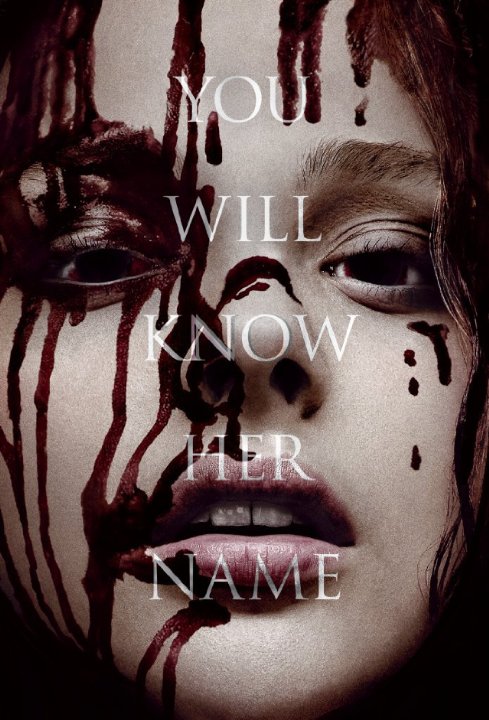
When the new Carrie (2013) was first announced I was curious to see if director Kimberly Pierce could cull anything new or relevant for our modern era that Brian De Palma’s 1976 classic, due to the time in which it was made, could not. Her film Boy Don’t Cry (1999) dealt smartly with the heavy issues of self-identity, sexuality, and class identification – all themes which the story of Carrie White touches upon. When buzz for this film was first making its rounds, I recall cast members and those associated with the picture touting that this version would be closer to Stephen King’s 1974 novel. They claimed their film was not a remake of the original but a reimagining of the source material. However, considering this movie hardly deviates from the path laid by De Palma, except to insert references to social media, 2013’s Carrie can be safely stored in the vault of pointless and soon-to-be-forgotten remakes.

To be fair, Pierce has claimed that studio executives butchered about forty minutes from her film. This footage supposedly contains many elements from the book, such as the White Commission, and more gore. There is currently an online petition from fans meant to restore Pierce’s vision. Nevertheless, as it now stands the movie closely resembles De Palma’s, and the scenes which it mirrors only serves to highlight the original’s superiority.

I love the 1976 Carrie but I don’t think of it as one of the untouchable classics. The story is perfectly served to be reimagined for each teen generation, changed to make it relevant to their fears and anxieties. The original is a terrific, artistic achievement, but it’s very much a capsule of its time. The 2013 film, though, is more tailored to modern teens’ short attention spans and reliance on pop culture. The overuse of CGI makes the scenes of Carrie testing her powers more akin to an X-men movie or Matilda (1996) than to anything foreboding. Sissy Spacek’s Carrie had a growing awareness of her ability that never went too far until her climactic mental breakdown. But this new Carrie is quickly confident in her powers and is closer to the literary version in this way, but it is a confidence that undermines the character who we should be viewing as a tortured victim unable to see potential within herself.

Chloe Grace Moretz is a capable actress, but when compared with Spacek’s iconic portrayal we see just how miscast she is. She fails to exhibit the vulnerability essential to the character or illicit the pity that Spacek was able to cull. I’ve seen reviewers who praise her performance but it didn’t work for me.

Yet it’s in the prom scene were everything truly falls apart and any comparison made to the original film reveals just how brilliant and horrifying De Palma’s work truly is. By comparison, the new film is flashier but tension-free. Also, it can’t decide if Carrie is a monster or a victim as it tries to redeem her in odd ways, but if we were to replace her telekinesis with a gun the distinction would be clear – Carrie is a monster.

2013’s Carrie is not a horrible film. It has its merits. Julianne Moore does well, for instance. But the film fails to elicit an emotional connection and feels sanitized in a way that the original didn’t. Despite the CGI deaths, it feels like the rest of the movie is holding back, particularly on the performance end. It’s a perfectly fine workmanlike movie, but I prefer the artistry of De Palma’s.

Grade: C-

Movie Review – Scream 4 (2011)

Movie Review – Scream 4 (2011)

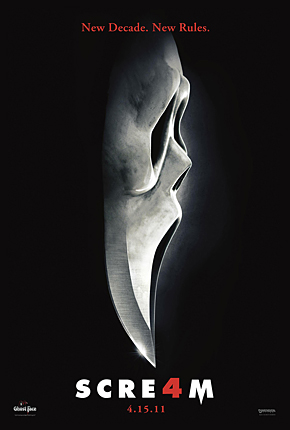
Scream 4 (2011) is the fourth Scream franchise entry and comes a full decade after the last movie. Wes Craven once again directs and Kevin Williamson, who wrote Scream and Scream 2, returns as the writer.

The film picks back up with consummate survivor Sidney Prescott, played by a still stunning and capable Neve Campbell, who returns to her hometown as a last stop on a book tour. But of course a Ghostface copycat is once again making foreboding phone calls and slashing at people close to her, including her teenage cousin, Jill (Emma Roberts). Old faces return and some new ones are added, mostly to be stuck like pincushions.

Of course, true to form, the script is laden with meta-commentary mostly directed at the nature of horror remakes, particularly their shortcomings. A lot of this works well, though sometimes the film seems to slip too far out of satire and into spoof, as Scream 3 did before it. The reveal is a jab on the nature of the modern celebrity, and while I appreciate what the film attempts to do the result is clunky. Some of the dialogue is funny, but if you think about the plot too hard you’ll soon find holes big enough to fall into, so mind the gaps.

I am once again perturbed by a film that points out clichés and then uses them so often. For instance, are cops really incapable of running after a suspect? I wish Craven would have stepped up his directing game in some scenes as little tension is built throughout the film and there are once again too many fake jump-scares. I wanted the movie to nod its head at the inevitable teenage audience and say, “We know these tricks, we invented them,” and then like Dan Akroyd in The Twilight Zone: The Movie (1983) say, “You wanna see something really scary?” Craven made his mark by pioneering the “video nasties,” and while I don’t want to see extensive rape scenes I was hoping for more drama in the kills, giving the audience an uncomfortable intimacy with the knife. It is, after all, rated-R, and the horror trend that had the most prominence between this film and the last was the subgenre known pejoratively as “torture-porn.” While it’s far from my preferred subgenre, I would have liked to have seen this new Scream take a few notes from it. But instead Ghostface stumbles like always and more by luck than by skill gets his victims, usually with a quick stab as the person goes down dead, blood dripping from their mouths. Yawn.

A real knife attack is quick and relentless. Police officers are trained to fear knives, as a wielder can close a distance of many yards and stab repeatedly before an officer can draw their gun (check out training videos on YouTube and you’ll never take a Hollywood knife fight seriously again). It’s terrifying in its primal brutality and in the violation of the blade biting into flesh. Instead, like most teen slashers of the past two decades, the punch of the violence is pulled and true fear never looms its head.

Likewise, I was hoping for more from Sidney. She’s noble, brave, and a fighter, and I really shouldn’t complain. But I was hoping she’d be confronted by Ghostface and reveal that she’s been training in self-defense against knife attacks for the last decade, and then kick his ass out a window before he can run away. It would have been a nice twist and a message that says we’re over this mediocre slasher crap, and it might have been a more appropriate metaphor for a post-9/11 Scream in which horror victims became more proactive. That being said, Sidney is well-written and portrayed perfectly by Campbell, who is the highlight of the film, as one who refuses to be a victim.

The other performances are a mixed bag, though Rory Culkin does well and is in what is perhaps my favorite scene. Hayden Panettiere eventually won me over towards the end. Emma Roberts, who plays Jill, doesn’t sell the role in my opinion, and couldn’t rise above the trite dialogue.

Scream 4 is an improvement when compared to Scream 3. That’s not high praise, but it remains an enjoyable film that, I think, ends the film series on a better note than its predecessor.

Grade: C+

Movie Review – Scream 3 (2000)

Movie Review – Scream 3 (2000)

Scream 3 (2000), again directed by Wes Craven but with a script by Ehren Kruger, continues the story of Sidney Prescott (Neve Campbell), Gale Weathers (Courtney Cox), and former-deputy Dewey (David Arquette). Due to public sensitivity about media violence resulting from the 1999 massacre at Columbine High School, the kills, which are noticeably less bloody, are moved out of small-town America to Hollywood, California. This time the victims are the actors of Stab 3, the metafictional movie-within-a-movie that dramatizes the tragic events surrounding our principal characters.

Scream 3 opens strongly but peters out quickly, and it never quite lives up to the two installments that came before. In Scream 2 the horror references were present, but they were beginning to be overshadowed by references to the stars’ other projects and pop culture. Scream 3 continues that trend and amplifies it by focusing on Hollywood culture, but in doing so it continuously threatens to cross over from being self-referential to being self-parodying. In some scenes the film definitely crosses that line, such as with the cameo by Jay and Silent Bob – not Jason Mewes and Kevin Smith, but the drug dealing characters they portray. Such scenes are little more than farce and can be taken as an indication that what made the Scream franchise fresh has grown stale.

Even though it posits itself as an examination of horror trilogies, even having the obligatory scene of Randy (Jamie Kennedy) giving us the rules, the movie never really feels about that. It instead goes off the rails and become a spoof on Hollywood rather than an examination of horror. As Stab takes over more of the narrative, the tone becomes decidedly comedic and the wit and tension are lost. At times it’s more Scary Movie, which was released the same year, than horror, and it hardly feels like it resides in the same universe as the first two Screams. Likewise, the series which was founded on exposing and upturning horror clichés falls into these dusty traps again and again in this outing. We get tired fake jump scares and characters who should know better making absurd decisions. The kills, too, are unimaginative and forgettable.

This being said, the acting is still solid, particularly Campbell’s portrayal of Sidney. She is able to convey strength and vulnerability in equal measure. Nevertheless, Sidney as the victim gets tiresome and I feel the writers lost a golden opportunity to make Gale the target, as they readily establish how disliked she is by the people about whom she writes. Due to Campbell filming another movie, Sidney gets less screen time and Gale and Dewey take up most of the plot. Making Gale the object of murderous intent could have taken advantage of this and we could have had Sidney come out of hiding to help Gale. Alas, Scream 3 sticks to its own franchise trope.

Despite the tired cameos and pop references, Craven films the lackluster script with the high quality filmmaking we’ve come to expect from the series, and even though it’s retreading old ground it always remains entertaining to watch. Nevertheless, this film was meant to close the trilogy and I imagine that anyone who saw it must have felt that there was nowhere else for the franchise to go.

Of course, Scream 3 would not be the last. After a decade Craven would return to the franchise for Scream 4 (2011), which I believe is actually a stronger film than this entry, if only by a small measure, and manages to successfully comment on Hollywood in a manner which this movie ultimately attempts but fails to do.

Grade: C

Movie Review – Devil’s Pass (2013)

Movie Review – Devil’s Pass (2013)

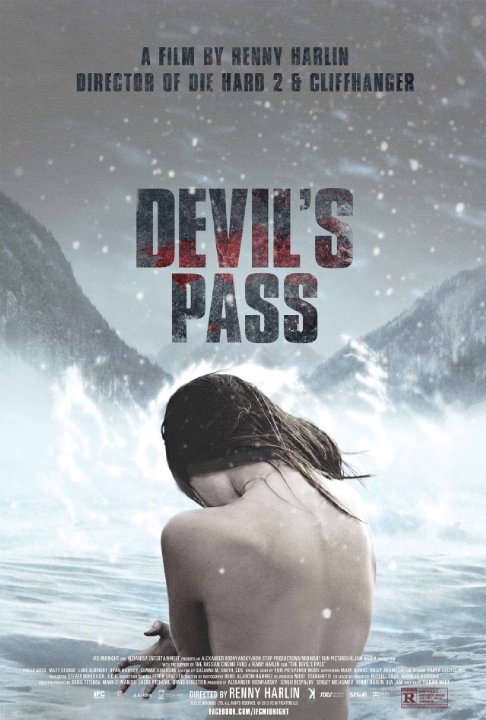
In 2013 Renny Harlin, who is known mostly for his action movies, once again returned to the horror genre with Devil’s Pass (2013). I’ve never been a fan of his previous horror/thriller forays. He did the passable A Nightmare on Elm Street 4: The Dream Master (1988), which still shines in my mind for the obvious stunt-double-in-a-wig-swinging-nunchacku scene. But he also gave us the “violently banal” The Covenant in 2006 (“I’m going to make you my wee-otch”), which is one of the worst horror films I’ve ever seen, though it at least gave us some choice reviews.

This time Harlin delves into found-footage horror and instructs us all on how not to do it. I don’t mean to sound flippant here, as I believe Harlin makes a genuine effort, but nowhere do we see evidence that he grasps what makes the story-telling technique truly effective. The story, which had an interesting plot relating to the real life Dyatlov Pass incident of 1959, in which nine hikers’ bodies were found in the snows of the Ural mountains and who appeared to have died under mysterious circumstances, is lost in an uninspired script. Harlin shot on location in the mountains of Russia, which is commendable, but it doesn’t really contribute anything authentic to the film. There are some interesting sci-fi elements which run along Harlin’s own theory on the case, but they never come together amidst the stale dialogue and rudimentary action. The acting is mediocre and the film devolves into a CGI-fest at the end, to mixed results.

Worst of all, the found-footage aspect was unnecessary and poorly done. Devil’s Pass may have actually worked better had it not been found-footage, or at least not entirely. Devil’s Pass has some promising ideas and it attempts an almost smart circular story, but in the end the movie is too light on story and too heavy on gimmick.

Grade: D

The Rules of Cheap Horror According to Jason Blum

Recently NPR’s Planet Money examined the business model of Jason Blum who is one of the most successful low-budget movie producers of all time. He accomplished this status by thumbing his nose at the Hollywood trend of creating ever bigger and flashier movies, where the budgets expand as quickly and as broadly as the monetary risks they entail, and scaling movies back to basics. Instead of putting all of his resources into one big film, Blum finances smaller films, most of which are horror. Up to 40% of these films flop, but others hit and when they do he makes an absolute fortune. The risk is smaller but the profit is just as considerable as those of the bigger budget productions.

Blum’s three rules for creating a cheap horror movie are as follows:

1. Not too many speaking parts (you need to pay extras extra if they speak).
2. Not too many locations. This is why so many of his films take place in a house.
3. Pay stars as little as legally possible. He approaches actors more as investors than as employees – if the film does well, they will profit. The talent is as invested in the film as he is.
4. Never, ever break your budget. This is the rule the rest of Hollywood is afraid to stick to.

While these limitations restrict filmmakers in many ways, they force them to be creative and inventive in others. These films include the Paranormal Activity series and certainly many duds, but it has also resulted in some notable genre entries including Insidious (2011), Oculus (2013), and 13 Sins (2013), the last of which can be counted among Blum’s flops, as well as many others. It also resulted in the Academy Award winning Whiplash (2014). His most recent release, M. Night Shyamalan’s The Visit (2015), cost only five-million dollars to make and has already grossed over thirty-million as of this writing. For more evidence, here is a list of some of Blum’s horror offerings (source):

2009 Paranormal Activity Budget: $15,000 Gross: $193,355,800
2010 Paranormal Activity 2 Budget: $3,000,000 Gross: $177,512,032
2011 Insidious Budget: $1,500,000 Gross: $99,549,294
2011 Paranormal Activity 3 Budget: $5,000,000 Gross: $207,039,844
2012 Sinister Budget: $3,000,000 Gross: $82,015,113
2012 Paranormal Activity 4 Budget: $5,000,000 Gross: $142,817,992
2012 The Bay Budget: $2,000,000 Gross: $1,581,242
2013 Dark Skies Budget: $3,500,000 Gross: $27,858,103
2013 The Lords of Salem Budget: $1,500,000 Gross: $1,544,989
2013 The Purge Budget: $3,000,000 Gross: $89,328,627
2013 Insidious: Chapter 2 Budget: $5,000,000 Gross: $161,919,318
2014 Paranormal Activity: The Marked Ones Budget: $5,000,000 Gross: $90,904,854
2014 Oculus Budget: $5,000,000 Gross: $44,105,496
2014 13 Sins Budget: $4,000,000 Gross: $794,767
2014 The Purge: Anarchy Budget: $9,000,000 Gross: $110,602,999
2014 Ouija Budget: $5,000,000 Gross: $102,529,779
2015 The Lazarus Effect Budget: $3,300,000 Gross: $36,143,981
2015 Unfriended Budget: $1,000,000 Gross: $62,882,090
2015 Area 51 Budget: $5,000,000 Gross: $7,556
2015 Insidious: Chapter 3 Budget: $10,000,000 Gross: $109,518,558
2015 The Gallows Budget: $100,000 Gross: $38,164,410
2015 Sinister 2 Budget: $10,000,000 Gross: $31,775,300
2015 The Visit Budget: $5,000,000 Gross: $34,943,156

Blumhouse has become a staple in the genre over the past five years. While at least half of these films flop we’ve thus far been given a few diamonds in the rough each year, and I for one am excited for what is yet to come.

To listen to the full Planet Money episode, click here.

Movie Review – Scream 2 (1997)

Movie Review – Scream 2 (1997)

Following the overwhelming success of 1996’s Scream, Scream 2 (1997), also directed by Wes Craven and written by Kevin Williamson, was released just shy of a year after the first film. Following the same winning whodunit slasher formula, the film nevertheless suffered considerable production problems, most notably being that the screenplay was leaked onto the internet revealing the identity of the killers. Major rewrites, therefore, had to be completed as the movie was being filmed. The actors did not even know who the killers were until those scenes were set to be shot.

Set two years after Scream, the film once again centers around Sidney (Neve Campbell) at her college campus as murders begin to spread familiarly around her. The script ups the meta ante, having a film within a film as the events of the first movie are dramatized in a feature called Stab. As Scream was partly inspired by the very real Gainesville Ripper murders, it’s fitting that the Woodsboro murders would get their own satirical Hollywood treatment complete with bad acting and even worse wigs. Craven shows just how skewed and shallow the Hollywood version of reality ultimately is.

While there are still horror film references, this time focusing more on Friday the 13th (1980) instead of Halloween (1978), many more references are dedicated to the other projects of the actors and actresses involved, such as Courtney Cox’s Gale Weathers mentioning Friends co-star Jennifer Aniston or the character of Sarah Michelle Gellar, who had recently begun playing the titular television role on Joss Whedon’s Buffy the Vampire Slayer, watching 1922’s Nosferatu. These are certainly timelier and, as a result, have not aged as well.

In addition to this self-analysis Scream 2 also confronts the nature and quality of horror sequels, which historically have been largely terrible. As Randy (Jamie Kennedy) comments, “The entire horror genre was destroyed by sequels.” Randy also, as in the first film, lays out the guidelines for the audience: “There are certain rules that one must abide by in order to create a successful sequel. Number one: the body count is always bigger. Number two: the death scenes are always much more elaborate – more blood, more gore – carnage candy. And number three…” Here he’s cut off in the film, though the movie’s trailer has him continue with: “never, ever, under any circumstances, assume the killer is dead.” True to form, Craven gives the audience a higher body count and some elaborate tension-filled set pieces, the first involving Sidney and her friend trapped in a police car with the unconscious killer and the second involving Gale Weathers in a soundproof booth.

The performances from our returning cast are strong, including David Arquette who adds a sympathetic vulnerability to Deputy Dewey. His and Gale’s story arc is the best written. That being said, the new characters are never really fleshed out. We learn too little about them to be emotionally invested, and also too little to suspect them to any real degree, with the exception of Liev Schreiber’s Cotton Weary. The movie becomes less of a whodunit mystery and more of a waiting game, as the red herrings are not nearly as convincing as in the first film.

Scream began strong and ended strong, and this film inverts that, though not purposefully. The opening scene is rather over-the-top and the ending not nearly as satisfying. However, considering the re-writes that occurred it’s impressive that Scream 2 is as solid a sequel as it is, even if it does not quite meet the standards of its predecessor. When compared to the other teen slashers that were being released or about to be released, including Williamson’s own I Know What You Did Last Summer (also starring Gellar) which came out the same year, Scream 2 is definitely a superior entry.

Grade: C+

Blog at WordPress.com.

Up ↑