Search

The Revenant Review

Horror Film History, Analysis, and Reviews

Tag

Movie Review

Movie Review – The Uninvited (2009)

Movie Review – The Uninvited [A Tale of Two Sisters remake] (2009)

I was thoroughly impressed with Kim Ji-woon’s 2003 horror film, A Tale of Two Sisters, known in South Korea as Jangwa, Hongryeon. It was an effective psychological thriller that weaved the supernatural and natural in unexpected ways, creating an almost suffocating, dreamlike world. As with most PG-13 American remakes, I expected 2009’s The Uninvited, directed by the British-born Guard Brothers, to butcher the strengths from the original story and delude them with tired Hollywood jump scares and clichés. Despite my low expectations, or perhaps due to them, The Uninvited is actually a well-done horror targeted to teens that is, on most levels, a superior entry when compared to the horror films generally offered to that demographic. It tells of a girl named Anna, played by Emily Browning, who returns home from a mental hospital and tries to hold onto her sanity as she comes up against her new stepmother and a possible haunting.

The script does indeed stray from its source material – the characters are quite different and the plot plays out more like a simplified mystery/thriller, and it does not demand the attention or intelligence that its predecessor did. Certain elements have been added that allow a few more surprises, and the twist plays out in a way different enough to warrant a viewing by fans of Two Sisters. One scene which stands out features a broken back, and the effects and lighting make for an effectively intense scenario.

The real strength in this film, however, lies in the performance of Elizabeth Banks. Admittedly, when she was cast in the stepmother’s role I was skeptical, but her acting goes against type and perfectly treads the fine line between sinister and sincere in a role that demands the delicate balance of ambiguity. Likewise, Emily Browning pulls off the lead role without difficulty and Arielle Kebbel, who plays the other sister, steals several scenes. Pulling the whole film together is a haunting musical score that adds an atmosphere of whimsical sorrow.

With all these strengths going for it, the truth of the matter is that there is not much new here to offer the genre, and it rather succeeds more in not screwing things up. What it excels at, however, is being a stepping stone for teens into the world of horror that genre fans won’t have to cringe at, and in that respect it is most welcome. It is not a great film, but it is an adequate one, and considering its peers, that definitely counts for something.

Grade: C

Movie Review – Orphan (2009)

Movie Review – Orphan (2009)

I really expected to dislike Orphan (2009), directed by Jaume Collet-Serra, though he had previously helmed the underrated House of Wax (2005) remake. What appeared from trailers like a rip-off of The Bad Seed (1956) and The Omen (1976), trying to profit from yet another “creepy kid” story, offered little to whet my appetite. It tells the story of a couple who adopt a little girl who, of course, turns out to be a psycho. I was pleasantly surprised to find, then, that Orphan too turns out to be much more than I had anticipated.

The film’s biggest asset is the convincing performance of its lead child star, Isabella Fuhrman, who plays the cunning and murderous Esther. This talented young actress carries the film and really does exude wisdom and understanding beyond her years, and creates a worthy counterbalance to Vera Farmiga in her role as Kate, Esther’s adoptive but suspicious mother. The rest of the roles are also well-cast, particularly the adorable Aryana Engineer, who plays the deaf and mute Max, the couple’s youngest daughter.

Orphan’s script has many strong elements within it. The film opens with a dream sequence that plays on its illogical nature through set changes and by having Peter Sarsgaard play both the doctor and the husband simultaneously as Kate is in labor. In the title credits the letters change from traditional print to chaotic, black-lit smears, in a way which ties nicely into the story later on. Also, the relationship between Esther and Max is very believable, and the use of sign language is implemented throughout the plot to great effect.

When scenes take a turn for the macabre they do so with a vengeance. Kids are not always scary in horror films, even when they’re supposed to be, for it is difficult to imagine a kid being able to accomplish too many grisly tasks before being stopped by a well-placed kick to the head. However, it is Esther’s cunning which is her greatest strength. She is smarter than those around her, expertly manipulating people and situations to her advantage – and the best part is that her plans sometimes go awry and she must think quickly to resolve new threats.

However, despite all these strengths, the film is not without weaknesses. For every great scene, and there are many of these, there is an awful one, or at least enough which are so mediocre and clichéd as to bring down the intensity of the film. How many times are we to watch someone close a medicine cabinet only to find someone standing next to them in the mirror’s reflection, providing yet another tired and ineffective jump scare? We even get the cue music to let us know we were supposed to be scared just then, in case we missed it. This happens, mind you, in the beginning before anything remotely creepy has happened. Likewise, when one of Esther’s bullies sees that she is no longer on a swing she suddenly feels threatened and creeps through a playground structure cautiously. The audience knows that Esther is dangerous, but there is no reason for this character to believe so. The tension of the film gets comically cranked to eleven as we see quick shots of kids on monkey bars, and a boy coming down a slide is used as yet another jump scare, and the whole scene comes off as fairly ridiculous. I claim no deep knowledge of filmmaking, but as a viewer these tactics signal that the director lacks the confidence that he has effectively captured his audience. Other scenes, and especially the final one, tumble into ever more Hollywood clichés, and this is unfortunately after a very creepy, effective twist.

I can’t help but imagine what a masterpiece this could have been if characters and their personal demons had trumped the Hollywood ending and fake scares. Orphan is a movie worth seeing and deserving of respect, but in the end it is a missed opportunity.

Grade: C+

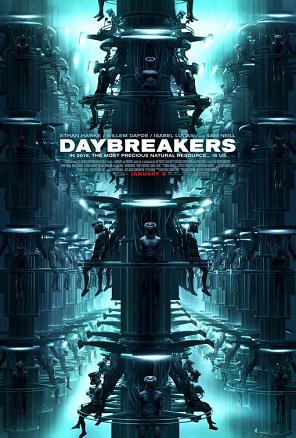
Movie Review – Daybreakers (2009)

Movie Review – Daybreakers (2009)

Daybreakers (2009), written and directed by Australian filmmakers Michael and Peter Spierig, depicts a dystopian near future in which vampires, their mythical lore a reality, rule the world. Here humans are an endangered species who are either in hiding or are factory farmed for their blood. Unfortunately, the blood supply, along with humanity, is running out, and starving vampires are morphing into ravenous bat-like creatures who stalk both vampires and humans alike.

There are varying feelings among the vampires, with some sympathizing with humans and loathing their present form, including the main character, Edward Dalton (played by Ethan Hawke), a hematologist working on a blood synthetic. He is approached by human rebels in need of his help to develop a vampirism cure. However, most vampires are nothing like Dalton and love being immortal bloodsuckers, content to gorge on the red commodity no matter the cost.

Daybreakers still.

The cinematography is wonderful and while some of the make-up and CGI effects are terrific, some look rather awkward. Nevertheless, the film boasts a strong cast with Hawke, Sam Neill, and Willem Defoe, an intriguing script, unflinching gore, and a twist that will keep you interested to the end.

Just as importantly, Daybreakers is a film whose veins are brimming with metaphor. The vampires are a reflection of our modern society, addicted to human blood, which is fast depleting, rather than taking nourishment from baser, though less satisfying animals. Similarly, we are dependent upon a finite supply of the world’s oil or we feed upon animals without regard to moral considerations or the effects our lifestyle and diet has upon the natural world, merely because it’s inconvenient for us to do so. Replace oil or animals for any number of malicious habits we have that do serious harm to the planet and its population. Likewise, the vampiric elite greedily isolate themselves from the hardships of the lower dregs, caring nothing for those beneath their class. Many could readily accuse today’s upper echelon of much the same disregard for those not within their tax bracket.

Daybreakers is a smart horror film that has a lot to say about the present. If vampires could see their reflections in the mirror, they would look like you and me.

Grade: B-

Movie Review – Frontier(s) (2007)

Movie Review – Frontier(s) (2007)

Writer-director Xavier Gens’s Frontier(s) (2007) is a French amalgam of The Texas Chainsaw Massacre (1974), Hostel (2005), and The Hills Have Eyes remake (2006). It is another European offering in the extreme gore subset, and though it is not a subgenre I generally gravitate toward, I was pleasantly surprised at how much I enjoyed it. It was originally meant to be a part of 2007’s Horrorfest but was pulled due to receiving an NC-17 rating from the MPAA for its graphic violence.

Set in the future of a right-wing takeover amidst civil unrest, four outlaws try to flee the country – the main character, Yasmina, doing so mainly to receive an abortion so her child will not be born into “this type of world.” This setting may at first seem rather unnecessary and contrived until the nature of the murderous family they encounter is revealed, in their deadly splendor, as Nazis. To make sense of this, one must take into account France’s history as well as the destructive riots that occurred in Paris back in 2005, which resulted from high youth unemployment and the failure of French society to integrate its immigrant population. One of our protagonists is a Muslim, which is certainly significant. The movie stakes itself as a morbid morality tale about the dangers of fascism and intolerance, with the murderous Von Geisler family serving as the horrifying culmination of both. Whether this metaphor succeeds or not is debatable. Nevertheless, it does offer an interesting layer to ample amounts of blood that splatter seemingly every frame in the second half of the film.

Maud Forget and Karina Testa in Frontier(s).

Yasmina and her friends are subjected to unspeakable torture via eugenics and cannibalism. This is not merely a torture flick, however, it is also a revenge one, and the best gore is reserved for the dispensing of the Nazis. A scene with a table saw, though predictable, is nonetheless incredibly satisfying.

Truly, if one were to simply read the script the film would sound awfully hokey, but a talented and well-chosen cast brings the characters and dialogue to life. The deformed daughter and mother to the subterranean mine children, especially, is a presence that captures one’s attention and sympathy. Despite some poor cinematography, the film succeeds. In the wrong hands, Frontier(s) could indeed have easily been terrible, but it manages to be an entertaining ride despite some of its narrative shortcomings.

Grade: B-

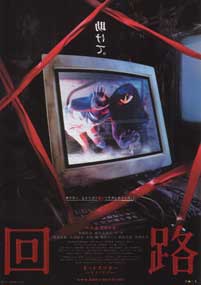
Movie Review – Pulse (2001)

Movie Review – Pulse (2001)

Kiyoshi Kurosawa’s Pulse (2001), known in Japan as Kairo, is a slow-paced mystery heavy with melancholy that effectively builds tension in a stark, bleak atmosphere. After a young man commits suicide his friends see his ghostly image on the internet. Soon other suicides follow. The images themselves are not particularly creepy, but rather their enigmatic purpose is as an overwhelming feeling of loneliness spreads. It is this despair that permeates through the film, assisted by depictions of empty streets and a devastated Tokyo, and which stays with the viewer after it is over. The supernatural is used symbolically as a critique of the physically isolating nature of the internet.

At times, however, the film moves a bit too slowly. Also, the scenes focus so heavily on a few characters who are in fairly remote corners of the city that it is not immediately apparent until rather too abruptly that the city is nearly empty.

That being said, there are some fantastic pieces, including a particularly realistic and well-timed suicide. While the message of the movie and some of its reasoning are at times questionable, the mystery, if not the answer, are well worth the exploration.

Grade: C+

Movie Review – Train (2008)

Movie Review – Train (2008)

With a brutal opening sequence of graphic dismemberment, Train (2008) begins on an unwavering track aimed to please gorehounds and fans of films like Hostel (2005). Directed and written by Gideon Raff, and starring Thora Birch, Train was originally set to be a remake of the Jamie Lee Curtis slasher Terror Train (1980), but evolved, if one can accurately ascribe that term to this film, into an original story.

Through numerous logical failures, an absurd script, and incredibly stupid characters who continually throw away their weapons to keep the film’s running time longer, Train is slowly derailed. Case in point: three wrestlers with an axe can’t overcome one guy, and their attempt is so halfhearted you actually want to root for their attacker. That these characters are strong athletes in a physically demanding sport seems forgotten by the filmmakers until the final battle, which is among the most ridiculous I have seen. Add to all of this Thora Birch, who I had expected to be the highlight, giving a performance where she seems incapable of expressing either fear or compassion and instead walks through the movie as though in a bored, stone-faced daze. Impressive practical effects, unfortunately, cannot mask the film’s many, many shortcomings.

Grade: D-

Create a free website or blog at WordPress.com.

Up ↑