Search

The Revenant Review

Horror Film History, Analysis, and Reviews

Category

Movie Review

DADDY DREADFUL – The Worst Witch (1986)

This review is part of the Daddy Dreadful review series.

Daddy Dreadful Review – The Worst Witch (1986)

I can’t help but to have a bit of anxiety when revisiting the influential films of my childhood even as I am excited to watch them with my son and see them anew through his eyes. Ultimately, it may be disheartening to have my fond memories tainted by the viewing of a film that clearly hasn’t aged well. Of course, nostalgia can carry us a long way, and I have to assume that is largely the case with the enduring popularity of 1986’s The Worst Witch. My wife watched this movie every Halloween season on a well-worn VHS recorded from television throughout her childhood. As we sat down to watch it with my son (age three) – my first viewing and his – she texted her two brothers a screen shot and they too felt compelled to find a copy and watch it that same night.

The Worst Witch is based on the Jill Murphy’s children’s book of the same name. It stars Fairuza Balk in her second of three films involving witches in her career, the first being 1985’s Return to Oz and the next 1996’s The Craft. Also starring are Diana Rigg, Charlotte Rae, and Tim Curry. The film was a collaboration between HBO and UK television, and the production quality is clearly minimal. The editing is shoddy and the story, especially the climax, is weak. There are three songs of varying quality: the first is cute and probably the best, the second catchy for kids but Charlotte Rae certainly wasn’t going to win any vocalist awards for it, and third one, performed by a confused-looking Tim Curry before a green screen, is an acid-trip of 1980’s kitsch. Rock Horror this ain’t. In addition to the worst witch, the film may also showcase the worst lyrics:

Your dentist could turn into a queen,
Has anybody seen my tambourine?

Of course, none of this mattered to my son. He loved Aggie’s song and sang it for days. I thought he’d be bored with the fairly slow pace of the movie but he asked to watch it again and again as the month of October went along. It’s a harmless film with nothing objectionable. I have to admit that there is a minor charm to all, and seeing the similarities that J.K Rowling would employ in the Harry Potter series can on its own occupy the focus of one’s viewing. As a bat lover my eyes widened when one girl briefly walked in with a live megabat hanging from her hand, and I wish we could have seen more of that. My wife recognizes the film’s shortcomings but, knowing it word for word, doesn’t adore it any less. Who am I to shit in their punch bowl?

Recommended Age: 3+
Final Thought: Soft recommendation. If you’re nostalgic for it, indulge to your heart’s content. No judgement here. For the kids it’s probably best for the preschool crowd before they graduate to Hogwarts. If you’ve never seen it before and want to, you might want a hard drink handy.

DADDY DREADFUL – Curious George: A Halloween Boo Fest (2013)

This review is part of the Daddy Dreadful review series.

Daddy Dreadful Review – Curious George: A Halloween Boo Fest (2013)

I loved the Curious George books as a young kid, attracted as I was to the illustrations and the bold yellow which swathed the covers. It wasn’t until my son came along that I saw the troublesome monkey in any other media, and thus far the animated features celebrating the seasons are what we’ve watched. Curious George: A Halloween Boo Fest (2013) served as a great introduction to the Halloween season for my son – it’s got pumpkins galore, music, the legend of a hat-kicking scarecrow named No Noggin, and a celebration of “boo” scares.

There was nothing that frightened my son though the movie definitely left an impression. He enjoyed jumping around yelling “boo!” afterward and mentioned “No Noggin” each time we put on our hats. The story is appropriate for preschoolers and, being under an hour, doesn’t outstay its welcome for the adults.

Recommended Age: 3+
Final Thought: Recommended for the preschool crowd.

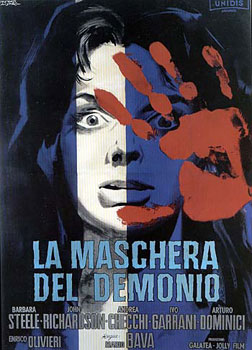
Movie Review – Black Sunday (1960)

Movie Review – Black Sunday (1960)

Mario Bava is a legend of Italian horror. During the 1960s and 1970s he helped to pioneer both giallo and slasher films. Before then, throughout the 1950s, he was an effective cinematographer who did some milestone jobs, often taking over when other directors walked away from projects. Two of these movies are considered the first horror and the first science fiction entries in Italian cinema, respectively.

But it was in 1960 that Bava received his first solo directing project, and he chose to loosely adapt Nikolai Gogol’s horror short story, “Viy”. The result was Black Sunday (1960), today considered a Gothic classic, but at the time was considered extremely graphic, so much so that it was banned in the UK until 1968.

The plot revolves around the resurrection of a vampire-witch who was murdered centuries ago, and who is now seeking revenge on her executioners’ descendants. The plot is admittedly thin and at times muddled, but it’s also not really the point. Filmed purposefully in black and white, much like Alfred Hitchcock’s Psycho (1960) which released the same year, Bava’s skills as a cinematographer are on full display. He creates rich compositions and cleverly employs shadow and light to announce characters and elements. He understands the way the eye moves along the screen and exploits it for surprising reveals. The story serves the visuals, not the other way around.

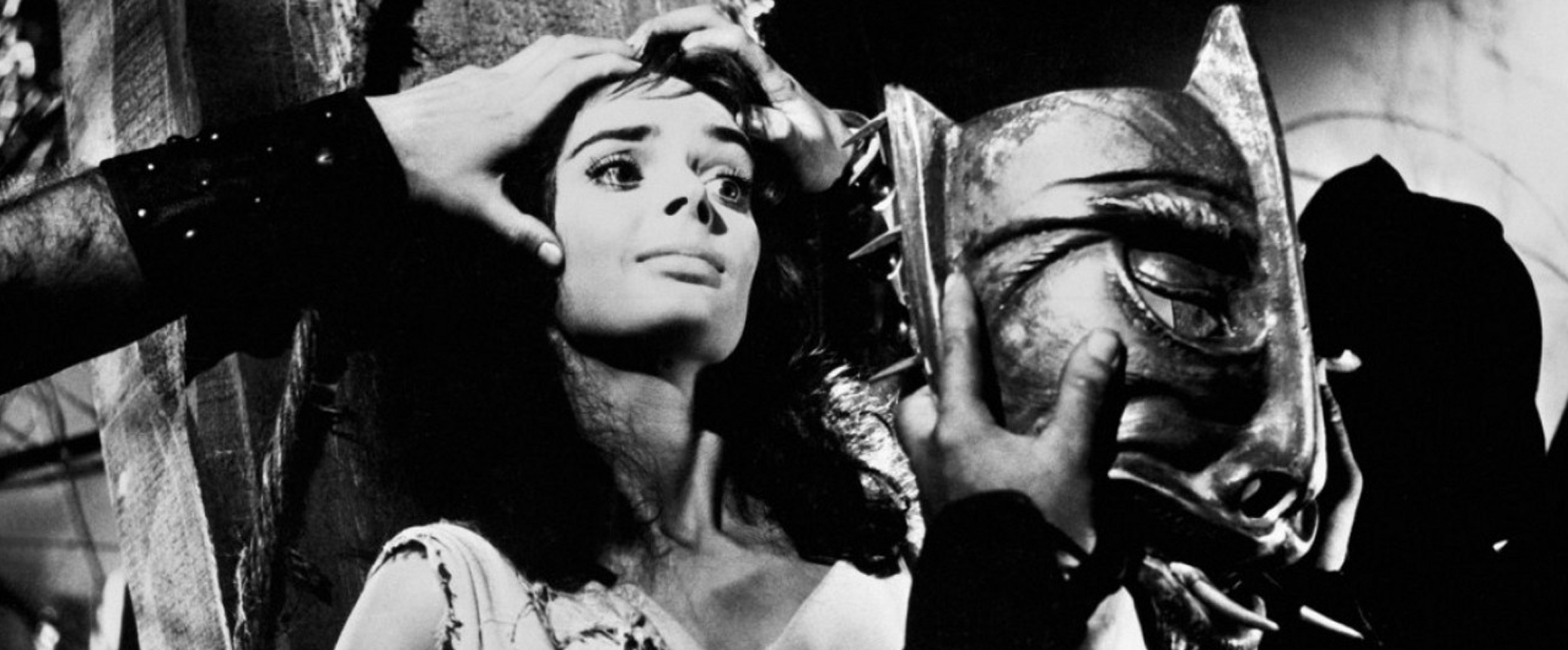
The film still has the power the shock, especially its opening sequence where a mask of spikes is nailed into the witch’s face. The effects are also still impressive, such as the reanimation of a skeleton as Bava plays with light to make it appear as though eyes are being formed in the hollow sockets. Old school techniques stand beside the new, like using make-up and special lens filters to make it appear that an actor’s skin is changing, used famously with Fredric March in 1932’s Dr. Jekyll and Mr. Hyde.

Black Sunday 1960 still

No less importantly, the film marked the debut of Barbara Steele, a British actress who would go on to become a horror icon through the next two decades, and who is still making horror movies to this day. Some of her more notable entries include The Pit and the Pendulum (1961) with Vincent Price and a famous bathtub scene in David Cronenberg’s Shivers (1975).

The pace of the story can be slow moving, which may challenge modern viewers. Also, as was typical with Italian films, the voices are dubbed, sometimes not terribly well. Even Barbara Steele, who is speaking English, is dubbed over with an American accent. But Black Sunday has a tremendous amount to offer for those with the patience to appreciate it. It feels like a Gothic horror from the 1930s infused, or updated, with a taste of the gore and sexuality that would harken the more visceral horror of the coming decades. Any list of great Gothic horror films would be incomplete without this film’s admission.

Grade: B

Movie Review – The Mirror (2014)

Movie Review – The Mirror (2014)

The Mirror (2014) is a British found footage film that was written and directed by Edward Boase. Boase was inspired by a 2013 news article that told of a mirror being blamed for its owners’ run of bad luck. Made on a micro-budget of only £20,000, the story centers on three flat-mates who buy a purportedly haunted mirror on Ebay and set up cameras in the hopes of winning The James Randi Educational Foundation’s Million Dollar Challenge, which until 2015 was a real challenge that offered one million dollars to whomever could scientifically demonstrate the paranormal. It was tool meant to debunk the validity of such claims and no one was able to successfully claim it.

Hoping to get rich quick, the three friends hang the unassuming mirror in their apartment and it isn’t long before one of them, Matt (Joshua Dickinson), begins sleepwalking and acting stranger and stranger. Essentially, this is the whole movie – we see Matt quietly wander the flat at night, sometimes being menacing, while those around him make profoundly stupid decisions. It becomes tedious and tiresome in equal measure, both from the film’s execution and from the thick-headedness of the characters. For instance, their apartment is broken into and they immediately blame the mirror instead of calling the cops, even though the front door was ajar when they returned and the mirror has thus far done nothing. Did the mirror trash the place and then run to the store for a pack of cigs? When their friend suddenly goes blind do they call an ambulance from the phone that is clearing mounted on the wall in the hallway? Nah, they just put him to bed and tell him to rest so they can fret endlessly about not knowing what to do.

Other questions abound: Do they work? Is Matt the only one who knows how to lock a door? Are they really going to run around the house panicking, searching for their lost and possibly homicidal friend with microphone equipment clipped to their pajamas?

So little happens with the lackluster mirror – I’ve seen creepier mirrors in Home Goods – that it becomes irritating each time they remind us it’s there and is supposedly causing these issues. We know that the mirror is, for the purposes of a horror film, supposed to be haunted, but this conclusion is continually reached through such asinine reasoning by the characters that they come to perfectly represent the very impressionable, superstitious people that The James Randi Educational Foundation seeks to expose and/or educate. I’m confident this was not the film’s intention. They may be right about the mirror because this is a horror film, but their methods in reaching this conclusion are anything but logical or reasonable. Consider their acquisition of the mirror – they purchase it on Ebay taking at face value the seller’s insistence that it’s haunted and then devote their time and resources to prove that unfounded claim. Clearly, they aren’t geniuses and would likely make very poor investment partners. With a little tweak to the script such as making the mirror a family heirloom with a legendary past their focus and dedication might have been a little easier to swallow.

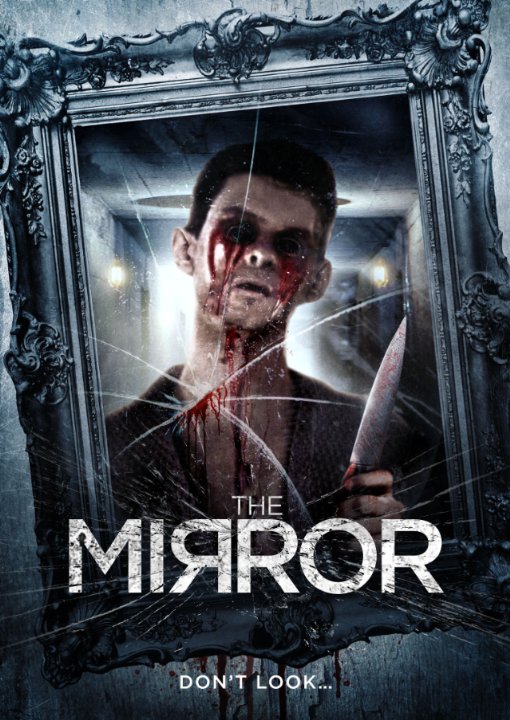
While the actors do a decent job with what little they’re given, there’s nothing to recommend The Mirror. I applaud the filmmaker for making a movie with so few resources, but what is offered will be repetitive and stale to any but the newest of horror watchers. If you’ve seen the movie’s poster, you already know the lone possibly horrific scene in the movie. The same poster warns the potential viewer “Don’t Look…” That’s good advice.

Grade: D-

Movie Review – Eerie Tales (1919)

This review is part of the A Play of Light and Shadow: Horror in Silent Cinema Series

Movie Review – Eerie Tales (1919)

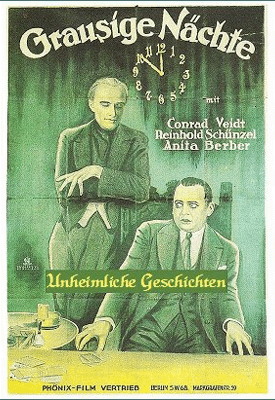
Eerie Tales (1919) is a German film released right on the cusp of the Expressionist movement, predating The Cabinet of Dr. Caligari (1920) by only a few months, and one can clearly see German cinema moving in that direction through this movie.

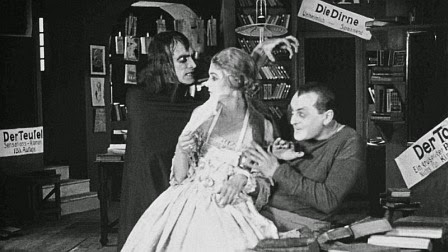
This film is one of the earliest examples of the horror anthology, perhaps even the first. The story revolves around a bookshop in which three portraits – the Devil, Death, and a prostitute – come to life and read scary stories from the stacks of books. The three main actors play both the portraits and all of the lead roles in the five stories, and they look like they’re having a blast doing so. The tone of the film is mirthful and a lot of the joy in watching Eerie Tales lies in seeing the actors trying different roles. Most of the stories are the predictable macabre tales of the time, and of course includes one by Edgar Allan Poe. As they nearly all involve a love triangle of sorts, the plots tend to blur together. The movie certainly creaks in places, but overall it’s a nicely paced romp for those acclimated to the filming styles of the time period, particularly the limitations.

Eerie Tales 1919 still1

Like with The Student of Prague (1913), gaining insight into the people involved makes the work more pleasurable to watch. Their stories tell a great deal about Germany between the wars, and their individual lives are generally fascinating. First is the film’s director, Richard Oswald, who would over the course of his career direct over 100 pictures (he was more prolific than good, unfortunately). Most significantly, in the same year he made Eerie Tales, he also directed the profoundly important Different from the Others, featuring the first gay character written for cinema. What makes this film so amazing is that the portrayal of the homosexual is entirely sympathetic. Not surprisingly, the Nazi censors would end up destroying most copies, but fragments do still exist. When the National Socialists overran Austria, Oswald, being Jewish, fled to America and had a waning career in Hollywood.

And who played the gay character in Different from the Others? None other than Conrad Veidt, who plays Death in Eerie Tales and who is one of my personal film heroes. Truly, Veidt is the only actor that can rival Lon Chaney in his work in silent horror. Fascinated by acting at an early age, he hid his passion from his disapproving father but was quietly encouraged by his supportive mother. In World War I he took part in the Battle of Warsaw but contracted jaundice and pneumonia. After recuperating he was still deemed physically unfit and was discharged from the army, and so he tried his hand at theater, eventually being hired as an extra by the renowned German Theater run by Max Reinhardt. His skills were quickly recognized and his roles increased. He made dozens of films, including of course Eerie Tales, before getting his international breakout role as Cesare in Robert Wiene’s The Cabinet of Dr. Caligari (1920). He would become the second-highest paid actor in Germany (behind Emil Jannings) and star in the horror films Waxworks (1924), which won him the admiration of American actor John Barrymore, The Hands of Orlac (1924), The Student of Prague (1926), and Paul Leni’s American masterpiece The Man Who Laughs (1928), which would inspire Bob Kane to create the Joker.

Committed to tolerance and liberalism, Veidt was a staunch anti-Nazi and outspoken enemy of Hitler. Joseph Goebbels, the Reich Minister of Propaganda, recognized his value and offered an Aryan certification to his half-Jewish wife if he would sign an oath of loyalty. Veidt refused and tried to leave for England but was placed under house arrest by the Gestapo and even ordered executed, but was eventually allowed to leave in order to avoid an international incident. Though not Jewish, once arriving in Britain he signed his religious affiliation as “Jew” and made a pro-Jewish film, thumbing his nose at his homeland’s anti-Semitism. In the era of talkies Veidt’s accent meant that he would be offered many roles playing Nazis, most notably in Casablanca (1942), and he had no qualms about taking them and revealing the horrific nature of the National Socialists. All the while, nearly all the money he made would go to the British war effort. Tragically, he died suddenly of a heart attack on a Hollywood golf course at the age of 50. In the 1920s he was known in Germany as the “Demon of the Silver Screen,” but in addition to being a brilliant actor Veidt was a true hero at a time when such moral fortitude was most needed yet was in such short supply.

Eerie Tales 1919 still2

The second male of the film’s acting trio playing the Devil is Reinhold Schunzel, who would go on to direct extremely popular films in Germany, so popular that despite his Jewish background the Nazis would name him an “honorary Aryan,” meaning they wouldn’t kill him if he kept making good films. That wouldn’t stop them from interfering, and in 1937 he went to Hollywood where his directing career sputtered. He eventually went back to acting, but after the war he carried the stigma of having stayed and worked in film with the blessings of the Nazis and found work increasingly hard to come by.

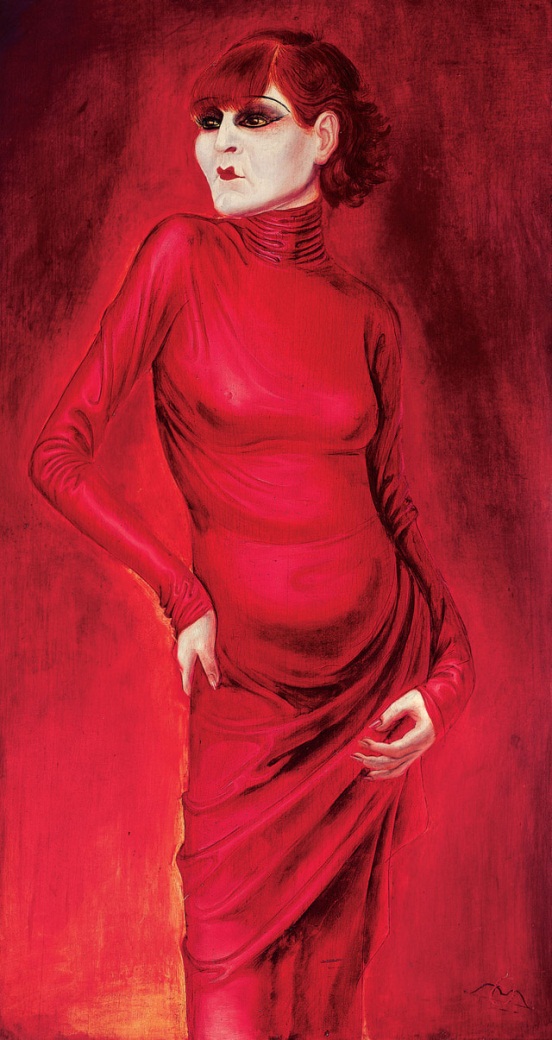
Lastly we have the role of the prostitute, and for Anita Berber the part probably wasn’t a stretch. During the 1910s Berber became a popular exotic nude dancer and quickly made a reputation for herself as a voracious lover of men and women. She became the embodiment of Berlin’s debauchery during the Weimar Republic. Many today would never believe that before the Nazis rose to power Berlin was arguably the most liberal and hedonistic city in Europe, mainly a result of the postwar economic downturn attracting foreigners with money looking for fun. Berber obliged. She was known to perform stark nude, the dances named after amphetamines, and was often seen walking around Berlin with her pet monkey wrapped around her neck. Marlene Dietrich could be counted among her lovers. She continued to dance throughout the 1920s while imbibing in copious amounts of alcohol and cocaine. Those substances would rack her body and, like the original candle in the wind, she would die of consumption by the age of 29 in 1928, but not before she would be captured for posterity in a famous painting by Otto Dix in 1925.

The Dancer Anita Berber by Otto Dix

On its own, Eerie Tales is a middling effort. But knowing the performers elevates the experience, at least for me. It’s great to see these people working together with such clear bacchanal joy, especially knowing that the dark cloud of fascism is moving ever closer and that so much of what they embody would no longer be tolerated, including tolerance itself.

Eerie Tales 1919 still3

Oswald would flee. Veidt would defy. Schunzel would collaborate. And Berber would burn out as a symbol of a dying age. Eerie tales, indeed.

Grade: C+

Movie Review – The Changeling (1980)

Movie Review – The Changeling (1980)

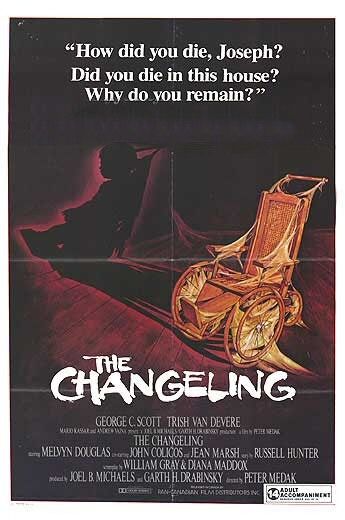
Any late-comer who watches The Changeling (1980) will have to contend with its considerable reputation, at least in the more discerning circles in which it is praised. Based on supposedly true events that writer Russell Hunter experienced while he was living in the Henry Treat Rogers Mansion in Denver, Colorado, the film won the first ever Genie Award for Best Canadian Film as well as awards in many other categories. Martin Scorsese placed it on his list of scariest movies of all time.

The plot follows a musical composer (George C. Scott) who is torn by grief, having just lost his wife and daughter, as he relocates to Seattle to concentrate on his music and to begin lecturing at a local university. He rents an old mansion owned by the historical society because of its music room and soon starts experiencing loud bangs and doors opening on their own. It isn’t long before he realizes the ghost of a child killed eighty years prior haunts the place, whose murder was covered up, and to further matters there may be a connection to a wealthy old senator.

The Changeling is filmed beautifully and the sets are terrific. The mansion is huge and exquisitely carved, yet manages to still feel claustrophobic and foreboding. The musical score is enchanting, often appropriately reflecting the main character’s piano numbers. The script unravels a very good plot as the secrets regarding the ghost’s origins are revealed, and the history-nerd in me is always a sucker for horror movies in which the characters are seen searching through old documents and libraries in the hopes of finding answers. The cinematography, too, is impressive and the shots well-framed.

There are definitely some scenes that will linger in the mind after viewing, particularly the séance. The most haunting for me is the one where a mother describes her daughter screaming in the night that a boy was trying to crawl out from her bedroom floor. It’s the imagining of the scene that is more effective than if it had been shown. And the wheelchair scene is of course iconic, if admittedly a bit silly.

The Changeling 1980 still

Is The Changeling deserving of all its praise after thirty-five years? In many respects it is, but it’s certainly not without its flaws. The film takes a little too long getting to the ghost story – the horseback riding scene could easily have been edited out, for instance – and some of the main character’s actions are questionable (such as hiding information and evidence). Keeping in mind the memorable scenes mentioned above, some scares are certainly less effective and clichéd, and the director has a habit of irritatingly cutting to another scene just when a powerful image is beginning to take shape. The music, which I praised earlier, can nevertheless at times be overbearing and a distraction. I sense an influence from Dario Argento’s Suspiria (1977), with its constant assault of noise and colors, and it appears here that the director attempts a more subdued form of that approach to varied success. (The director is Peter Medak, a Hungarian who fled his home country in 1956 during the Hungarian Revolution.)

George C. Scott’s performance has often been hailed, and while it didn’t affect me personally I can see why others might be moved by it, and the supporting cast does well enough, including Scott’s wife, Trish Van Devere. It was also nice to see Melvyn Douglas playing the aged senator. He would go on to star in another ghost movie, Ghost Story (1981), the following year just before his passing. At the beginning of his career he had starred in James Whale’s Old Dark House (1932), one of my favorite horror films of the 1930s and an early example of campy humor being infused into the genre. As a genre fan it’s great to see an accomplished actor with such a long résumé bookend his career with notable horror entries. And for those fellow Trekkers out there, the guy who plays De Witt is John Calicos, who played the first Klingon in the original series and who would memorably reprise that role in Star Trek: Deep Space Nine.

The Changeling is a good ghost yarn with many strong aspects. It attempts to tell a creepy ghost tale with class and relative minimalism. In my opinion, it has been surpassed by subsequent haunting movies, and calling it one of the scariest films of all time is a considerable overstatement. Nevertheless, it’s still a classic worthy of respect and worth seeking out.

Grade: B

Movie Review – Killer Mermaid (2014)

Movie Review – Killer Mermaid (2014)

Killer Mermaid (2014), also known as Nymph and Mamula, is the first ever Serbian creature feature. The director, Milan Todorovic, also directed the first Serbian zombie film, Zone of the Dead (2009). A horror concept like a killer mermaid was once laughable, until of course we saw something like it in Cabin in the Woods (2012). Nevertheless, when you go into a creature feature like this, you have a pretty good idea of what to expect, and those expectations are never high.

Honestly, that may be to best way to approach this film, as it’s more well-done than one would at first suppose. The film begins like a B-movie exploitation flick, with a naked girl and a typical slasher-style killing, but this appears more like a ploy to get the audience’s attention as it tries to skirt away from a reliance on those tropes for the rest of the film. The first half of the movie is actually devoted to character development and flushing out their connections, which succeeds only partially. The mermaid doesn’t even enter in until the second half of the film, and her scenes are actually very impressive. The cinematography, too, is very appealing. It is shot on location at the island of Mamula, which is uninhabited and houses a nineteenth-century fort which, during WWII, was converted into a concentration camp by Italian fascists and became infamous for the tortures which occurred there.

This is all not to say that this is a great film. The acting is shaky and we spend a lot of time with characters just running around an island trying to hide from a crazed killer, sometimes making stereotypically poor decisions. Also, for some reason the movie focuses on two American girls, though one clearly has an accent (Ukrainian) which is never explained.

But really, the film tries harder than I would have given it credit for, and I was never bored while watching it. Instead, I wanted to see more of the mermaid, which is effectively only teased at for the majority of the film. She is actually creepy, which given the premise one can imagine is no small feat.

Killer Mermaid is an entertaining ride that just might surprise some genre fans in the mood for something light and fun. It’s a B-movie that doesn’t try to be an A-film, but that doesn’t condescend to its audience either.

Grade: C

Movie Review – Eyes of the Mummy Ma (1918)

This review is part of the A Play of Light and Shadow: Horror in Silent Cinema Series

Movie Review – Eyes of the Mummy Ma (1918)

1918’s Eyes of the Mummy Ma is a German film which, despite its title, features no mummies. Instead we get Emil Jannings in blackface playing the role of an evil Egyptian who hypnotizes a young woman, the Ma of the title, played by Pola Negri. Jannings’ makeup is applied haphazardly, leaving exposed gleaming white hands, arms and shoulders. I don’t expect cultural sensitivity in films of this era, but I expect a little more effort from filmmakers to assist the audience in suspending disbelief. For her part, Ma spends the film fainting and doing awkward “exotic” dance numbers. The story is too weak to warrant its feature length run-time, and pacing is a serious issue (thank the movie devils they resolve that, for most films, in the next decade).

The Eyes of Mummy Ma 1918 still

The director, Ernst Lubitsch, would go on to earn great respect with his talky films, including 1940’s The Shop Around the Corner, which my wife and I enjoy watching during the Yuletide season. But this early effort, and one of his only forays into horror, is easily forgettable, and it makes me sad that films like this survive while those like Tod Browning’s London After Midnight (1927) are probably lost forever. This would be the first of many successful collaborations between Lubitsch and Negri, who was the first European film star to be invited to Hollywood where she would have a thriving career for the remainder of the silent era.

Emil Jannings had an enormously successful career both before and during the Third Reich, at one point being Germany’s highest paid actor. He would star in other horror classics, notably in Paul Leni’s Waxworks (1924) and as Mephisto in F.W. Murnau’s Faust (1926). He starred in numerous Nazi propaganda films and was even named by Minister of Propaganda Joseph Goebbels an “Artist of the State” in 1936. After the war, Janning’s was unable to work due to denazification and he retired to Austria where he died of cancer in 1947.

Grade: D-

Movie Review – The Houses October Built (2014)

Movie Review – The Houses October Built (2014)

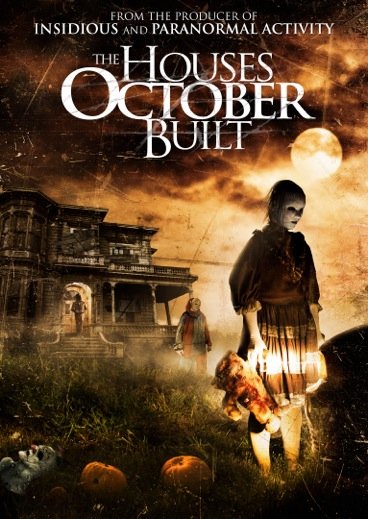
The Houses October Built (2014) is a found footage horror about a group of friends on an RV road trip in search of extreme haunted house attractions, until they are stalked by some of the more unnerving performers and the scares start coming to them. Directed by Bobby Roe, who also stars, and co-written by him and some of the others who also star, the movie begins with an intriguing premise. Halloween haunted house-like attractions are a surprisingly under-utilized setting for horror films, with the main exception being Tobe Hooper’s The Funhouse (1981). The film is part found footage, part docu-style, and although the film is sometimes creepy but not terribly scary, it does actually do a good job of making one apprehensive about visiting such attractions – it unsettles the security one feels that they will be untouched. Who exactly are behind those masks? Have there been background checks? What’s to stop a killer from dressing up and taking people out, hiding them amongst the fake body parts and theatrical blood?

As has been mentioned, there are some creepy parts to The Houses October Built, particularly one involving a girl in a porcelain doll mask. And if you’re afraid of clowns, there’s plenty of them around. The narrative actually owes a lot to The Blair Witch Project (1999), with thuds on an RV standing in ruffles on tent fabric.

However, the movie falls into some of the unfortunate traps of found footage that ironically could have been fixed with a few more lessons from Blair Witch. Firstly, we’re never given a convincing reason as to why these people would be filming everything. They say they’re documenting their trip, but real people would forget about the camera after constantly being approached by hostile locals and being terrorized by strangers in frightening Halloween costumes. Had they been documentarians committed to the craft, we might have believed their persistence in filming. Also, it would have helped to have more camera perspectives rather than the single hand-held cam and a few stationary shots from mounted cameras (and why was there a camera facing the front of the RV?).

Lastly, Houses pulls its punches far too often, having much of the violence take place off camera. Blair Witch can get away with this because of the mythology it was building and the supernatural nature of the antagonist. But in Houses they’re people in masks and what we have is the equivalent of a slasher film that turns the camera away every time someone is killed. The ending is also abrupt and anticlimactic, and the creepy characters we’ve been seeing are inexplicably replaced by henchmen in skull masks who basically all look the same. There’s simply no pay off, and I for one was left feeling very disappointed.

The Houses October Built does not reach its promising potential, but I could easily see it fitting into a rotation of Halloween films. As said before, there’s really no onscreen violence, and though it’s unrated it could easily be shown on television with very little editing. On its own it’s generally avoidable, but just before going to a haunted attraction it might serve to set the mood perfectly.

Grade: D+

Movie Review – The American Scream (2012)

Movie Review – The American Scream (2012)

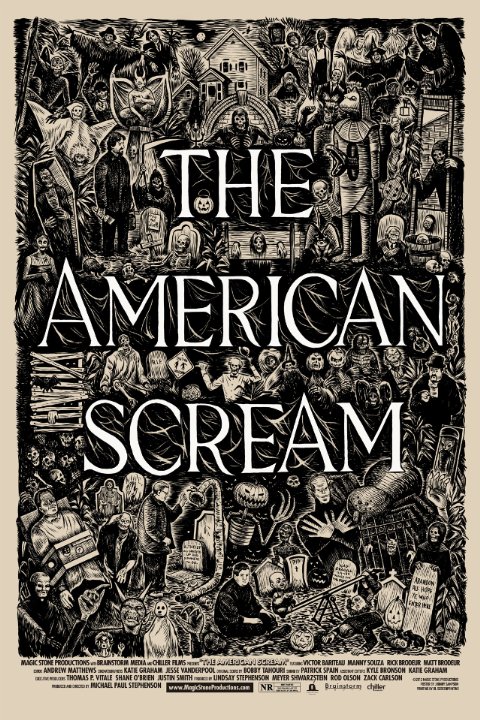
My childhood memories of Halloween are all fond ones, but the ones that stick out most involve visiting those houses on the block that went the extra mile. They would create sensory wonders in their homes or in their yards, inviting people into their creative world to be scared or awed, or both. Strobe lights, gravestones, jack-o-lanterns lighting the paths, descending spiders, shrieking ghosts, eerie music and sounds being fed from the darkness, and if you were really lucky, a neighbor with questionable judgement jumping out with a chainsaw dressed as Leatherface. Everyone embraced the macabre for just one night. We faced our fears of death and laughed at our own mortality.

The 2012 documentary The American Scream, which first premiered on Chiller, follows three working-class men in Fairhaven, Massachusetts, whose drives and passions lead them to create extravagant “home haunts” even more elaborate than the ones I experienced as a child. It highlights the amount of work, dedication, inventiveness, and personal resources required to make an even minor home haunt successful. While the men’s reasons vary somewhat, all are ultimately motivated by communal celebration, and the film, directed by Michael Stephenson, captures the spirit that made my own childhood experiences so special. As one of the men says, “Everybody’s screaming, they’re smiling, and that’s the point… Halloween is intensely special to me and it feels very different from every other day. It’s a community thing, it’s not just a family thing – Thanksgiving and Christmas are family holidays. Halloween brings the whole community together. You’re not going to see that any other time of year.”

The American Scream is an endearing documentary, even if it’s a bit light on content given its length. Nevertheless, it really makes one appreciate just how much effort and commitment it takes to pull off a home haunt, and I for one would love to see the trend continue and grow.

Grade: C

Movie Review – Blind Justice (1916)

This review is part of the A Play of Light and Shadow: Horror in Silent Cinema Series

Movie Review – Blind Justice (1916)

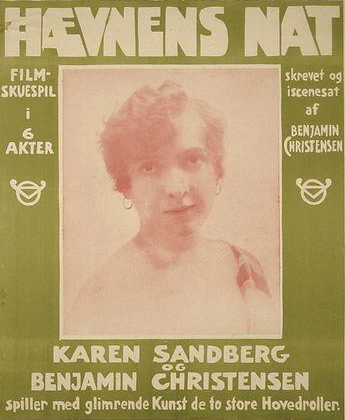
Blind Justice (1916) is a Danish thriller directed by Benjamin Christensen, who also plays the lead character – the tragic and simple-minded Strong John, a circus strong man who is falsely accused of murder. On the run with his infant son, John mistakenly believes a young woman, Ann, has betrayed him, causing him to be caught and imprisoned. Fourteen years later he’s acquitted as new evidence comes to light. He leaves prison a broken man, in search of his son who he believes is forever beyond his reach. Eventually, Strong John comes under the influence of local thieves and soon decides to carry out the revenge he promised upon Ann – to strangle her with a rope – not knowing how connected she now is with the circumstances of his boy.

Blind Justice is a tightly crafted tale of interweaving subplots and terrific characterizations, especially in the sympathetic John. It is well-paced, the lighting is excellent and the camera placement creates many shots of depth and intriguing, almost voyeuristic perspective. One memorable shot is of Ann in her bedroom looking frightened into the camera, only to have the camera pull back into the night to reveal the window frame and John’s silhouette creeping before the panes. The scene where a monkey puppet in baby’s clothes is revealed, due to the camera’s perspective, might qualify as a very early fake jump scare (and is still better than a screeching cat). Even the inter-title cards are stunning and evocative.

Blind Justice 1916 still

The last twenty minutes had me anxiously watching the screen, my legs restless. That’s no small feat for a silent film, especially since I watched it on mute so as not to be distracted by the generic music that was being played over it. Blind Justice is thoroughly impressive.

Of course, this was still 1916, of which I was reminded when the circus manager yells, “Get the crocodile act on at once and warn the Chinks to be ready twenty minutes earlier!” But that’s all just part of the experience of watching an old film like this, as is the final frame which comes after the tense finale, and which is a title card that simply reads “SLUT.” Come to find out, this means “END” in Danish.

Christensen would have many false starts in his film career. When Blind Justice was not met with great success he returned to the theater. But in 1922 he would return to horror to direct the seminal Häxan which contained what was considered at the time graphic depictions of torture, nudity, and perversion. Christensen would continually return to film, fail, and then go back to the theater in a cycle thereafter. The actress who played Ann, Karen Caspersen (as Karen Sandberg), would go on to appear in films until she died in a house fire in 1941.

Blind Justice is a major achievement of the early silent era that deserves more recognition.

SLUT.

Grade: B

Movie Review – Crimson Peak (2015)

Movie Review – Crimson Peak (2015)

In an early scene in Guillermo Del Toro’s Crimson Peak (2015), our American heroine, Edith Cushing (Mia Wasikowska), is trying to write a novel which someone casually dismisses as a ghost story. “It’s not a ghost story,” she tells him, “it’s a story with ghosts in it.” The same description can be applied to the film’s approach to the supernatural. As Cushing states in the opening, “Ghosts are real. That much I know.” This is less an indication of what is to come for the audience, who would be justified in anticipating a story infested with malevolent entities, and more of a statement of fact. In Cushing’s world ghosts exist and they sometimes interact with mortals, just as her inky mother visited her as a child and cryptically warned her to stay away from Crimson Peak. Ultimately, however, in this tale they are peripheral – truly, the plot would still stand if the ghosts were removed.

Ghosts are not the point, yet they are also not the gratuitous window-dressing their inclusion may at first appear to be. Cushing says that in literature they are metaphors for the past, and that is to some extent true for this treatment of them, though Del Toro’s preoccupation with moths and butterflies in the film could offer another. The ghosts may be the past coming back to haunt our central character, but they come equipped with knowledge of the present and future. In one scene, as Cushing and the mysterious Lady Lucille Sharpe sit in the park they view butterflies dying in the sun and note at least one particular cocoon. Perhaps death is simply a metamorphosis to an altered state, yet like these butterflies the spirit cannot live in the open. Nevertheless we later see dozens of moths thriving in an attic – the home is the place for the dead, if our centuries of stories are any indication.

Those going to see Crimson Peak expecting a fast-moving modern horror will likely leave the film feeling underwhelmed. The film is a gothic romance, through and through, and is an ode to the gothic writers of the nineteenth century. Set in the last years of the Victorian era, Del Toro takes Cushing from Edith Wharton’s New York high society backbiting to a veritable House of Usher oozing with blood-like red clay. It is the stuff of what Edgar Allan Poe’s contemporaries called “German tales,” where the horrors weren’t the figments of imagination, but real and dangerous. Victorian literature rears its head as Cushing notes a copy of Arthur Conan Doyle on a bookshelf, foreshadowing her own detective work later in the film as she begins to realize the danger in which she has placed herself. I almost wish there were more of these literary nods for I could easily see Cushing being a variation of Jane Austen’s Catherine Moreland from Northanger Abbey (1817), who is so taken with gothic literature that she immediately suspects the worst when first inside an actual, though entirely benign, medieval abbey. Austen’s story was satire (though she personally loved the gothic genre), yet I could imagine Cushing being more mentally prepared for the agitated spirits and murderous mysteries she encounters due to her familiarity with the gothic genre, like the Victorian equivalent of meta-horror in the vein of Scream (1996). To emphasize her as a romantic, rather than a budding logician, might have better served to explain her willingness to be swept away in the more macabre circumstances.

Crimson Peak 2015 still

Crimson Peak is not a film in a rush to tell its story. It’s in no hurry to leave the exquisite sets and impressive period wardrobe that the camera picks up in rich detail. The house is a character unto itself, built whole for the film. While the story looks two centuries back for inspiration, the color palette and general mood look to the period films of 1960s Hammer Film Productions (Cushing’s last name is likely an homage to Hammer’s Peter Cushing) and to the vibrant reds of Italian filmmakers like Mario Bava or Dario Argento. Similarities could easily be made, in period and visual style, with Francis Ford Coppola’s Bram Stoker’s Dracula (1992), though Crimson Peak is in many ways less surreal and more grounded than that film. Nevertheless, Del Toro doesn’t always allow logic to get in the way of his images and gives his imagination relatively free reign, particularly in the aspects of the crumbling estate as red clay flows continuously like blood down the walls or snow falls dreamlike within the house through a hole in the roof. Del Toro’s approach is a conscious contrast to modern horror. He attempts to make horror big both in budget and in ambition again, and perhaps also more respectable to the general audience who may be more forgiving of its horrific qualities if they can get lost in a compelling tale. The story, which was co-written by Matthew Robbins, is not one that will hold many surprises for most experienced viewers, but for those with a fondness for gothic romance there is a great deal to appreciate and respect about Del Toro’s loving treatment of it here.

For all the nostalgia at play, Del Toro’s take on the centuries-old genre is still decidedly modern. Firstly, the gore is consistent with today’s tastes. Del Toro doesn’t let the camera look away from the more uncomfortable and brutal acts of violence, shown in patient, painful detail. Secondly, Del Toro reverses traditional gender roles where men can now be the weak and manipulated sex and women can be dominant, smart, and capable of saving themselves. Gothic romance generally emphasized the female perspective, illuminating fears of patriarchy. Crimson Peak does this too and attempts to infuse its female character with a strong dignity. All in all, it becomes that rare breed of horror film, in a genre dominated by boyish sensibilities, which seeks to attract and focus upon the perspective of the female audience.

The cast is solid, particularly the macabre siblings Sir Thomas Sharpe and Lady Lucille Sharpe, played by Tom Hiddleston and Jessica Chastain. Hiddleston manages to evoke despicability and sympathy in equal measure, and Chastain is perfectly cold and unhinged.

My lone complaint of the film, and it is one on which much of the film unfortunately relies, is the central character of Edith Cushing. She is thoroughly likable and Mia Wasikowska does a fine job in her portrayal, but she lacks a story arc. The head-strong, intelligent woman we see in the beginning is the same head-strong, intelligent woman we see at the end, albeit bloodier. Her single weakness was the desire for her writing to be accepted, but this plot-line ceases half-way through the film and should have come into some significance before the end. She is a surrogate for the viewer and sometimes feels like little else.

Considering his stellar output, it is not a great criticism to say that Crimson Peak is not Del Toro’s best film. For my money, that is still 2006’s Pan’s Labyrinth. However, it is thus far his best English language film, and that indeed is saying something. Crimson Peak is Del Toro the auteur returning from his big budget forays, and if those who watch it know what they’re getting into and allow themselves to be swept down the dark, dank corridors of a bygone era, filled with the suffering cries of restless dead and the malicious secrets of the living, the experience is a rewarding one.

Grade: B

Movie Review – WolfCop (2014)

Movie Review – WolfCop (2014)

WolfCop (2014), written and directed by Lowell Dean, is a Canadian comedy-horror that consciously stays within the bounds of B-movie fare. In the film, a lazy alcoholic small town cop named Lou Garou (“loup-garou” means “werewolf” in French) is abducted by Satanists and turned into a werewolf, to be used towards their own nefarious ends. Finding that he stays conscious while transformed, Garou decides to clean up the town. But things aren’t what they seem and people close to him may not be who they appear.

WolfCop earnestly tries to be a cult classic, but such a status is bestowed, not made. There are some funny sight-gags, especially one involving a genital-first transformation and another with a bloody face being thrown on a windshield. Also, I appreciated the nods to past werewolf myths and classics, from Garou’s name to the use of the pentagram (1941’s The Wolf Man) and a shop called “Stiles Autobody” (1985’s Teen Wolf).

However, WolfCop ultimately does not deliver on its promise. The acting ranges from adequate to amateur, the story moves along slowly, and a lot of the comedy falls flat. At one point Garou decides to modify his police car into something akin to a cross between the Batmobile and Knight Rider, yet the changes are purely cosmetic and never play a part in the rest of the movie. It’s symptomatic of the film’s larger problem – ultimately, there’s simply not enough here.

WolfCop is overall entertaining. It had potential and it tried to be something fun and memorable, and it sometimes succeeded in the first goal but never really attains the second.

Grade: C

Movie Review – The Queen of Spades (1916)

This review is part of the A Play of Light and Shadow: Horror in Silent Cinema Series

Movie Review – The Queen of Spades (1916)

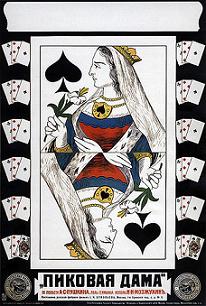
The Queen of Spades (1916) is a Russian horror film made upon the eve of the revolution, which would erupt the following year. It is often referred to as one of director Yakov Protazanov’s masterpieces, and he would go on to make films well into the Soviet era. The film’s star, Ivan Mazzhukin, would flee to Crimea and then to France. His career would thrive until the advent of talkies which exposed his thick accent, effectively making his marketability obsolete.

The plot is based upon Alexander Pushkin’s 1834 short story of the same name and is filled with beautiful sets and lavish costume designs. The story follows a young nobleman who learns that an old wealthy countess was once told of a progression of cards that, when played, were unbeatable. He is determined to get the secret and accidentally scares the old woman to death, only to be visited by her ghost and given the secret. He goes to gamble and at first wins before things begin to unravel for him.

Queen of Spades 1916 still

There is artistry here, certainly, but pacing is an issue. The camera lingers too long too often and left me staring at the screen wondering if I was missing something when, in fact, the character was just slowly finishing a meal and putting on his coat. This has a lot to do with feature length film still being in its infancy, especially in Russia, but the plot is fairly thin and moves quite slowly through its 84-minute running time. I have considerable patience for silent films, and I sometimes even enjoy those long candid shots. Nevertheless, I found my attention being tried here, especially as the plot doesn’t really kick in until the last twenty minutes, and from there it ironically feels too rushed.

That being said, The Queen of Spades employs novel techniques for the time, such as split screen and retrospection. Additionally, it’s easy to see how this film would have resonated deeply with Russians at the time with its depiction of a slothful upper class having little to do but drink and gamble away their fortunes. One scene even shows the countess returning home while beggars are pushed away from the door, ignored by her as she passes. Her privileged class would be overthrown within a year’s time, and one can’t help but see what the poor and underclass must have been thinking and feeling as that day quickly approached.

Grade: D+

Movie Review – Banshee Chapter (2013)

Movie Review – Banshee Chapter (2013)

Loosely based upon H.P. Lovecraft’s “From Beyond” (1934), 2013’s Banshee Chapter, the directorial debut of Blair Erickson, mixes elements both real and unreal to generate effective scares.

When an old college friend takes a mysterious chemical and goes missing, an investigative journalist named Anne goes in search of him and of the origins of the chemical. She eventually tracks down his supplier – a burnt-out, drug obsessed author named Thomas Blackburn, based upon Hunter S. Thompson (Fear and Loathing in Las Vegas), and played brilliantly by horror icon Ted Levine. The plot throws in elements of the factual Project MKultra, which were illegal mind control experiments using human subjects carried out by the CIA from the 1950s into the 1970s, as well as the eerie nature of number stations – strange broadcasts heard on shortwave radios that often have repeating sounds or voices, usually of women but sometimes of men or children, reading numbers. Many of these are likely government transmissions meant to discourage others from using the frequency, but some have yet to be fully explained. Soon Anne and Blackburn are being followed by an otherworldly entity and are in a race against time to find the source before they succumb to it.

Lovecraft, MKultra, and number stations make a good stew. The scares are mostly predictable but they’re also mostly pulled off so well that they’re still effective. The transmission of the number station, which acts as a harbinger for the entity’s approach, is an unnerving soundtrack to the visuals on screen.

Ted Levine is the highlight of the film. He’s a bit like having Jeff Lebowski, AKA The Dude, in a horror film, yet he never devolves into being a mere cartoon version of that character, which in lesser hands he might have become. His Blackburn is sympathetic while maintaining enough mystery as to seem untrustworthy and potentially dangerous. He also manages to get all the good dialogue, like when he tells Anne: “People are afraid of death because it’s so fucking ordinary, it happens all the time.” Levine single-handedly elevates the movie to the point where he almost looks out-of-place within it.

While there are a few instances of found-footage in the film, mainly in the opening, this is not that kind of movie. Nevertheless, the director takes the found-footage approach, filming hand-held and moving with the actors as though he is another character in the film. At times this is distracting, but when the horror elements start it gives that unnerving sensation of a camera swinging and not knowing what its lens will land on.

Yet Banshee Chapter is not without its shortcomings. The plot is threadbare and, except for Blackburn, the characters are all two-dimensional. Even Anne gets no depth. The most we learn about her is her relationship to the missing friend, told only in a few flashback images, and her job. Also, as has been mentioned, despite being genuinely creepy the film is still predictable and borrows heavily from other films, such as The Ring (2002). It’s stuff we’ve seen before, but at least they’re doing it fairly well. Finally, the two twists at the end are rather absurd. The first makes no sense when one considers the effect it would have had over several decades and yet there’s no indication of it in the film, and the second is so obvious as to not be a twist at all.

Christopher Nolan was originally tied to making this film before deciding to do Interstellar (2014), and I can only imagine what he could have created with these strong ingredients already in place. As it is, Banshee Chapter is a film that is worth watching, especially in the dark, but it doesn’t warrant repeat viewings.

Grade: C+

Blog at WordPress.com.

Up ↑