Search

The Revenant Review

Horror Film History, Analysis, and Reviews

Tag

Movie Review

Movie Review – The Phantom Carriage (1921)

This review is part of the A Play of Light and Shadow: Horror in Silent Cinema Series

Movie Review – The Phantom Carriage (1921)

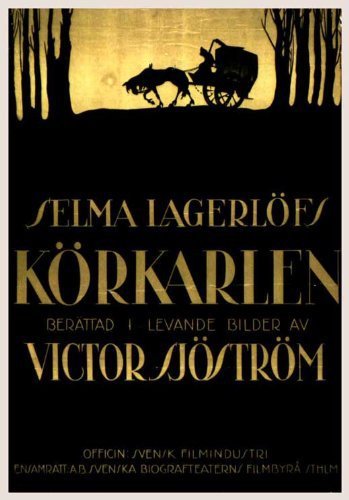
Adapted from the novel Körkarlen (1912) by Nobel prize-winning Swedish author Selma Lagerlöf, The Phantom Carriage (1921) is a Swedish fantasy-horror which had a profound influence upon subsequent filmmakers – the axe-chopping sequence would go on to influence Stanley Kubrick in The Shining (1980) and Ingmar Bergman considered the movie a prime inspiration and even cast the film’s director, Victor Sjöström, in his 1957 Wild Strawberries, considered one of Bergman’s best films. Sjöström had previously made outdoor dramas, and both the content and the studio-bound approach to the filming of this piece, necessary due to the complicated special effects shots and desired deep focus, was a significant departure for the director – and one which paid off in spades.

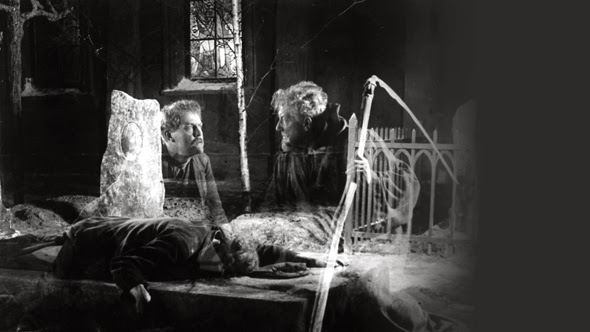
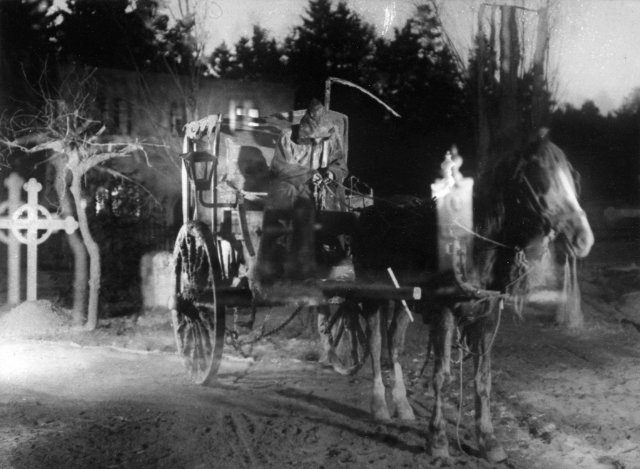
Appropriately released on New Year’s Day in 1921, the plot revolves around a rotten drunkard named David Holm who is killed at midnight on New Year’s Eve, now condemned to become Death’s servant. For a year he must drive a ghostly horse-drawn carriage, collecting the souls of the damned. However, the previous driver for whom he is taking over was an old drinking buddy who helped lead him astray, and, like Marley to Scrooge, Holm is shown the havoc and sorrow his actions have caused and all the opportunities for redemption he dismissed.
phantom-carriage-001

Sjöström, who plays Holm, gives an excellent naturalistic performance. He easily inhabits the role as do the other cast members. There’s very little of that broad overacting often found in silent films. Insight into the director’s personal history may provide deeper understanding of both his approach and his profoundly convincing, touching portrayal. As Paul Mayersberg, in his Criterion essay, writes of the performance:

“Coming from the theater, Sjöström nonetheless rejected traditional stage acting as detrimental to films. He wanted another style of performance since the dialogue could not be heard, concentrating on face, movements, and gestures. His own performance in The Phantom Carriage avoids melodrama by admitting David’s inner confusion, which simultaneously erupts into violence. His outward realism explores inner states. Some of the intertitles are actually voice-over, as he talks to himself…

In 1881, as a small child, Sjöström went to America with his father, Olaf, and mother, Maria Elizabeth, to whom he was devoted. Tragically, she died when he was seven… Olaf was a womanizer, twice bankrupt, and a born-again Christian. In 1893, Victor was returned to Sweden to live with his aunt… All his life, Sjöström feared becoming like his father, whom he closely resembled physically… Perhaps his rendering of David’s alcoholism derived from the tensions in Sjöström’s relationship with his father. His performance is so realistically and subtly detailed that it may have come from precise memories, a ghostly reincarnation of his father.”

Perhaps due also to his father’s religiosity, Sjöström is careful to avoid overtly religious moralizing and divine intervention. His intercessor is his old friend, the current Death’s assistant. Despite this, the film was re-cut when released in America to appear more as a Christian morality tale. There nevertheless remains a diabolical element, for

The Phantom Carriage is at root a Faustian tale, with drink as the devil. If the film were the work of a Jansenist Catholic like Robert Bresson, David’s suffering would be a struggle with God’s design for him, alcohol being the mysterious presence of the divine in his bloodstream, and would probably end in suicide. But for Sjöström, God helps those who help themselves. There is an extraordinary moment when David’s wife faints out of fear at his ax attack and he fetches her a cup of water, only to berate her violently when she recovers consciousness. Here is a glimpse not of God but of a good man within a bad man. Sjöström the actor marvelously conveys the brutish, the melancholy, the sarcastic, and the reflective aspects of his character… Sjöström’s David is a study of tortured self-humiliation.”

The cinematography is beautiful and wonderfully lit, again thanks to the director’s choice in filming in a studio (the story’s author, Lagerlöf, had come into conflict with him when she originally insisted on filming in the town where the tale was set). Some scenes are truly haunting, such as that of Death’s servant retrieving the soul of a drowned man from beneath the murky sea. Likewise, the costumes are rich and the sets are appropriately claustrophobic. Sjöström’s directing is confident and the editing moves the story along smoothly.
MV5BMjAwMzgzNDYwNF5BMl5BanBnXkFtZTgwMzAzMDkwMjE@._V1_SX640_SY720_

The script is tight and sophisticated, even employing flashbacks within flashbacks, which was an advanced storytelling technique for the time. The extensive special effects of the semi-transparent ghosts are particularly impressive when one considers that the double exposures were done in-camera, which had to be hand-cranked at exactly the same speed so as to appear natural.

Though the ghostly carriage is a spooky sight, the actual horror of the film lies in the actions of the living. Holm is at times unstable and needlessly cruel, at one point flicking his sleeping daughter on the nose just for drunken laughs. Yet it is in the final ten minutes that things get really dark, and I wasn’t at all sure how far Sjöström was willing to push the drama, creating a genuine sense of tension and emotional turmoil. Expectedly, his performance here is wonderful.

the-phantom-carriage

The actress, Astrid Holm, who plays the Salvation Army do-gooder, Sister Edit, would star in Benjamin Christensen’s Häxan: Witchcraft Through the Ages (1922) the following year. (As a few points of random observation, Holm is a near dead-ringer for Jena Malone; also, Salvation Army women in 1920s Sweden apparently wore hats with the word “SLUM” on them.)

tumblr_m4r8oqm5101rph0vbo1_1280

The Phantom Carriage is an excellent example of silent cinema, both within the horror genre and beyond, and its prayerful message is a sober meditation on our inevitable deaths: “Lord, please let my soul come to maturity before it is reaped.”

Grade: A

Movie Review – Mother’s Day (1980)

Movie Review – Mother’s Day (1980)

The late 1970s saw the beginning of a trend, beginning with 1974’s Black Christmas and being cemented with John Carpenter’s Halloween (1978), of creating horror films – mainly slashers – centered around holidays or similar annual occasions. 1980, in particular, saw a slew of them, including Prom Night, both Christmas Evil and New Years Evil, and of course the classic Friday the 13th. Curiously, across the lake from where they were filming the opening cuts of the Vorhees clan another slasher was being made, Charles Kaufman’s Mother’s Day. Kaufman is brother to Lloyd Kaufman, co-founder of Troma Entertainment, who ended up distributing the film.

True to Troma’s brand, Mother’s Day is a black comedy exploitation film which was panned upon its release but has since gained a cult following. However, it takes itself a bit more seriously, though not much so, than Troma’s later gross-out offerings. The film centers around three women who went to college together and gather each year to camp in a new location. Unfortunately for them, they choose to make their site near a secluded house inhabited by a sadistic, overbearing mother (Beatrice Pons, credited as Rose Ross) and her two simple-minded, equally sadistic sons, Ike (Frederick Coffin, credited as Holden McGuire) and Addley (Billy Ray McQuade), and soon become their bruised and abused playthings.

Mother’s Day doesn’t so much walk the line between the realms of horror and comedy as it does clumsily stumble one way and then the other. The turns between farcical, almost cartoon-like humor and misogynistic violence can be jarring, and it’s not always clear as a viewer what you’re supposed to be taking from the scene. That being said, some of the scenes are actually funny and some are effectively upsetting, but their overlap would have taken a more nuanced hand to have been pulled off tastefully. Of course, Troma did not build its reputation on nuance.

The end product is not a good film, but it is one that tries to be a bit more than pure exploitation. The three female protagonists are given distinct personalities, meant to be well-rounded individuals, though their depths are still relatively shallow. Also, there is a satirical bent to much of the humor, particularly in the way that the sons process the world. The twisted clan appears to gain most of their knowledge of the outside world based upon what pop culture they can gleam from advertising and poor television receptions (what Mother considers “good” from the city), and when not raping and murdering generally derive their entertainment from copying what they’ve seen on screen, sometimes only superficially. At one point we see Ike and Addley echoing the musical debate of the time, going back and forth with “punk sucks” and “disco’s stupid,” yet it’s not clear if these two characters have any real feelings toward the subject or even any knowledge of the music they’re talking about, or if they’re mindlessly reiterating something they’ve heard on television.

Mother’s Day is far from being a classic, but it is understandable why it has garnered a cult following. It has exploitative violence and inventive kills, and the performances are broad yet solid for this type of film. Beatrice Pons and Frederick Coffin, in particular, embody their cartoonish roles with an admirable gusto. It’s not the kind of movie to share with your mother, but for exploitation and schlock fans it’s certainly a film that will entertain.

Grade: C-

Movie Review – Destiny (1921)

This review is part of the A Play of Light and Shadow: Horror in Silent Cinema Series

Movie Review – Destiny (1921)

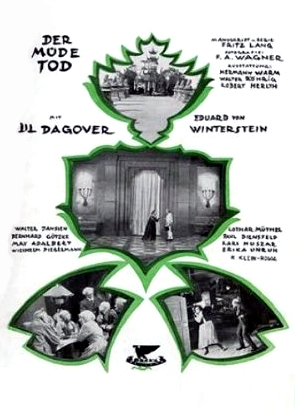
Fritz Lang’s Destiny (1921) can easily be counted among the most influential films of all time. It inspired both Alfred Hitchcock and Luis Bunuel to enter filmmaking, both of whom would make important contributions to the horror genre, and one cannot ignore its clear influence on Ingmar Bergman’s brilliant The Seventh Seal (1957).

Set in the early nineteenth century, Destiny is a dark fantasy. The story follows a young woman who’s fiancé has been taken by Death and is provided a chance to save him – she will have three opportunities to save a life and if she can save but one, her lover will be released. This provides a frame story and three vignettes which take place in fantastical time periods, namely an Arabian Nights-like Persia, the Renaissance, and ancient China, with the inter-titles changing with each setting. The girl, her amorous man, and Death play roles in each, the former two always as star-crossed lovers.

The film is richly imaginative and, for the most part, very well written, providing a fairytale contemplation on the inevitability of death. At one point a character remarks, as if in summary, “How close people often are to death, without a premonition. They believe eternity is theirs – and don’t even survive the roses they play with.” And yet we battle against it. Even those characters who profess to be weary of life and wish an end to it, when confronted with the opportunity to do so, run screaming to preserve their last remaining breaths.

The set designs, too, are stunning and a touch whimsical. Death is depicted by Bernhard Goetzke, whose tall, gaunt figure is perfect for the role. Death is wary of his labor but is stark and unrelenting in the performance of his duty. At one point we see him snuff out a candle of life only to realize it was that of a child. S.S. Prawer wrote in 1980 of one effective component about which I fully agree:

“One film above all others has been able to show convincingly a supernatural enclave, a realm of otherworldly terror and awe inserted into our familiar world. The film which Fritz Lang called Der müde Tod [meaning Tired Death] and which in English is more generally known as Destiny features one of the most haunting sets in the history of cinema: a Palace of Death whose huge sombre wall and mysterious Hall of Lights has only to be seen once to be seared for ever into our memory. Except for Bernhard Goetzke’s quietly impressive performance as Death, however, nothing in the rest of the work lives up to the visual terrors and delights of this grand architectural conception” (Caligari’s Children: The Film as Tale of Terror, pg. 77)

destiny still 3

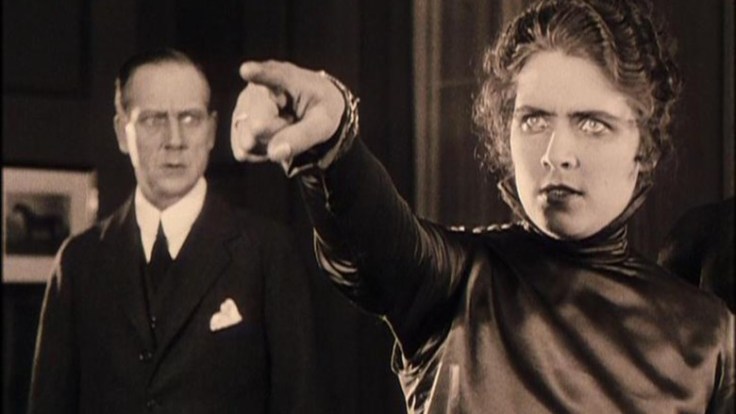
The young heroine is played by Lil Dagover, and her character is determined and fearless, seeking to save the man for a welcomed departure from traditional storytelling. She is challenged in moral ways as well, particularly in one wonderful scene involving her, Death, and a baby in a burning hospital. Will she sacrifice the infant to Death in exchange for her lover?

Only one sequence has not aged well, that being the one set in ancient China. The film changes tone here to one of comical farce and the depiction of Asians is about as cringe-worthy to modern viewers as Mickey Rooney’s Mr. Yunioshi is in Breakfast at Tiffany’s (1961). Had Lang decided to keep the dark tone throughout the whole movie it would have elevated this otherwise darkly compelling tale into a more effectively haunting experience.

The film was poorly received in Germany upon its release. Critics accused it of not being ‘German’ enough. However, it was met with great enthusiasm in other countries. Douglas Fairbanks bought the American rights and delayed its release so he could study and copy the effects of the Persian sequence for his 1924 Thief of Baghdad.

DESTINY still

Fritz Lang, born in Vienna in 1890, ran away from home at the age of 21, dissatisfied with the career path his wealthy father had chosen for him, to study art in Paris and Munich. In WWI he quickly rose in rank through distinguished bravery, being wounded four times and temporarily blinded. It was during his yearlong hospitalization in Vienna in 1916 that he began to write and sell many of his stories and screenplays.

In 1919 he married Lisa Rosenthal and a year later began collaborating with female screenwriter Thea von Harbou, with whom he wrote Destiny. He also began an affair with von Harbou, and one night Rosenthal walked in on the two making love on their couch. Soon police were called to the house and found Rosenthal’s body in the bathtub with a bullet hole between her breasts. The gun used was Lang’s revolver. Producer Erich Pommer and cameraman Karl Freund were called to the apartment to support Lang, and the director used his power to cover up his wife’s supposed suicide. For his part, Freund suspected Lang of murdering Rosenthal. In 1922 Lang and von Harbou were married. (This account is taken from Steve Haberman’s Silent Screams: The History of the Silent Horror Film.)

Whatever his guilt, Lang would of course go on to make history and become the most powerful director in Weimar Republic cinema. In addition to making Metropolis (1927), he also would make the masterful M (1931), his first “talkie,” starring Peter Lorre, considered the first serial killer movie and one I cannot recommend highly enough. It was Lang’s personal favorite. As the Nazis rose to power he knew it was time to leave. Von Harbou had developed Nazi sympathies and, even though he was raised Catholic, his Jewish heritage would make him a target. He immigrated to America and would continue making films into the 1960s, though none had the impact that his Weimar Republic era films had.

Lil Dagover, Destiny’s star, had appeared in The Cabinet of Dr. Caligari (1920) the year before and would go on to a long career, sticking to German films after the advent of “talkies.” Though she remained apolitical, she was known to be a favorite actress of Hitler and dined with him on occasion, though after the war she would appear in anti-Nazi films.

Destiny is undeniably imaginative and always interesting. It’s easy to see why this film inspired so many young filmmakers.

Grade: B-

Movie Review – Deathgasm (2015)

Movie Review – Deathgasm (2015)

Stop. Read the title of this movie again. If this comical conjoining of Eros and Thanatos makes you wary (though it may have made Freud proud), choose a different film to watch. If you’re intrigued, welcome to this review you sick, head-banging motherfucker.

In early 2014 Weta Digital’s Jason Lei Howden won first place in New Zealand’s “Make My Horror Movie” competition, winning the NZ$200,000 prize towards production. Executive Producer Ant Timpson said that “Deathgasm was an early front runner in many peoples’ eyes but it was the sheer enthusiasm and utter commitment shown by Jason and his team that I think helped push the project to pole position.” That same excitement and passion can be seen on the screen, as well.

Howden took inspiration from his youth to write the story of two outcast teenagers who seek escape from their mundane life through heavy metal. Brodie (Milo Cawthorne) lives with his fundamentalist Christian extended-family members who think he’s a Satanist and is bullied by his cousin constantly, and he finds a kindred spirit in Zakk (James Blake), a loner with a fuck-all attitude who helps him indulge in his metal-mania. They form a metal band with two mild-tempered D&D nerds and unwittingly unleash a demonic onslaught upon their town. Joining them is Medina (Kimberley Crossman), Brodie’s crush, though Zakk tries to sabotage their relationship for fear of losing the one guy in the world he’s ever connected with.

deathgasm-header

The basics of the plot are fairly conventional, but it’s Howden’s way of implementing the heavy metal sensibility that allows Deathgasm to really shine, marrying elements of The Evil Dead (1981) with one of my childhood favorites, The Gate (1987), and adding a gory helping of Brain Dead (1992) for good measure. If a word combination like “murder-boner” is likely to elicit a chuckle from you, you’ll most likely connect with the sometimes offensive and often cartoonish humor and clever editing on display here – everything we’ve come to expect and love from Kiwi splat-stick – even if some of the sight gags run a bit too long.

Deathgasm deals heavily with themes of being misunderstood: Brodie is assumed to be miscreant because of his attire; Medina is not expected to like heavy metal; being a Christian doesn’t necessarily mean being nonjudgmental or squeaky clean, etc. The misfits form their own family, finding solidarity in their ostracism and in their attempts to imagine a more magical and accepting world.

Deathgasm (1)

My only gripe with the film, ultimately, is in the ending, which I found to be anticlimactic and somewhat confused. The film builds up this final conflict with a hellish demigod named The Blind One, and I couldn’t help but expect more than what we were given. I am willing to forgive Howden, however, due to the shoe-string budget with which he had to contend. Truly, considering the task at hand and the meager resources available, it’s an accomplishment that Deathgasm turned out as competent and entertaining, let alone as ambitious, as it did.

Grade: B

Movie Review – The Legend of Hell House (1973)

Movie Review – The Legend of Hell House (1973)

In 1963 American director Robert Wise released The Haunting, based upon Shirley Jackson’s classic 1959 novel The Haunting of Hill House. Telling the story of a small group of investigators who spend time in a supposedly haunted house, The Haunting has rightly been deemed the quintessential ghost movie, praised for its restraint and its employment of psychological suggestion. When horror fans wish to suggest that “less is more” when it comes to cinematic terror, that what is created in the viewer’s mind is always more frightening than what a filmmaker can show, they point to The Haunting as the prime example.

Nevertheless, within a decade the American landscape – cinematically, politically, and socially – was severely altered. Social mores were changed by counterculture, the conflict in Vietnam, and the sexual revolution. Enter into this fray the prolific and legendary American author Richard Matheson who, inspired by Jackson’s original tale, publishes the novel Hell House in 1971, and adapted it to a screenplay which would become 1973’s The Legend of Hell House, directed by John Hough.

48559EAE9B

The basic premise is the same – a small group of paranormal investigators spend time in a presumably haunted house – and some have even called it a rip-off, but I feel it’s actually more of a tribute. It begins with inspiration from Jackson’s understated tale and runs in a more visceral, literal direction. The novelization was set in Maine and contained many graphic passages that were actually cut for the film version, which is set in England, yet The Legend of Hell House remains a colorful, more boisterous entry when compared to Wise’s masterpiece (though actually tame when one considers that The Exorcist was released the same year). Whereas The Haunting purposefully subdued its sexual elements, especially in regard to Theo’s orientation, Hell House is overt in its exploration of erotic tension as the spirits here do far more than simply hold your hand at night. As Ann Barret (Gayle Hunnicutt) seethes through clenched teeth, barely able to contain her lustful desire as whatever is in the house affects her sleep, “You… me… that girl… Lionel… all together… naked… drunk… clutching… sweating… biting…” There’s never a doubt that a supernatural force is at play, assaulting the investigators and playing upon their weaknesses.

the-legend-of-hell-house still

Many of the effects still hold up, especially one in which the physicist is attacked at the dinner table and flames shoot from the fire place. The cinematography explores odd, disorientating angles, uses frequent close-ups and makes a habit of introducing characters on reflective surfaces. Much like Hill House, the Belasco haunted Hell House becomes its own character as the camera sweeps across its interior. The sets are cluttered with gaudy Victoriana, making even the most expansive enclosures feel pressing and claustrophobic. Color, too, is used in interesting ways, such as the use of red whenever we see the medium Florence Tanner (Pamela Franklin). The cast is solid, and Roddy McDowall as Benjamin Franklin Fischer chews the scenery in the finale’s monologue. Franklin is great as Tanner, and her presence here is quite fitting as she had played the role of Flora at age eleven in another classic ghost movie, 1961’s The Innocents, based on Henry James’s gothic novella The Turn of the Screw (1898).

In the end, The Haunting is still a better film and remains the quintessential ghost movie, but The Legend of Hell House is a fun, effective haunted tale in its own right, and not merely a sexed-up clone. It’s fast-paced and still quite creepy if one can look past the occasional goofiness. In the end, it scratches a different itch than The Haunting and is more often my go-to haunted house flick. When I want something contemplative and classy, I’ll go to Mr. Wise. When I want sex and flying objects, Mr. Hough is who I turn to. As Fischer says of Emeric Belasco’s vices: “Drug addiction, alcoholism, sadism, bestiality, mutilation, murder, vampirism, necrophilia, cannibalism, not to mention a gamut of sexual goodies. Shall I go on?” Yes, please do!

Grade: B

Movie Review – The Haunted Castle (1921)

This review is part of the A Play of Light and Shadow: Horror in Silent Cinema Series

Movie Review – The Haunted Castle (1921)

A year before making the timeless Nosferatu (1922), F.W. Murnau created the minor whodunit thriller The Haunted Castle (1921), a screenplay by Carl Mayer. The English title is deceiving as there is no haunting to speak of. Instead, the chamber-drama surrounds a group of aristocrats who have gathered at an estate to hunt but find themselves shut in due to persistent storms. An uninvited guest arrives – a local Count who many believe murdered his brother a few years before but avoided conviction. To make matters more uncomfortable, due to arrive also is his brother’s widow and her new husband, who stay only because an old friend, a priest, is going to be arriving from Rome. Soon after his arrival the priest disappears and all fingers point to the Count.

The sets are richly decorated and Murnau makes use of some nice location shots, and the ending actually has a pretty nice twist. However, most of the film is plodding and the overall direction is fairly rudimentary, having none of the flair or drama Murnau would evoke in later films. Despite being made in German Expressionism’s heyday, there is no evidence of that revolutionary movement here.

The Haunted Castle 1921 still

F.W. Murnau would of course go on to great things afterward. If he had only then made Nosferatu his remembrance would be guaranteed, but he would make several other critically acclaimed classics of the era, including The Last Laugh (1924), Faust (1926), and his American romantic masterwork Sunrise (1927).

Unfortunately, Murnau would die in 1931 at the age of 42 from injuries suffered in a car accident while driving in California on the Pacific Coast Highway. For reasons not entirely known but saucily speculated upon, Murnau allowed a handsome Filipino teenager named Garcia Stevenson to chauffeur his Packard limo. Driving erratically, Stevenson crashed into an electric pole and while he was uninjured, Murnau cracked his head open. Rumors soon spread that Murnau had been performing fellatio on the young man while he was driving. Because of the scandalous nature of his death, very few people attended his funeral. However, Greta Garbo (who biographers also believe was bisexual), an admirer of Murnau, did attend and even had a death-mask made of the late, great director. Curiously, in 2015 his grave would be broken into and his skull stolen in what authorities believed (due to the presence of wax residue) was part of an occult ceremony.

Grade: C-

Movie Review – Oculus (2014)

Movie Review – Oculus (2014)

Mirrors have been a favorite prop of filmmakers going back to the very beginning. In 1913’s The Student of Prague, the first feature length horror film, a malicious doppelganger is culled from the title character’s reflection. Mirrors symbolize self-examination, often resulting in fears of our own terrible potentials, and portals to other realities, making them a superb storytelling element which is all too often squandered by directors looking for a tired, silly jump scare. Occasionally horror filmmakers will make the mirror the focus, sometimes giving it malevolent agency, such as in 1945’s Dead of Night or 2008’s Mirrors, though rarely are such attempts successful.

S.S. Prawer, in his Caligari’s Children: The Film as Tale of Terror, writes of the effectiveness of mirrors in horror films: “Here claustrophobic and agoraphobic motifs come together. The mirror experience is claustrophobic when it hems us in and throws our own face back at us… It is agoraphobic when… the mirror opens out into an unfamiliar space, reflecting a room quite different from that in which it hangs.” The mirror may also “assert dark energies, allow glimpses of a repressed part of the personality, a world of violence and sexuality with which the characters cannot come to terms.” However,

“the mirror may be most disconcerting of all when it reflects nothing, registers an absence: the absence of a reflection, das verlorene Spiegelbild, an uncanny motif that runs from popular superstition via the tales of E.T.A. Hoffmann to the vampire films of the thirties and sixties.

As has been often noted, mirrors have a relation to cinema-experience itself; their shadow-images admit us to what Cocteau called la zone, the realm between dream and reality, the tangible and evanescent” (pgs. 78-79).

2014’s Oculus effectively embraces and utilizes all of these aspects to impressive ends.

Oculus 2014 still2

My first viewing of the film, written and directed by Mike Flanagan, was thoroughly enjoyable. My wife and I were impressed and the movie gave us a lot to talk about afterward. My second viewing was a solitary one, and as I sat in a dark room with only the dim glow of the television to keep me company I went to press play… and I hesitated. I don’t often get scared by horror films – it’s their macabre phantasmagorical quality that attracts me more than the frights – but Oculus unsettled me in ways I hadn’t appreciated the first time around. I had wanted to revisit it for a while, to see if it held up to a second, more scrutinizing viewing, and I was silently thankful that no mirrors adorned the walls in my room as I did so.

The plot centers on two adult siblings, Kaylie (Karen Gillan) and Tim (Brenton Thwaites), who come together to fulfill a vow they made as children – to kill the haunted mirror they believe is responsible for the deaths of their mother (Katee Sackhoff) and father (Rory Cochrane). The film continually shifts back to an earlier timeline when Kaylie and Tim were kids, revealing as the story progresses their prior experiences with the mirror. The narrative effortlessly alternates between the two timelines, and as the story progresses and the horror gets ramped up the timelines begin to converge in clever ways, ways which become an artistically viable way of allowing the audience to experience the characters’ disorientation without losing the plot. As the minutes pass the doom becomes ever more palpable.

Oculus 2014 still

The mirror manipulates and alters its victims’ perceptions, and our own fallible minds are a central theme in the story. Our understanding of the world is unreliable – our senses deceive us, our memories can be insufficient or even false, and our self-analysis can be our own worst enemy. Sackhoff as the mother, in a magnetic performance, embodies this in another way, through suggestions of body dysmorphia. Sackhoff is a beautiful actress of strong, stellar physique, yet her character’s self-esteem is teetering on the edge as she becomes overly conscious of her weight and a scar which she fears is becoming more visible. The mirror exploits fears and weaknesses to steadily grind down its targets, ultimately showing its beholders that which they fear. The father is seduced by the mirror and becomes convinced of his own maliciousness. “It is me,” he says as he looks at his own twisted reflection, “I’ve met my demons and they are many. I’ve seen the devil, and he is me.”

All of the performances are strong, including the actors who play the younger Kaylie and Tim. Truly, this is one of the best “children in peril” films I’ve seen, setting up an arc for the kids as they try their best to overcome the mirror and their dangerous parents while dedicating themselves to saving each other. For children, the notion of the adults you trust turning on you is terrifying. I recall being disturbed by Tobe Hooper’s remake of Invaders from Mars (1986) as a kid for that very reason. Oculus excels at this. Nevertheless, a powerful message of the importance of family runs throughout, and this makes the audience root for young Kaylie and Tim even more. Oculus is highly recommended; it is a smart, well-told horror tale with fantastic images and a continually growing sense of dread.

Grade: B+

Movie Review – The Mechanical Man (1921)

This review is part of the A Play of Light and Shadow: Horror in Silent Cinema Series

Movie Review – The Mechanical Man (1921)

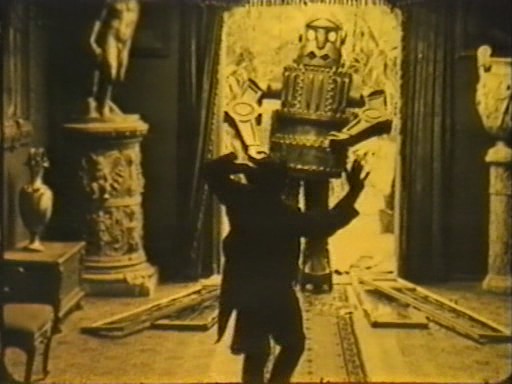
Italy’s The Mechanical Man (1921), directed by André Deed, is a mix of science-fiction, horror, and comedy. It tells of a scientist who creates a large robot that is incredibly strong and fast, and is controlled remotely via a series of cranks, wheels, and switches. The scientist is killed and his invention commandeered by a criminal mastermind, a woman named Mado, who uses his creation to burst through doors, steal safes, and wreak general havoc. The scientist’s brother creates another robot to battle it, and there is a final showdown inside an immense opera house.

Unfortunately, anyone who has not done prior research might be forgiven for missing plot points, as only 26 minutes of film remains, which originally ran over an hour. Most of the lost footage encompasses the beginning sequences and cast titles, so it is not always clear watching who some of the characters are. Nevertheless, the present footage hints at a fun movie filled with sight gags, robot destruction, and pulp-like villainy.

Yet as it is, only a select few of genre completionists today will find reason to watch this curio, or at least what’s left of it.

Grade: D

Movie Review – Children of the Corn (1984)

Movie Review – Children of the Corn (1984)

There are certain horror films that I recall seeing at a fairly young age, most likely because they were frequently shown on television during the 1980s. One of my earliest conscious memories of watching a horror movie multiple times, where I could anticipate the pacing and the sequence of scenes and quote dialogue, was Stephen King’s Children of the Corn (1984). It was also my first real introduction to King. Carrie (1976), The Shining (1980), and most of the other adaptations until then, save for Creepshow (1982), which even as a kid I found more fun than scary, felt very adult to me. I had seen parts of them on television at various points but I don’t recall watching them wholly until I was a few years older. Their imagery was frightening – The Shining made my midnight trips to the bathroom speedy as I imagined the woman in the bathtub just on the other side of the plastic shower curtain that brushed against my elbow as I stood before the toilet – yet they were dealing with themes for which I at the time had no context.

But Children of the Corn, with its cast of young heroes and villains, was more approachable and easier for me to follow and immerse myself within. It dealt with childhood fears of losing your parents and it brought bullying to an extreme. Malachai (Courtney Gains) was most frightening because we all knew a kid in school or in the neighborhood that had the potential to become like him, if given the opportunity. Young Joby and Sarah were around my age and became avatars for kids like me, seeing the proceedings through their experience and believing that I too could be instrumental in thwarting evil, even helping the adults to accomplish what their ineptitude consistently sabotaged. Children of the Corn may also have been an early lesson in the dangers of theocracy, a cautionary tale emblazoned upon my young mind that still very much guides my ethical and philosophical identity.

children of the corn still

So it is no wonder that my memory of this film, and I imagine many of my generation feel the same, is one of fondness. Of course, not everything ages well, and the last time I had watched the film before recently revisiting it was as a teenager more than fifteen years prior. Needless to say, I’m a very different person now, and especially as a father I knew that for the first time I would be seeing the movie through not only an experienced adult perspective, but also through the adult protagonists’ eyes.

Children of the Corn was the directorial debut of Fritz Kiersch and is certainly his most well-known film. Kiersch’s career would quickly peter, though he did manage to direct the ridiculously campy action-fantasy Gor in 1987. The two adults, Burt and Vicky, who find themselves in the parricidal, theocratic ghost town of Gatlin, Nebraska, are played by Peter Horton, who went on to a successful career in television, and Linda Hamilton. Hamilton, of course, rose to fame playing Sarah Conner in The Terminator (1984) which was released the same year. In all respects that film, with the sole exception of Hamilton’s hair, has aged better than Children of the Corn.

As an adult viewer I cannot dismiss the glaring plot-holes that puncture the story like clumsy sickles. As a child with little experience I could buy into the idea that a town could go off the map in modern America and be run by murderous kids for three years without anyone coming to check up on things. Postal or produce deliveries? Extended family? Utility crews? No, sir! Apparently, everyone just stopped coming to Gatlin or got fooled by a couple of misplaced road signs. Of course, this and more could all be fixed, or at least allow for more suspension of disbelief,  if the film had simply stated that the opening murders had taken place three months, or better yet, three weeks earlier. Even as a kid I noticed that none of the kids seemed to age over those three years’ time. Similarly, “He Who Walks Behind The Rows,” the malevolent entity that the kids worship, is vulnerable to the corn being damaged, but there’s no corn for most of the year. Whence, then, goes our main baddy during that time?

These problems generally stem from the fact that the source material was a very short story by King which was published in the 1978 collection Night Shift. Things were necessarily added to extend the story but we get logical inconsistencies along the way. The movie starts fairly strong but meanders as it continues, unable to maintain the atmosphere of dread and mystery that pervades the beginning. The script also veers from the short story in both tone and substance, making for very different endings, and what the film offers as a resolution is ultimately unsatisfactory.

All these shortcomings having been said, there are still things that this movie does right. The music harkens back to the supernatural horrors of the 1970s and helps to create, at times, a creepy atmosphere. There are effective images that stay with viewer, such as the kid being struck by the car, the Blue Man, or Isaac staring through the diner window. Truly, John Franklin as Isaac is alone worth viewing the film, as his performance as the child preacher is charismatic and energetic and perfectly embodies what that character needed to be. Though child-like, Franklin suffered from a growth hormone deficiency when he was young and was actually twenty-five when he filmed the movie. Not knowing this about the actor the viewer will gather an uneasy sense that there is something disturbing about the character of Isaac beyond his murderous preaching – he has a confident gravitas beyond his years that wonderfully suits and serves the story.

children of the corn still 2

In regard to the themes, it’s easy to see commentary on the Religious Right and on Reaganism, particularly with its treatment of religion as being largely dangerous if left unchecked. Ronald Reagan became president in 1980 largely from the support of the self-proclaimed “silent majority” (a term first popularized by Nixon) which included Christian and social conservatives like anti-feminist Phyllis Shafly and televangelist Jerry Falwell, who told millions of Americans in the 1980 election that “God is calling millions of Americans in the so-often silent majority to join in the moral-majority crusade to turn America around.” Liberal Americans, and especially those in Hollywood, felt adrift in this new conservatively aligned nation. Stephen King himself, an out-spoken liberal, has been openly critical over the years of Reagan and the Republican Party.

Seen through this lens, the characters of Burt and Vicky are surrogates for a left-leaning, secular America, lost in what is to them an alien landscape of endless corn. Burt is revealed early on to be in the medical field en route to his new assignment. This suggests that he is generally scientifically minded and, through his ability to resist the sexual advances of Vicky so as to stay on schedule and to shrug off her remarks about commitment, appears to be a man who doesn’t let emotions or lust derail his mental focus. As the couple drive through an ocean of corn they jokingly mock a radio preacher who has “no room for the homosexuals!” revealing a mutual disdain for socially conservative religion. When they strike the child in the road Burt is quick to assess that there is more going on, once again approaching the situation with a cold, rational mind. As they search the kid’s suitcase they find a crucifix made from corn that Vicky finds ugly and Burt concludes to be, as might an anthropologist, like a primitive form of folk art. Other scenes like this follow, and though the ending of the film muddles things with awkward monologues about religion from Burt or a vague biblical passage that they somehow make absurd leaps of logic to conclude is helpful, this theme of a secular, liberal America being encroached upon by conservative extremism is still very potent.

Children of the corn still 3

Another aspect of religion is suggested throughout the film, and though I’ve seen only bits and pieces of the many poor sequels they seem to misunderstand what made the tragedy of Gatlin possible. The children in the town are brainwashed, but they are far from being mind-controlled. Instead, their upbringing in a religiously conservative environment made the ascension of “He Who Walks Behind The Rows” possible. Joby talks of how Isaac was a popular child preacher, apparently embraced by the community and held in high regard. Children are an appropriate vehicle for zealotry because they are the most susceptible to indoctrination. In the end, it was Gatlin’s predisposition to adopt a charismatic, fundamentalist brand of Christianity that made Isaac’s influence possible – their own openness to extremist rhetoric and irrationality for solutions (in this case prayer to end a drought for a good corn harvest) allowed their children to take it a step further. As Burt says to the kids, “Maybe you’ve been listening to these holy rollers so long that it’s all starting to sound the same.” Like any cultists, the kids are seen in the beginning wearing contemporary teenage clothes, but after the murders have adopted plain, conservative attire. They have outlawed pleasure in the forms of the music and secular art. The only people who are not swayed are the natural skeptics, for Joby says that he and Sarah had always found Isaac weird. The old man at the gas station appears to have been an outcast even before the children took over and was possibly not a religious participant, and perhaps his isolation is partly why he had been allowed to live for so long. When warning Burt to avoid Gatlin, he simply states, “Folks in Gatlin got religion. They don’t cotton to outsiders.” The first part of his explanation seemed like reason enough to steer clear from the town. (IMDB has the quote as saying “Folks in Gatlin’s got a religion. They don’t like outsiders,” but I’m pretty sure this rendition is inaccurate.)

Children of the Corn is a flawed film, but it does stick with you. It may be riddled with logical inconsistencies, but it still offers deep enough concepts to chew on. Just as I was enamored with it as a child, I feel like it is actually a more effective children’s horror film than an adult one. That is not necessarily a bad thing. The 1980s had many horror movies best appreciated by a younger audience, like 1987’s The Gate, and their potency to viewers who are in those formidable years should not be dismissed or devalued. Children of the Corn is a perfect film to show a budding pre-teen horror fan who can handle some minor gore. They will not only relate more closely to the child characters and their plight, but they may learn, as I did, to be skeptical the next time someone tells them what God wants or an adult condescends to promise them the keys to the kingdom. “Folks in Gatlin got religion,” the film will remind them, “What you wanna do is to go to Hemmingford…”

Grade: C+

Movie Review – Jack & Diane (2012)

Movie Review – Jack & Diane (2012)

The 2012 hipster lesbian romance film Jack & Diane, which is marketed unquestionably as a horror film, has nothing to do with John Mellencamp’s famous “ditty.” Why they chose those names and picked that title then is as mysterious and as needlessly gratuitous as most of the other decisions made in this film. Written and directed by Bradley Rust Gray, the movie’s official site describes it as thus:

“Jack and Diane, two teenage girls, meet on a summer day in New York City and spend the night kissing ferociously. Bubbly and naïve, Diane’s charming innocence quickly begins to open tomboy Jack’s tough-skinned heart. However, when Jack discovers that Diane is moving at the end of the summer, she pushes Diane away. Diane is overwhelmed by her powerful new feelings, and they begin to manifest themselves in terrifying ways, causing unexplainable violent changes to her body. Young love is a monster – can Jack and Diane survive?”

So that’s what I was supposed to get out of this? That actually sounds like a movie I’d really like to see. What we actually get are two girls wandering around New York City, mumbling to each other while sitting in close proximity as the viewer struggles to hear what they’re saying (and then wonders why they cared at all). The romance we are supposed to see is never convincing, and in fact the actresses look like they are barely tolerating each other’s company. I have to guess that whoever wrote the above description has never actually seen or experienced “ferocious” kissing, as what we ever see from the characters physically is incredibly tame. Diane (Juno Temple) appears confused and lost most of the time, and we aren’t given reason to believe that her supposed same-sex attraction is something new. Nevertheless, she has vague dreams about werewolves which I assume are meant to be a metaphor for her repressed desires, but both characters come off as more disinterested than repressed. I don’t feel I can lie all of the blame on the actresses, for there isn’t much in the script for them to work with. If they didn’t say that they had feelings for one another we’d never know it, and even then we don’t believe it.

The werewolf sequences are never committed to and add nothing to the story, and their manifestations are hardly terrifying. Like various other subplots and attempts at symbolism found throughout the film, the horror inclusion comes off as confused and unnecessary. The filmmakers appear to have wanted to make a quirky, artsy, understated romance with some edge, but managed only to muster a dull, incoherent experience with no substance. Not much actually happens in Jack & Diane, and even the clever but underutilized stop motion animation sequences of hair moving around organs are not enough to recommend this film to people. A movie can be incoherent so long as it remains entertaining. The elation I felt when the words “The End” finally came upon the screen, as I shook myself from a bored stupor, were enough to reveal my feelings about it.

Grade: F

Movie Review – A Girl Walks Home Alone at Night (2014)

Movie Review – A Girl Walks Home Alone at Night (2014)

2014’s A Girl Walks Home Alone at Night was tagged upon its release as “The first Iranian vampire Western,” and that turns out to be a very apt description. Written and directed by Ana Lily Amirpour, an Iranian-American filmmaker in her feature film debut, the film blends the styles of various genres into a stunningly beautiful black and white presentation, seen through the lens of an Iranian immigrant sensibility. While the language of the film is Farsi and the location is set in a fictional Middle Eastern town which the characters call Bad City, the actual filming location was the town of Taft in southern California with a cast of fellow Iranian-American actors.

a girl still

The film follows the parallel lives of Arash, a young man dealing with a drug addicted father, and The Girl, a vampire who stalks the night and feeds upon the lower dregs of Bad City. Both are lonely figures who find something attractive in the other, and the movie, in addition to the other genres mentioned, is very much an understated romance.

a girl still 3

Bad City is the Middle Eastern industrialized equivalent of the American frontier town where law and order are of pure vigilantism. If the allusion weren’t made clear enough, the music that is played several times as Arash drives through the streets will remind audiences of a Sergio Leone Western, and we even see a cross-dresser playing with a balloon wearing a kitschy, tasseled cowboy novelty shirt. The Girl wanders the night wearing a black chador, and as the wind catches the fabric it spreads to evoke a bat spreading its wings. Her targets are predominantly abusive men, and the commentary and criticism of the misogyny of many Middle Eastern countries is certainly not accidental, nor is the use of the chador as her predatory attire. She is the stand-in for the lone gunman in this lawless land.

a girl still 2

We see oil pumps continually rising and falling, like the pecking of hungry hens, drawing oil from the earth symbolically as The Girl draws blood from her victims. Both can be viewed as addictions, and the themes of dependence and moral conflict are strong. We see characters trying – and often failing – to maintain an ethical standard while also maintaining a standard of living. Eventually, one must give way to the other.

Amidst these ideas is a gorgeous, largely quiet film. The aesthetics draw inspiration from teen cultures of the 1950s and 1980s. Though Arash and The Girl look like they’re from different decades, the combination somehow works and adds an additional quirky layer to an already eclectic film. A Girl Walks Home Alone at Night makes something distinctive by borrowing from familiar elements and employing them in new, unique ways.

Grade: B+

Movie Review – Haunt (2014)

Movie Review – Haunt (2014)

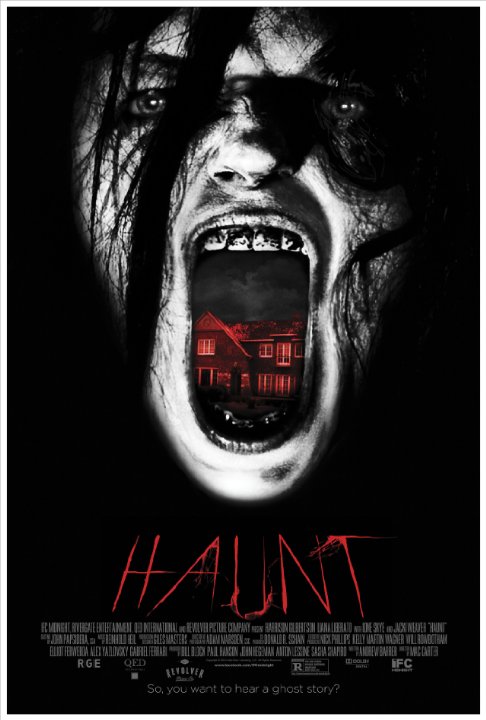
Haunt (2014) is the directorial debut of Mac Carter and tells of a family who moves into a new house with tragic past. The teenage son begins a physical relationship with a neighbor girl and together they use an EVP box to discover that the house in haunted and try to appease the increasingly dangerous spirits.

Aesthetically the film takes its cues from James Wan, invoking elements of Insidious (2010) and The Conjuring (2013), to varying success. Story-wise there isn’t much new here and some of the plot elements, like the EVP box or the subplot involving the younger sister seeing the ghosts, are clunky and not well explained. We get some effective scenes, like a possessed teenager getting up like a marionette, but we also get an overabundance of creepy music and loud audio cues to let us know we’re supposed to be scared. Clichés as well as ghosts haunt the tale.

The perspective of the film is a decidedly teenage one. The two protagonists are the main focus and the adults are, as per genre tropes, either disbelieving of them or unwilling to assist. However, credit should be given for treating the teenagers with a modicum of intelligence and respect. The young characters are seen as morally responsible, caring, and to a small extent philosophical about their situation. Because of this, even though Haunt has nothing to really recommend it to an adult audience or to experienced horror fans – we’ve seen it before and we’ve seen it done better – this is actually a decent option for teenagers to watch who are just getting into horror. There’s an element of sexual awakening but nothing overtly sexual and teen viewers will likely not feel demeaned or insulted by their depiction throughout the film. In a genre that often offers their age group condescendingly shallow movies, Haunt at least allows the characters to talk through their problems and to treat those around them with dignity and concern.

Grade: D+

Movie Review – He Never Died (2015)

Movie Review – He Never Died (2015)

I received my first computer just before I was entering high school and I quickly took to spending my evenings writing stories. One of the first stories I began to tap away at involved a girl who became involved with a vampire – a figure who was as deadly as he was seductive. I took inspiration from various vampire depictions that were popular at the time and it showed. He was dark, handsome, elegant, and, as clichés demanded, hunted for prey in New York City raves. Unsurprisingly, there was a bit of a love story. Nevertheless even then, despite being very much in keeping with contemporary vampire lore, this depiction of immortality didn’t feel right. I wrote about fifty pages and even though they are now lost to ether the core story has stuck with me, and in the two decades since I first began writing it I’ve periodically returned to the tale as something of a mental exercise, tweaking and adapting it over time.

As I contemplated immortality more deeply it lost more and more of its glamour, and so did my vampire. He went from dashing and regal to reclusive and mentally unhinged. He didn’t frequent raves and live an unlife of bacchanalian excitement but sometimes slept for days or sat in a room quietly for hours while time ticked by. The urgency of life which propels us was forgotten to him, and when he wasn’t dangerous he was a person who people would frankly find boring to be around. Unlike supposed movie immortals who appear to shop at Hot Topic, my vampire became literally old fashioned, wearing out-dated, threadbare clothing, no longer able or willing to keep up with style trends. He loathed interacting and feigning niceties and dealing with the petty problems of pulse-pumping people, and had told so many lies and used so many names he had difficulty remembering which memories were real and which were fabrications. Furthermore, he became more dangerous. His personality was fractured from centuries of deceit and murder, and which personality one met depended on the depths of his hunger. If he needed to feed the man that ignored you the day before might now not hesitate to break your skull without a moment’s notice, and as your vision fades you’ll find no remorse behind his cold, staring eyes. I may sit down one day to rewrite the story in its transformed state, but it’s this version of everlasting life – particularly one that is also of everlasting violence – that seems the most real to me.

After watching Jason Krawczyk’s He Never Died (2015), it’s the similar depiction of immortality – of a monotonous existence devoid of empathy – that most impressed me. Krawczyk had Henry Rollins in mind when he wrote the part of Jack, an immortal cannibal who’s tired of life and wants as little to do with people as possible, and Rollins quickly signed on to do the part. Rollins is well-cast: he hits the right tone and delivers the dry wit that infuses the somber tale with welcome dabs of humor. In many ways Rollins plays opposite his own nature – he’s loud, energetic, and intense, whereas Jack spends his days sleeping and watching television, trying to go through existence expending the littlest amount of energy possible and similarly keeping his interactions with mortals short and impersonal, mostly for their own safety. Essentially, he’s bored and depressed. When he does go out, it’s to buy blood, eat vegetarian dishes at a local diner, or play Bingo with seniors. Jack has clearly done some terrible things, but two women enter his life who exploit the sliver of humanity that remains, if one can call it that. Jack’s connection to them is driven more by a sense of obligation than by anything that could be considered emotional. These aspects, and Rollins’s embodiment of them, are certainly the strongest aspects of the film and the ones which I most admire.

He Never Died tells a quirky tale of vampirism, biblical allusion, and sociopathic tendencies tentatively restrained. The budget is obviously low, and these financial limitations make themselves apparent in the meager and mostly off-screen action sequences. This is unfortunate, as the film feels largely like a somber, understated build to some explosive violence which seems to always be potentially brewing beneath Jack’s surface, but the eruption of said violence is rarely satisfactory. Additionally, there is a scene which I found confounding, where Jack is in search of his estranged daughter and appears to detect her behind a bookcase, but he then leaves and goes on searching only find himself back at the same exact bookcase as though he never suspected it the first time. It’s a directorial choice I found overall confusing. Likewise, there’s a gratuitous application of Dutch angles and sometimes the editing makes it difficult to determine how much time has passed.

If one really wanted to tear this film apart, one would find ample ammunition to do so. But I am not so inclined. Despite some shortcomings I feel that He Never Died is a ride worth seeking out. Rollins carries the role well and there are enough ideas and circumstances here to entertain even the most discerning of viewers.

Grade: C+

Movie Review – Below (2002)

Movie Review – Below (2002)

One of my favorite horror subgenres can perhaps be classified as historical period horror (“period horror” sounds too much like something else entirely). As a student and educator of history I am always on the lookout for great historical period dramas – it even allows me to enjoy romance movies with my wife as she can concentrate on the budding love story and I ogle at the historical details of the sets, props, and costumes. Of course, these details usually mean larger budgets, something Hollywood is very rarely willing to bestow upon horror. So it is with excited anticipation each time I sit down to watch a blending of these two genres.

2002’s Below, directed by David Twohy, infuses haunted house tropes into a WWII submarine thriller. Written by Twohy, Lucas Sussman, and Darren Aronofsky, the film takes place in 1943 and follows a United States Navy submarine that experiences dangers both supernatural and temporal while on patrol in the Atlantic Ocean.

With interior sets modeled on the World War II-era U.S. Navy submarine USS Silversides, and using exterior shots on the actual vessel, the film effectively creates a claustrophobic atmosphere, using an incredible sound design to sustain the sense that there is never much room behind the camera’s lens. Truly, the film excels as a wartime thriller, making the most of its setting. One scene in particular stands out as “splashers” sink down from an attacking vessel, exploding charges all around them, and one that has yet to explode can be heard bouncing along the submarine’s hull. In that confined space, every sound is amplified and becomes uncanny, from items scraping against the exterior to whale songs drifting dreamlike into their cramped little world. I am largely ignorant about submarine operations, though I have been on a few vessels, yet the mechanical explanations throughout the film were rational and intriguing, at least for me.

below still

The cast is strong and the characters are given distinctness, though one might expect a real crew to be comprised of younger men than what we see. Holt McCallany is an intimidating figure on the vessel and Zach Galifianakis provides some brief comic relief in an early role as Weird Wally. The scene in which the men surmise that they may be in the afterlife is a particularly good one.

The supernatural elements are largely secondary to the plot and, when present, are executed with uneven success. Some scenarios build great tension while others fall flat, and the film never quite fulfills the potential of its premise. That’s a shame, because the idea of a haunted submarine is scary as hell, yet the ghosts never seem as threatening as the Germans or the very ocean in which they travel.

Below is a taut historical thriller with some supernatural smatterings. Despite some minor quibbles, it remains an effective and overall satisfying experience.

Grade: B-

Movie Review – Genuine: A Tale of a Vampire (1920)

This review is part of the A Play of Light and Shadow: Horror in Silent Cinema Series

Movie Review – Genuine: A Tale of a Vampire (1920)

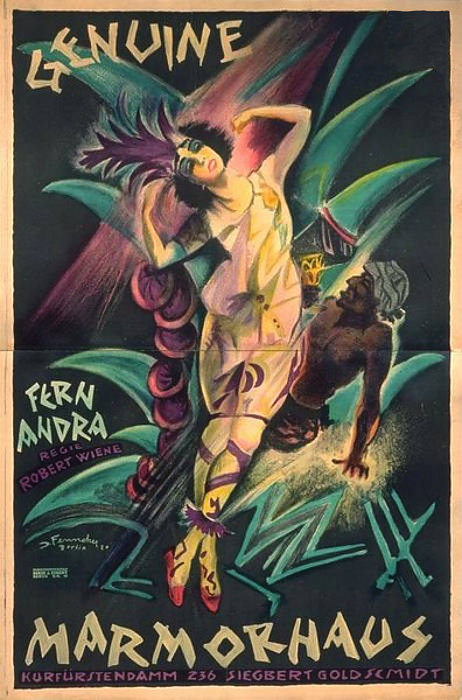
In February of 1920 German director Robert Wiene released the groundbreaking horror classic and German Expressionist masterpiece The Cabinet of Dr. Caligari, a transformative milestone in cinema. Later that year he released another work of Expressionist horror, Genuine: A Tale of a Vampire, to much less success. In fact, contemporary critics considered the film a failure (fortunately, his 1924 The Hands of Orlac would reestablish his reputation as a horror master).

Genuine is the titular “vampire” – which at the time was a reference to her status as a femme-fatale. Vampires in film were not generally associated with blood-suckers until F.W. Murnau’s Nosferatu (1922), but were instead seen as beautiful, manipulative women (“vamps”). Genuine, the former priestess of a conquered tribe who is sold into slavery, seduces men and drives them to madness, pushing them to commit heinous acts.

What is available to the public today is a 44-minute condensed version, only half of the film’s original length. The longer version can only be viewed at the time of this writing at the Munich City Film Museum archives. This trimming could of course account for the many confusing aspects of the narrative, which is brimming with plot holes. However, other aspects of the film, having nothing to do with editing, weigh it down like a wet blanket, and inevitable comparisons to Caligari only serve to accentuate its overall inferiority.

Whereas the sets of Caligari evoked a dream-like world with skewed perspectives and sharp angles, the sets designed by Expressionist painter César Klein, while interesting in many respects, are too busy and cluttered. The fact that the costumes often appear designed to blend in with the background, which was in part keeping with Expressionist cinema by matching the wardrobe to the sets, creates a combination which is ultimately an eyesore.

Genuine the Vampire still

The writing and acting are equally broad and melodramatic. Genuine’s presence, with costumes as busy as the sets, is more irritating than compelling. She is played by the American actress Fern Andra, who was popular during the German silent era. Interestingly, in 1922 Andra would be in a plane crash with German WWI ace pilot Lothar von Richthofen, the younger brother of the Red Baron. Richthofen would perish but Andra would survive, spending a year recovering from her injuries.

The role of Florian, one of Genuine’s conquests and her ultimate nemesis, is played by Hans Heinrich von Twardowski. He was a homosexual who fled Nazi Germany in 1933 and went on to star in prominent anti-Nazi films in America throughout WWII, including the creature-feature-sounding Hitler – Beast of Berlin (1939).

Greater appreciation of Genuine has not been forthcoming in the near century since its release, and the condensed version does nothing to whet one’s appetite for the original installment. Unlike Wiene’s two other horror classics, there’s nothing to recommend this film to modern audiences.

Grade: D

Blog at WordPress.com.

Up ↑